Every day, millions of people sling a bag over their shoulder and head out the door. But which style serves them best? The crossbody bag has surged in popularity in recent years—touted as sleek, secure, and stylish. Meanwhile, the messenger bag, long favored by students, creatives, and urban commuters, promises capacity, organization, and durability. But beyond trends and aesthetics, which one actually performs better in daily life? Is the crossbody truly more practical, or is its reputation built on hype? Let’s cut through the marketing and examine what each bag offers in terms of function, comfort, security, and real-world usability.
The Anatomy of Practicality
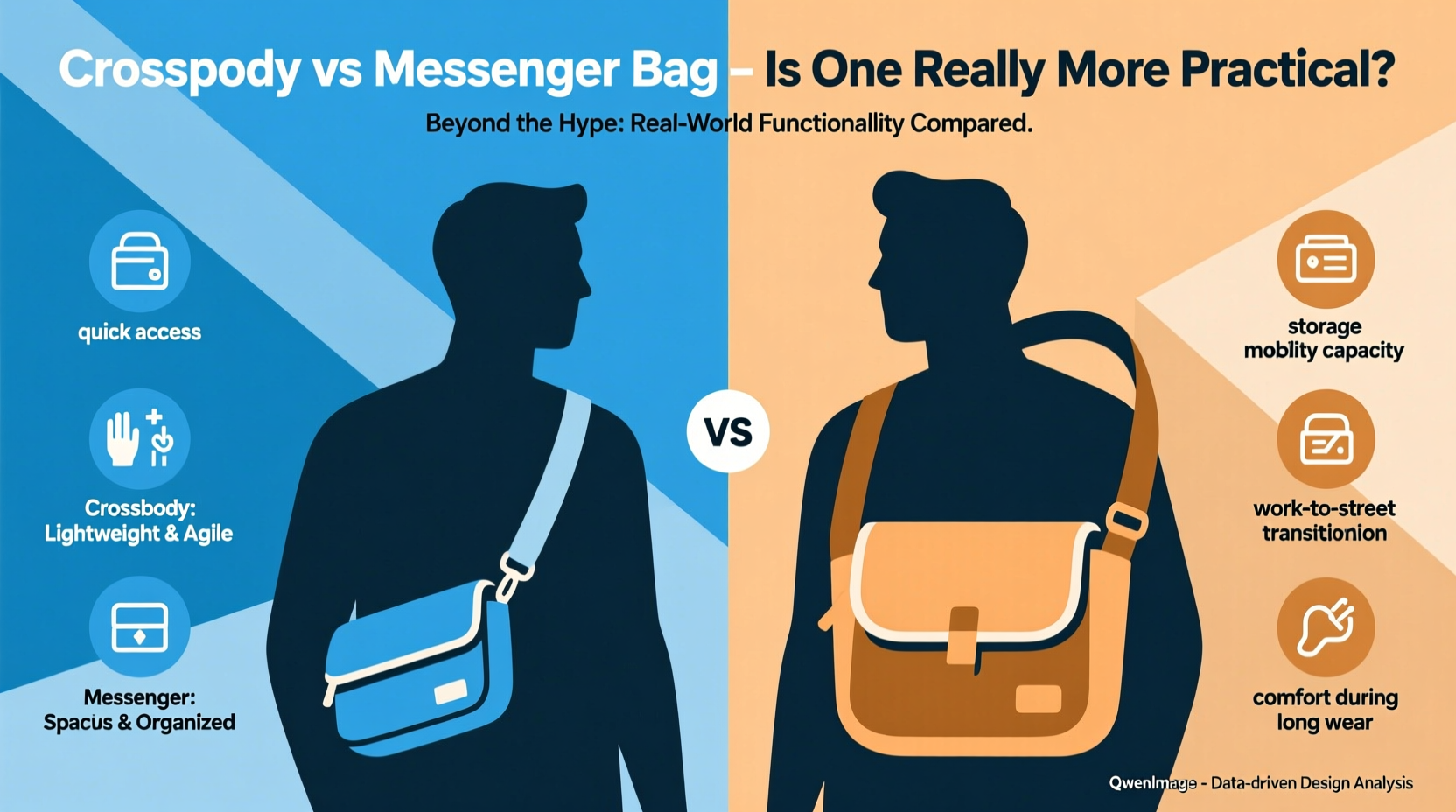
Practicality isn’t just about how much a bag can carry—it’s a combination of accessibility, weight distribution, security, and adaptability across environments. A bag might hold everything you need, but if it strains your shoulder or forces you to stop every time you want your phone, it fails the practicality test.
Crossbody bags typically feature a single strap worn diagonally across the torso, keeping the bag in front or at the hip. This design promotes visibility and deters pickpockets, making it ideal for crowded spaces. Messenger bags, with broader straps and larger compartments, are built for load-bearing. They often include padded laptop sleeves, multiple pockets, and quick-access flaps.
So while crossbodies excel in mobility and awareness, messengers dominate in storage and structure. The “best” choice depends not on universal superiority, but on individual lifestyle demands.
Comfort and Ergonomics: Who Wins the Long Haul?
Carrying a bag all day takes a toll—especially if it's poorly balanced. Ergonomics matter, particularly for those who commute, travel frequently, or carry heavy loads like laptops, books, or work tools.
Messenger bags distribute weight more evenly across one shoulder and into the back, especially when worn snugly against the body. Many models include chest or waist straps to further stabilize the load and reduce strain. However, wearing a heavy messenger on one side for extended periods can lead to postural imbalances or muscle fatigue—a common complaint among couriers and students.
Crossbody bags, by contrast, spread weight diagonally from one shoulder to the opposite hip, engaging the core slightly and promoting natural gait. This can reduce localized pressure and make walking easier, particularly in dense urban areas. But if overloaded, a crossbody can pull the wearer off-balance or dig into the shoulder due to narrow straps.
Tip: For loads over 5 pounds, opt for a messenger with a stabilizing strap or consider switching to a backpack.Security and Accessibility Compared
In cities, festivals, or transit hubs, theft prevention is a top concern. Crossbody bags have gained favor here because they sit in front of the body, within clear sight. Their compact size also limits access points, making it harder for thieves to slip a hand inside unnoticed.
Messenger bags, while often secured with flap closures or magnetic snaps, are traditionally worn on one shoulder with the bag resting at the back or side. This positioning creates blind spots—especially when seated or navigating crowds. That said, modern messengers increasingly include RFID-blocking pockets, lockable zippers, and anti-slash materials that close the security gap.
Accessibility favors the crossbody for quick grabs: wallet, phone, keys. Most models open with a single zipper or snap, and their smaller size means fewer layers to dig through. Messengers offer more organization—but at the cost of speed. Reaching into deep compartments while standing on a moving train can be awkward.
“From a security standpoint, visibility is everything. If you can see your bag, so can potential thieves—but you’re also in control.” — Jordan Lee, Urban Safety Consultant
Detailed Comparison: Crossbody vs Messenger Bag
| Feature | Crossbody Bag | Messenger Bag |
|---|---|---|
| Capacity | Low to moderate (ideal for essentials) | High (fits laptop, notebooks, chargers) |
| Weight Distribution | Diagonal, balanced across torso | Shoulder-focused, can cause strain |
| Security | High (visible, hard to access unnoticed) | Moderate (improved with modern features) |
| Organization | Limited (1–3 compartments) | Excellent (multiple pockets, dedicated sleeves) |
| Fashion Flexibility | High (easily styled with casual or dressy outfits) | Moderate (often seen as utilitarian) |
| Durability | Varies (often lightweight materials) | Generally high (reinforced stitching, rugged fabrics) |
| Best For | Short commutes, travel, casual outings | Work, school, long days with gear |
Real-World Use Case: Two Days, Two Bags
Consider Maya, a freelance graphic designer who splits her time between coffee shops and client meetings. On Monday, she uses a slim crossbody with her phone, wallet, AirPods, and a small notebook. She walks 4 miles across downtown, hops on two subway lines, and attends three brief meetings. Her bag stays visible, light, and never slows her down. She feels confident and agile.
On Tuesday, she switches to a medium-sized messenger to carry her 13-inch laptop, charger, sketchbook, and water bottle. While the extra space is welcome, she notices discomfort by midday—her left shoulder aches, and adjusting the bag constantly interrupts her flow. At one point, someone bumps into her on the train, and though nothing was stolen, she realizes the bag was behind her and out of view.
Her experience reflects a broader truth: neither bag is universally superior. Each excels in specific scenarios. The crossbody won the day for mobility; the messenger was necessary for capacity—but came with trade-offs.
Choosing the Right Bag: A Practical Checklist
Instead of asking which bag is “better,” ask which one fits your routine. Use this checklist to guide your decision:
- Do you regularly carry a laptop or tablet? → Lean toward messenger.
- Are you often in crowded places (markets, concerts, public transit)? → Crossbody offers better security.
- Do you walk more than 3 miles a day? → Consider weight and strap comfort.
- Do you value quick access over organization? → Crossbody wins.
- Do you switch between work and leisure frequently? → A convertible crossbody-messenger hybrid might be ideal.
- Is fashion a priority? → Crossbodies generally offer more style variety.
Hybrid Solutions and Emerging Trends
The line between crossbody and messenger is blurring. Many brands now offer convertible bags that adjust strap length and configuration. A bag can start as a messenger during work hours and transform into a crossbody for evening outings. Others integrate anti-theft features like hidden zippers and slash-proof straps into messenger designs, borrowing from crossbody strengths.
Materials also play a role. Lightweight nylon, water-resistant coatings, and ergonomic padding are becoming standard in both categories. The future of practical carrying lies not in choosing sides, but in adaptable design that responds to real-life needs.
Frequently Asked Questions
Can a crossbody bag fit a laptop?
Some larger crossbody bags accommodate laptops up to 13 inches, especially those marketed as “work crossbodies.” However, they rarely provide the same level of padding or stability as a dedicated messenger or backpack.
Are messenger bags outdated?
No. While fashion trends favor minimalism, messengers remain essential for professionals, students, and creatives who need reliable storage. Modern versions are slimmer, lighter, and more stylish than ever.
Which bag is safer for travel?
For international or urban travel, crossbody bags are generally recommended due to their front-facing design and resistance to opportunistic theft. Travel-specific models often include secret pockets and locking zippers.
Final Verdict: It’s Not Hype—It’s Context
The rise of the crossbody isn’t just fashion hype. Its advantages in security, comfort, and ease of movement are real and measurable—especially for light carriers and city dwellers. But dismissing the messenger as obsolete ignores its unmatched utility for those hauling gear daily.
Practicality isn’t inherent to a style; it emerges from alignment between tool and task. A surgeon doesn’t debate whether a scalpel is “better” than forceps—the right instrument depends on the procedure. Similarly, your bag should serve your life, not the other way around.
Instead of chasing trends or loyalty to one silhouette, assess your actual needs. Try both. Mix and match. Your most practical bag isn’t the one everyone’s raving about—it’s the one that makes your day smoother, safer, and more efficient.
💬 What’s your go-to bag, and why? Share your experience and help others find the perfect balance between function and style.








