
In an age where smartphones are nearly extensions of our bodies, how we hold and carry them matters more than ever. Two popular solutions have emerged for improving grip and reducing drops: crossbody phone cases with built-in straps and PopSockets—compact adhesive grips that expand into handles. But which one actually performs better in daily life? Is the freedom of a wrist or shoulder strap worth sacrificing pocketability? And can a sticky disc truly compete with a wearable design?
This isn’t just about convenience—it’s about durability, ergonomics, and lifestyle alignment. Whether you’re commuting, traveling, or simply navigating a crowded sidewalk, your phone’s grip solution impacts both safety and usability.
The Anatomy of Grip: Why It Matters
A dropped phone can mean cracked screens, water damage, or data loss—all avoidable with proper handling. According to a 2023 consumer report by SquareTrade, over 70% of smartphone owners have dropped their device at least once within the first year of ownership. Many of those incidents occurred during routine use: texting while walking, pulling the phone from a bag, or adjusting it mid-conversation.
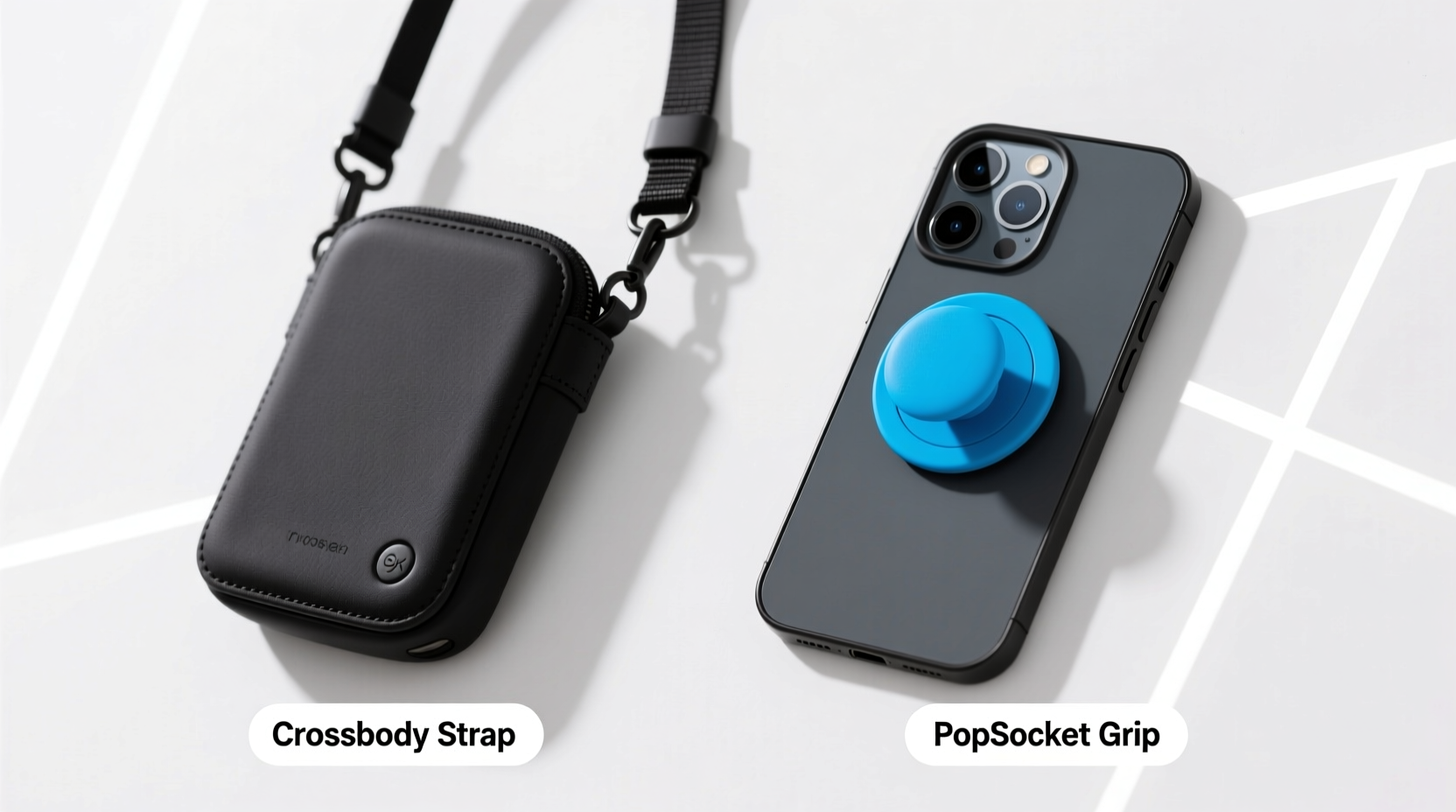
Grip aids aim to reduce these risks by increasing surface contact between hand and device. Crossbody cases do this through physical attachment—straps that loop around wrists or drape across shoulders. PopSockets, on the other hand, rely on friction and leverage. When expanded, they provide a collapsible handle you slide fingers through.
But function isn’t the only factor. Aesthetics, portability, and adaptability matter too. Some users want minimalism; others prioritize security above all else.
Crossbody Phone Cases: Security First
Crossbody phone cases integrate adjustable straps directly into rugged or fashion-forward designs. These range from slim silicone models with detachable lanyards to heavy-duty holsters used by outdoor enthusiasts. The core advantage is clear: if properly worn, the phone stays attached to your body.
This makes them ideal for high-movement scenarios—running errands, hiking trails, attending festivals, or riding public transit. Even if you fumble your phone, the strap prevents it from hitting the ground. Parents juggling kids and groceries often find relief in this “set it and forget it” security.
Tip: Choose a crossbody case with an adjustable, breakaway strap for safety and comfort—especially when wearing around the neck.However, trade-offs exist. Most crossbody cases add bulk. Sliding your phone into a tight jeans pocket becomes difficult, if not impossible. Some models interfere with wireless charging due to thickness or metal components in the strap mechanism. Additionally, constant wear may lead to neck or shoulder strain if the strap isn’t padded or balanced correctly.
PopSockets: Compact Versatility
Introduced in 2012, PopSockets gained viral popularity for their clever engineering: a collapsible disc adhered to the back of a phone or case. Press once to expand into a grip; press again to collapse flat. Beyond improved handling, many users repurpose them as kickstands for watching videos or as mounts for car vent clips.
Their strength lies in adaptability. Unlike permanent straps, PopSockets don’t alter how you carry your phone. You can still slip it into narrow pockets, wallets, or clutch bags without issue. They also come in thousands of designs—from minimalist metallic finishes to artist collaborations—making them as much a fashion statement as a functional tool.
Yet limitations persist. Adhesive degradation is common after several months, especially with frequent temperature changes or exposure to moisture. Once the grip starts peeling, so does its reliability. Also, while excellent for one-handed scrolling, PopSockets offer no protection against full drops. If your fingers slip past the grip, the phone falls.
“Grip accessories should complement—not compromise—your natural interaction with your device.” — Dr. Lena Patel, Ergonomics Researcher at MIT Media Lab
Head-to-Head Comparison
| Feature | Crossbody Case | PopSocket |
|---|---|---|
| Dropping Prevention | High – physically tethered to user | Low to Medium – improves grip but doesn't prevent drops |
| Pocket Compatibility | Low – adds size and protrusion | High – collapses flush when not in use |
| Wireless Charging Support | Variable – depends on model thickness | Generally compatible unless thick design |
| Lifespan | Long – durable materials, replaceable straps | Moderate – adhesive wears out in 6–12 months |
| Multifunctionality | Limited to carrying and grip | Yes – doubles as stand, mount, and style accent |
| Portability | Lower – requires space for strap movement | Higher – ultra-compact when folded |
Real-World Use Case: Commuter vs Content Creator
Consider Sarah, a city commuter who walks 45 minutes daily, checks messages constantly, and rides packed subways. She switched to a crossbody case after dropping her phone twice in one month. Now, even when jostled during rush hour, her phone remains secure. Though she no longer carries it in her back pocket, she values peace of mind over minor inconvenience.
Then there’s Jordan, a social media creator who films vertical videos and uses their phone throughout the day. They prefer a PopSocket because it doubles as a mini tripod during shoots and doesn’t interfere with studio lighting setups. For them, flexibility trumps total drop protection—they work in controlled environments and keep phones on tables whenever possible.
Their choices reflect different priorities shaped by environment and behavior.
Which Should You Choose? A Practical Checklist
Use this checklist to determine the best fit for your lifestyle:
- ✅ Do you frequently walk, run, or ride transit with your phone exposed?
- ✅ Have you dropped your phone multiple times despite being careful?
- ✅ Do you carry keys, bags, or children while using your phone?
- ✅ Are you willing to sacrifice sleekness for added security?
If you answered “yes” to most of these, a crossbody case likely suits you best.
Alternatively:
- ✅ Do you value pocketability and minimalist design?
- ✅ Do you use your phone primarily indoors or in stable settings?
- ✅ Would you benefit from a built-in stand for video calls or streaming?
- ✅ Do you change phone cases often or dislike permanent attachments?
If these resonate more, a PopSocket—or similar grip disk—may be the smarter choice.
Hybrid Approach: Best of Both Worlds?
Some users aren’t choosing one over the other—they’re combining them. A growing trend involves attaching a PopSocket to a crossbody case. This gives dual functionality: the security of a strap plus enhanced grip and stand features.
Just ensure compatibility. Mounting a PopSocket too close to the strap hinge may cause interference. Opt for central placement and consider magnetic variants that allow repositioning.
Frequently Asked Questions
Can I use a PopSocket with any phone case?
Most PopSockets adhere well to hard plastic, silicone, and rubber cases. However, they struggle with textured, soft-touch, or waterproof-coated surfaces. For maximum stickiness, clean the surface with alcohol before applying and let it cure for 24 hours before use.
Do crossbody straps damage clothing?
Not typically. Most modern straps use smooth nylon or neoprene backing. That said, prolonged friction against delicate fabrics like silk may cause pilling. Avoid wearing under tight collars or abrasive zippers.
Are there alternatives to both options?
Yes. Wrist straps, ring holders, and magnetic car mounts serve similar purposes. Ring holders screw into the case and rotate for grip or stand use. Wrist straps resemble camera leashes and are popular among photographers. Each has pros and cons, but none match the continuous security of a crossbody design.
Final Verdict: Function Follows Lifestyle
So, does a strap really beat a sticky grip? In raw protective power—yes. A crossbody phone case offers unmatched drop prevention because it physically connects your phone to you. But superiority depends on context. For urban adventurers, parents, or active travelers, the strap wins hands down.
For digital creators, office workers, or minimalist users, the PopSocket delivers greater versatility without compromising form. It enhances control without dictating how you carry your phone.
Ultimately, the best solution aligns with your habits, not marketing hype. Evaluate your typical day: where you go, how you move, and what frustrates you most about current handling. Then choose accordingly.
🚀 Ready to upgrade your phone grip? Try a 7-day experiment: use only a crossbody case one week, then switch to a PopSocket the next. Track comfort, confidence, and near-misses. Your real-world experience will tell you more than any review.