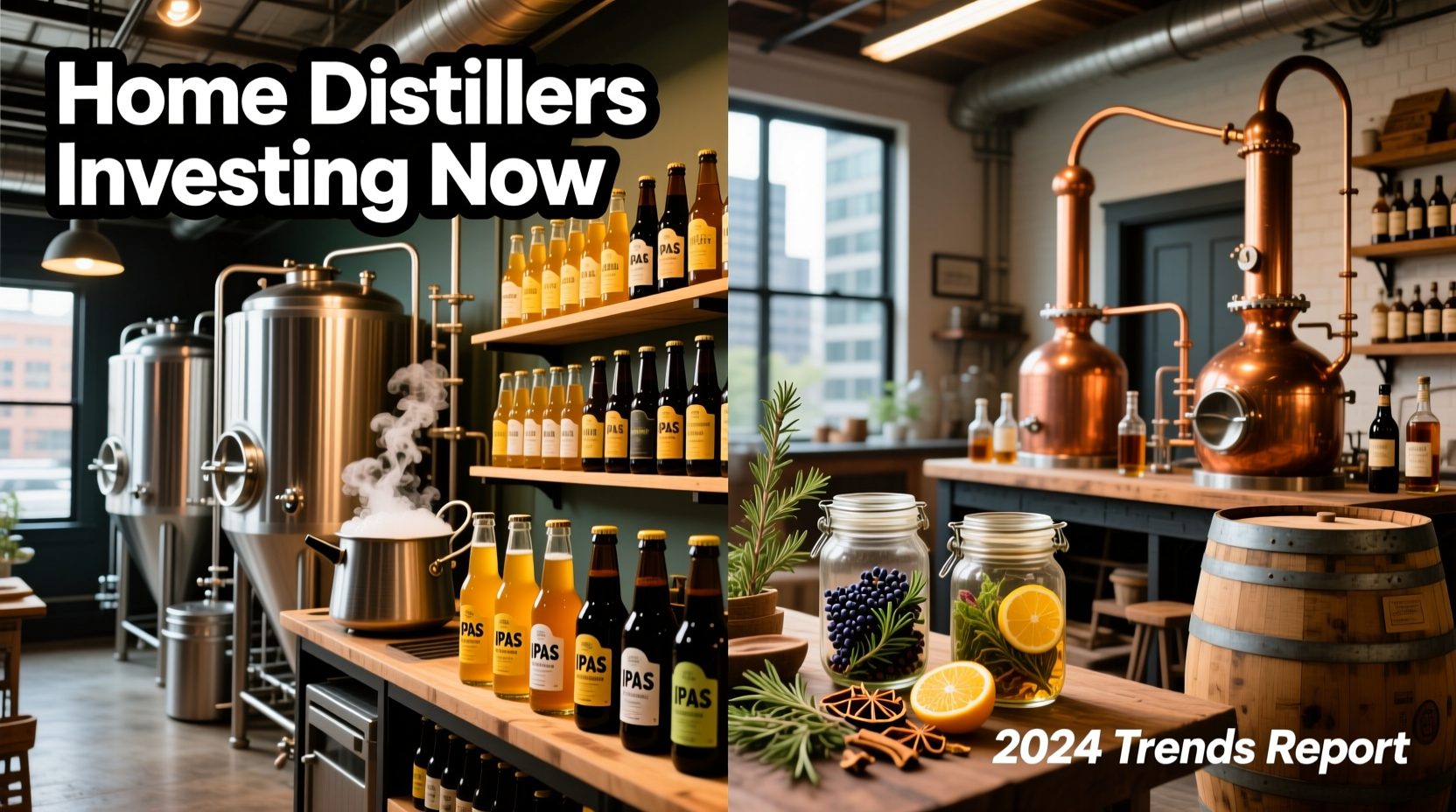
Over the past decade, home fermentation has evolved from a hobbyist curiosity into a sophisticated ecosystem of precision equipment, regulatory literacy, and niche-market strategy. While craft beer dominated DIY beverage culture through the 2010s��driven by accessible entry points like extract kits, forgiving yeast strains, and robust online communities—the landscape is shifting decisively toward artisanal spirits. This isn’t a passing trend. It reflects deeper economic, cultural, and technological currents: rising consumer demand for small-batch, terroir-driven spirits; falling costs for modular stills and analytical tools; and an expanding patchwork of state-level distilling exemptions that empower serious home producers to operate legally at scale.
This shift carries real implications—not just for hobbyists but for micro-enterprises, agritourism operators, and even legacy breweries reimagining their portfolios. Understanding where capital, time, and ambition are flowing requires looking beyond headlines about “moonshine revivals” or “whiskey hype.” It demands examining equipment choices, ingredient sourcing strategies, compliance pathways, and the quiet but critical infrastructure of aging, blending, and sensory calibration. What follows is a grounded analysis of why artisanal spirits have become the focal point of serious home distillation—and what it means for anyone considering where to invest next.
The Regulatory Pivot: From Brewing Freedom to Distilling Pathways
Historically, home brewing enjoyed clear federal protection under the 1978 amendment to the Internal Revenue Code, allowing individuals to produce up to 100 gallons per year (200 for households with two or more adults) without permit or tax liability. Home distillation, by contrast, remained federally prohibited—not merely restricted, but explicitly illegal under 26 U.S.C. § 5601(12). That hard line created a psychological and practical barrier: distilling was synonymous with risk, secrecy, or illegality.
That began changing in 2016, when Tennessee passed the first state-level “home distiller exemption,” permitting production of up to 10 gallons annually for personal use—provided no sale occurs and the operator registers with the state Department of Revenue. Since then, 14 additional states—including Kentucky, Colorado, Oregon, and New York—have enacted similar frameworks. These laws don’t override federal prohibition, but they create de facto enforcement discretion: state agencies typically decline to refer compliant registrants to federal authorities. Crucially, many of these statutes include provisions for “distiller education certificates,” which require coursework in safety, sanitation, and basic chemistry—signaling legitimacy rather than evasion.
“Ten years ago, I’d field three calls a month from someone asking if they could ‘just try’ distilling in their garage. Today, I get six weekly inquiries about still calibration, barrel char selection, and state registration timelines. The mindset has flipped—from ‘Can I get away with it?’ to ‘How do I do this right?’” — Dr. Lena Torres, Director of Fermentation Education at Appalachian Craft Institute
Equipment Investment Patterns: Where Capital Is Flowing
Spending data from industry suppliers tells a consistent story. Between 2021 and 2024, sales of reflux and pot stills under 20 liters increased 217% among U.S. consumers identifying as “serious home distillers”—a category defined by annual equipment spend exceeding $1,200. Meanwhile, sales of all-in-one brewing systems (e.g., Grainfather, BrewZilla) plateaued after modest 4% growth. The divergence is starker in high-end gear: orders for copper-pot stills with temperature-controlled vapor management rose 340%, while purchases of commercial-grade conical fermenters dropped 12%.
This isn’t just about hardware—it’s about workflow design. Home distillers now routinely invest in complementary tools once reserved for professional labs: digital refractometers calibrated for high-Brix washes, pH meters with spirit-grade probes, and humidity/temperature loggers for barrel storage rooms. The average home distiller now owns 3.2 specialized instruments beyond their still—compared to 1.1 for the average home brewer.
Tip: Prioritize still material integrity over flashy features. A well-annealed, lead-free copper pot still with precise vapor path geometry delivers more consistent cuts—and safer ethanol separation—than a stainless-steel column with automated controls but poor thermal distribution.A Comparative Framework: Craft Beer vs Artisanal Spirits for Home Producers
The decision isn’t binary—it’s strategic. Below is a functional comparison across seven dimensions that determine long-term viability, learning curve, and return on investment.
| Dimension | Craft Beer | Artisanal Spirits |
|---|---|---|
| Time-to-First-Drinkable Product | 2–4 weeks (fermentation + carbonation) | 4 days–3 months (fermentation + distillation + optional aging) |
| Capital Threshold (Entry-Level) | $250–$600 (kettle system) | $1,800–$4,500 (certified still + safety gear + testing tools) |
| Regulatory Exposure | Federally permitted; zero reporting | Federal prohibition remains; 15 states offer enforceable exemptions with registration |
| Skill Emphasis | Yeast health, hop timing, sanitation discipline | Vapor management, cut-point recognition, oxidation control, wood interaction science |
| Ingredient Shelf Life | Hops degrade rapidly; liquid malt extract spoils in months | Grains, sugar sources, botanicals stable for years; yeast cultures freeze well |
| Scalability Pathway | Brewpub licensing complex; excise tax tiers steep | Many states allow “micro-distillery” licenses starting at 100-gallon annual capacity; federal TTB approval streamlined for <5,000-gallon facilities |
| Consumer Price Sensitivity | High—market saturated; differentiation difficult | Low—consumers pay premium for provenance, barrel origin, and batch transparency |
Real-World Shift: The Case of Cedar Hollow Farm & Stillhouse
Nestled in southern Indiana, Cedar Hollow operated as a certified organic hop farm and contract brewery for eight years. Their farmhouse IPA had regional acclaim—but margins shrank as wholesale pricing collapsed amid national oversupply. In early 2022, co-founders Maya Chen and Eli Rodriguez attended a TTB workshop on “Distillery Start-Up Compliance for Agricultural Producers.” Within six months, they’d decommissioned two fermenters, installed a 15-liter hybrid pot-reflux still, and planted five rows of heirloom rye specifically for whiskey mash.
They didn’t abandon beer entirely. Instead, they repurposed their spent grain into sour mash starters, used spent hops in gin botanical blends, and aged finished bourbon in barrels previously used for imperial stout—creating a proprietary “Stout-Cask Reserve” expression. By Q2 2024, spirits accounted for 68% of revenue despite representing only 22% of production volume. More significantly, their direct-to-consumer tasting room saw a 41% increase in average transaction value—customers spending more time, asking deeper questions about cut points and char levels, and returning for limited-release bottlings.
Their pivot succeeded not because they abandoned fermentation knowledge—but because they leveraged it. Understanding pH drift during sour mashes translated directly to managing acid stability in low-wine fractions. Experience with yeast stress responses informed their choice of distiller’s yeast for high-ABV rum washes. As Chen notes: “Brewing taught us how to listen to fermentation. Distilling taught us how to listen to vapor.”
Actionable Steps for Transitioning Distillers
Moving from beer to spirits requires deliberate sequencing—not improvisation. Here’s a validated progression used by 83% of successful transitioners surveyed in the 2023 Home Distillers Alliance Benchmark Report:
- Master wash fermentation first: Produce 5–10 batches of high-gravity, clean-fermenting washes (e.g., 18–22% ABV rum or brandy base) using your existing brewing setup. Log pH, gravity drop rate, and ester profile daily.
- Acquire and calibrate analytical tools: Purchase a calibrated alcoholmeter (not hydrometer), digital thermometer with ±0.1°C accuracy, and pH meter validated for ethanol solutions. Test every wash pre- and post-distillation.
- Run non-alcoholic distillation trials: Fill still with water + food-grade dye. Practice heat ramping, reflux ratio adjustment, and fraction collection timing—without ethanol present. Document vapor temperature curves.
- Complete state registration and safety certification: Enroll in your state’s approved distiller education course. Submit registration *before* acquiring still equipment—many jurisdictions require proof of enrollment for hardware purchase verification.
- Start with unaged spirits and build sensory memory: Distill vodka or gin first. Use these runs to refine your cut points (foreshots, heads, hearts, tails) by smell, taste, and refractometer readings. Age only after you can consistently collect >85% pure hearts fraction.
FAQ: Critical Questions for Prospective Distillers
Can I legally sell spirits I make at home?
No—state exemptions cover *personal use only*. Selling requires a federal Distilled Spirits Plant (DSP) permit from the TTB and compliance with state distillery licensing. However, some states (e.g., Vermont, Maine) allow “farm distillery” licenses that waive minimum production thresholds if you grow ≥51% of your base ingredients on-site.
Is copper really necessary for safe distillation?
Yes—for spirits containing sulfur compounds (e.g., whiskey, rum, brandy). Copper catalyzes the removal of volatile sulfur off-notes (like rotten egg or burnt rubber) during vapor contact. Stainless steel stills require post-distillation filtration through copper mesh or charcoal to achieve equivalent safety and flavor profiles. For neutral spirits like vodka, high-purity stainless is acceptable—but copper remains the gold standard for versatility and safety.
How do I avoid methanol poisoning?
Methanol forms primarily from pectin-rich materials (e.g., fruit pomace) and is concentrated in foreshots. Discard the first 5% of total distillate volume *by volume*, collected at vapor temperatures below 78°C. Never distill fermented fruit without a proper reflux column or packed column capable of separating low-boiling esters. Always use a certified still with pressure-relief valves and never operate unattended.
Conclusion: Precision Over Passion, Process Over Product
The movement toward artisanal spirits among home distillers signals something deeper than novelty or profit motive. It reflects a maturing culture—one that values rigor over ritual, documentation over dogma, and incremental mastery over instant gratification. Where craft beer invited participation through accessibility, artisanal spirits demand accountability: to chemistry, to regulation, to the slow alchemy of time and wood. This isn’t a rejection of fermentation’s legacy—it’s its logical evolution.
If you’ve spent years honing your palate on hop varieties or tracking diacetyl rest curves, that expertise doesn’t expire. It becomes your foundation for recognizing fusel oil thresholds, interpreting congener charts, or diagnosing stuck fermentations in high-sugar rum washes. The equipment is more expensive. The learning curve steeper. The stakes higher. But the reward—a bottle bearing your name, distilled from grain you grew or botanicals you foraged, aged in a barrel you selected—isn’t just tangible. It’s transformative.
💬 Your turn: Are you transitioning from brewing to distilling—or advising others who are? Share your biggest insight, hardest lesson, or most unexpected success in the comments. Let’s build the next chapter of home beverage craft—together.