
For millions of city dwellers, the daily commute involves walking, climbing subway stairs, weaving through crowds, and balancing work essentials. The right bag can make the difference between arriving energized or with a stiff neck and sore shoulder. While both backpacks and crossbody bags are popular choices, their impact on physical comfort varies significantly. The core question isn’t just about style or capacity—it’s about long-term wearability. Which one truly feels lighter on the shoulders during hours of urban movement?
This article examines the biomechanics, design features, and real-life usage patterns of backpacks and crossbody bags to determine which option delivers superior shoulder comfort for city commuting. We’ll break down weight distribution, posture effects, load capacity, and situational suitability—helping you choose based on how your body actually responds.
Ergonomics: How Weight Distribution Affects Shoulder Load
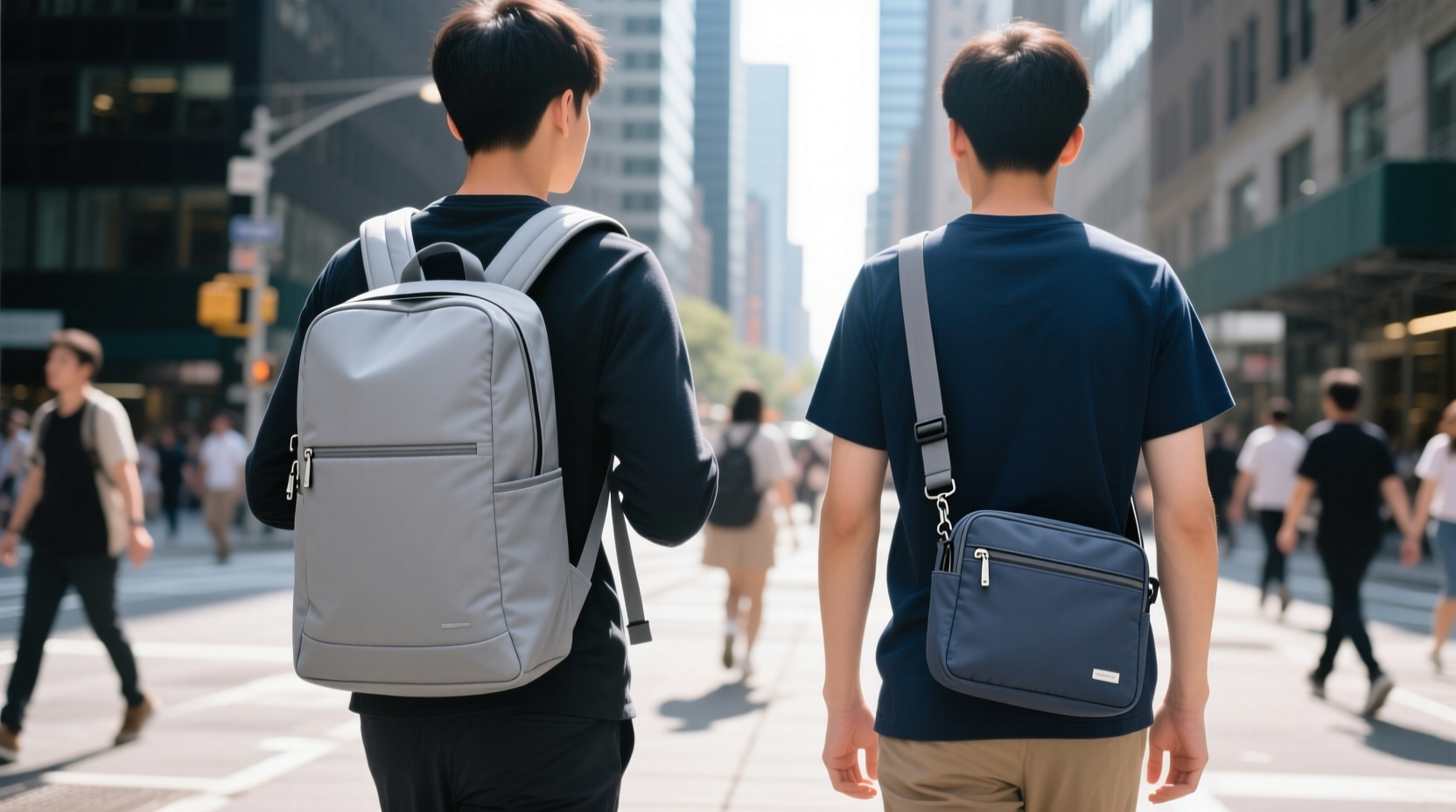
The sensation of “lightness” isn’t solely determined by the bag’s weight. It’s dictated by how that weight is distributed across your body. This is where the fundamental design differences between backpacks and crossbody bags become critical.
A backpack rests evenly on both shoulders, transferring the load directly to the upper back and torso. When properly fitted, it aligns with the spine and allows the strongest muscles in your body—the trapezius, rhomboids, and latissimus dorsi—to share the burden. This balanced approach reduces localized pressure on any single point.
In contrast, a crossbody bag hangs from one shoulder and crosses diagonally over the chest. Even when adjusted tightly, it creates an uneven pull. One shoulder bears the full weight, while the opposite side compensates to maintain balance. Over time, this leads to asymmetrical muscle fatigue and postural strain.
Tip: If you must use a crossbody bag, switch sides every 15–20 minutes to prevent one-sided strain.According to Dr. Lena Patel, a physical therapist specializing in urban ergonomics, “The human body is built for symmetry. Carrying weight on one side forces spinal rotation and pelvic tilt, which can lead to chronic discomfort even with light loads.”
“The difference between feeling ‘light’ and ‘heavy’ often comes down to balance, not total weight.” — Dr. Lena Patel, DPT, Urban Mobility Specialist
Design Comparison: Structure, Fit, and Functionality
To understand why one bag might feel lighter than the other, we need to examine key design elements that influence perceived weight and comfort.
| Feature | Backpack | Crossbody Bag |
|---|---|---|
| Weight Distribution | Evenly split across both shoulders and upper back | Concentrated on one shoulder, counterbalanced by torso twist |
| Posture Impact | Promotes upright alignment when worn correctly | Encourages leaning and shoulder hiking on loaded side |
| Load Capacity | High (laptops, notebooks, water bottles) | Limited (essentials only: phone, wallet, keys) |
| Access Speed | Moderate (requires removal or turning) | High (front-facing access without removing) |
| Mobility in Crowds | Can snag on railings or be bumped from behind | Stays close to front; easier to control in tight spaces |
| Adjustability | Multiple straps, sternum clip, hip belt options | Single strap; limited fine-tuning |
While crossbody bags offer quick access and compactness, they lack the structural support needed for prolonged comfort. Backpacks, especially those with padded shoulder straps, breathable back panels, and load-lifter features, are engineered to minimize perceived weight through intelligent design.
Real-World Commuting Scenarios: Who Feels Lighter?
Theoretical advantages matter less than actual performance during a typical commute. Let’s consider two realistic cases.
Case Study: Maria, Office Worker in Downtown Chicago
Maria commutes 45 minutes each way via train and walking. Her essentials include a 13-inch laptop, lunch container, notebook, water bottle, and jacket. For years, she used a stylish crossbody bag but began experiencing left shoulder pain and frequent headaches. After switching to a lightweight, ergonomic backpack with padded straps and a chest stabilizer, her discomfort vanished. She reported, “It doesn’t just feel lighter—it *is* lighter on my body, even though the contents are the same.”
Case Study: James, Freelancer in Austin
James walks short distances and values accessibility. He carries only his phone, wallet, AirPods, and sunglasses. He uses a slim crossbody bag made of recycled nylon. Because his load is under 2 pounds and he frequently accesses his phone, the crossbody works well. He finds backpacks “overkill” for his needs and says, “I don’t feel any strain because there’s barely anything in there.”
These examples highlight a crucial insight: the ideal choice depends on **load size** and **commute duration**. For heavier loads or longer walks, backpacks consistently reduce shoulder strain. For minimal carry, a well-designed crossbody can be comfortable—provided the user remains mindful of posture and load limits.
Step-by-Step Guide to Choosing Your Lightest Option
Selecting the bag that feels lightest on your shoulders isn’t guesswork. Follow this five-step process to make a data-driven decision based on your personal commute.
- Inventory Your Daily Carry
List everything you bring: laptop, charger, umbrella, lunch, etc. Weigh the total package using a kitchen scale. - Assess Commute Duration and Terrain
Note walking time, elevation changes, stairs, and public transit use. Longer, more active commutes favor backpacks. - Evaluate Access Needs
If you frequently check your phone or need quick wallet access, a crossbody may save time—but consider if that convenience outweighs physical cost. - Test Wearability
Try both styles with your actual load. Walk around for 10–15 minutes. Notice shoulder pressure, back tension, and balance. - Optimize Fit
For backpacks: adjust straps so the bag sits snug against your back, bottom at waist level. For crossbodies: tighten so the bag rests near your hip, minimizing swing.
This method shifts the decision from aesthetics to biomechanical reality. Many users discover that even a slightly heavier backpack feels subjectively lighter due to better weight dispersion.
When Crossbody Bags Work—and When They Don’t
Crossbody bags aren’t inherently bad—they’re just context-dependent. Their advantage lies in agility and visibility. In crowded subways or tourist-heavy areas, having your bag in front reduces theft risk and improves awareness.
However, limitations emerge quickly:
- Straps dig into the shoulder, especially with heavier items like tablets or books.
- Long-term use causes lateral spine flexion, potentially aggravating existing back conditions.
- Fashion-focused designs often sacrifice padding and structure for style.
Manufacturers have responded with hybrid models—small backpacks, convertible crossbody-to-backpack designs, and sling bags with wider, contoured straps. These aim to blend accessibility with improved ergonomics.
Tip: Look for crossbody bags with wide, padded straps and adjustable lengths. Avoid thin leather straps—they concentrate pressure and increase discomfort.Expert Recommendations for Long-Term Shoulder Health
Urban commuters often underestimate cumulative strain. Carrying even 5–7 pounds asymmetrically for 60+ minutes daily adds up over weeks and months.
Dr. Arjun Mehta, an orthopedic specialist, advises: “I see patients in their 30s coming in with rotator cuff issues traced directly to one-sided bag use. The body adapts poorly to constant imbalance.”
“Switching to a backpack isn’t just about comfort—it’s preventive care for your musculoskeletal system.” — Dr. Arjun Mehta, MD, Orthopedic Surgeon
He recommends limiting crossbody use to situations where the total weight is under 3 pounds and the duration is less than 30 minutes. For anything beyond that, a backpack—even a minimalist one—is the healthier choice.
Frequently Asked Questions
Can a crossbody bag cause shoulder pain?
Yes. Carrying weight on one shoulder forces the cervical spine to tilt and the scapula to elevate. Over time, this leads to muscle imbalances, trigger points, and nerve compression. People who carry crossbody bags daily often report tension in the neck, upper back, and trapezius muscles.
Are small backpacks still better than crossbodies for light loads?
Often, yes. Even with light loads, the symmetrical design of a backpack promotes neutral posture. A small backpack weighing 2 lbs will typically feel more balanced than a 1.5 lb crossbody due to even distribution. The psychological sense of equilibrium contributes to perceived lightness.
What’s the maximum weight for a crossbody bag?
Most ergonomists recommend staying under 3 pounds (1.4 kg) for crossbody bags. Beyond that threshold, the risk of postural strain increases significantly. If your essentials exceed this weight, consider downsizing or switching to a backpack.
Checklist: Is Your Commute Bag Shoulder-Friendly?
Use this checklist to evaluate your current bag or assess new options:
- ✅ Total weight under 3 lbs for crossbody, under 15 lbs for backpacks
- ✅ Straps are padded and adjustable
- ✅ Bag sits close to the body without swinging
- ✅ No shoulder indentation or numbness after 30 minutes of wear
- ✅ You can walk without hunching or leaning to one side
- ✅ Quick-access items are within reach without overreaching
- ✅ For backpacks: sternum strap available and used when needed
If you answer “no” to more than two of these, your bag is likely contributing to unnecessary shoulder stress.
Conclusion: Choose Based on Physics, Not Fashion
The debate between backpacks and crossbody bags for city commuting ultimately hinges on biomechanics. While crossbody bags offer convenience and style, they fail to distribute weight effectively—leading to increased shoulder load and long-term discomfort. Backpacks, especially modern ergonomic models, spread the burden across stronger muscle groups, resulting in a genuinely lighter feeling, even with heavier contents.
Your shoulders don’t lie. If you notice persistent tension, asymmetry, or fatigue, it’s not just fatigue from the day—it’s feedback from your body about your carry strategy. Upgrading to a well-fitted backpack or a convertible hybrid could transform your commute from a daily grind to a smooth transition between home and work.
💬 Have you switched from a crossbody to a backpack—or vice versa—for your commute? Share your experience and what finally made it comfortable!








