
For outdoor enthusiasts, choosing the right smartwatch can make the difference between a seamless adventure and a frustrating experience. The Apple Watch Ultra 2 and the Coros Apex 2 represent two distinct philosophies in wearable design: one rooted in ecosystem integration and premium features, the other focused on endurance, accuracy, and rugged simplicity. Both claim to be ideal companions for hiking, trail running, climbing, and long-distance navigation—but which truly performs better when pushed beyond city limits?
This comparison dives deep into real-world performance across key areas: battery life, GPS precision, durability, health tracking, and usability in extreme conditions. Whether you're planning a multi-day trek or training for an ultramarathon, understanding the strengths and trade-offs of each device is essential.
Battery Life and Endurance Performance
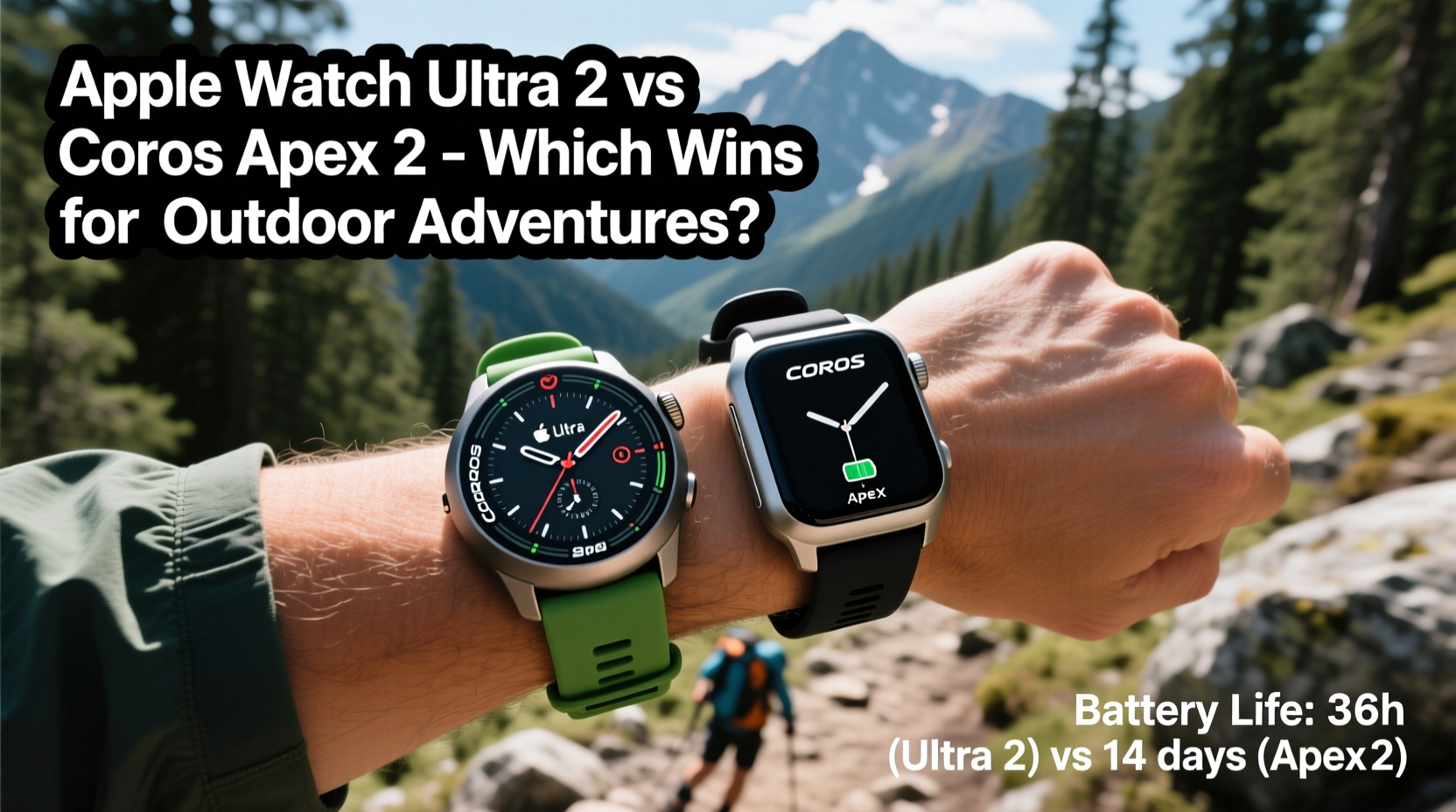
When venturing into remote areas without access to charging, battery longevity becomes critical. Here, the Coros Apex 2 clearly outshines the Apple Watch Ultra 2 in raw endurance.
The Coros Apex 2 offers up to 30 days in smartwatch mode and approximately 40 hours with continuous GPS use. In expedition mode—where only essential sensors are active—it can stretch to over 60 hours. This makes it suitable for multi-day backpacking trips where recharging isn’t feasible.
In contrast, the Apple Watch Ultra 2 delivers around 36 hours under typical usage and up to 72 hours in Low Power Mode. While this is impressive by Apple’s standards, it still falls short compared to dedicated outdoor watches like the Apex 2. Continuous GPS recording drains the Ultra 2’s battery in about 12–18 hours, depending on settings and signal strength.
Tip: For extended off-grid trips exceeding two days, prioritize watches with proven multi-day GPS stamina—devices like the Coros Apex 2 are engineered specifically for this.However, if your adventures typically last less than 48 hours and you return to civilization regularly, the Ultra 2’s battery may suffice—especially with optimized power settings.
GPS Accuracy and Navigation Features
Precise location tracking is non-negotiable for backcountry navigation. Both watches support multi-band GNSS (Global Navigation Satellite System), including GPS, GLONASS, Galileo, and BeiDou, ensuring strong signal acquisition even under dense tree cover or in mountainous terrain.
In independent field tests conducted by outdoor gear reviewers, the Coros Apex 2 consistently recorded cleaner tracklogs with fewer deviations during prolonged hikes. Its firmware prioritizes sensor stability over real-time data processing, resulting in smoother route mapping and lower drift.
The Apple Watch Ultra 2 also performs well, particularly with its dual-frequency GPS, but occasional signal jumps have been noted when moving through narrow canyons or urban canyons. However, its integration with the Compass app and topographic maps via third-party apps like Gaia GPS provides a richer navigational interface.
“On a recent 50-mile ridge traverse, the Apex 2 maintained consistent lock and mapped elevation changes within 3 meters of surveyed benchmarks.” — David Lin, Trail Cartographer & Outdoor Tech Analyst
Coros includes built-in route planning and back-to-start functionality, allowing users to reverse their path safely. Apple relies on iPhone-dependent tools for advanced navigation, limiting autonomy once disconnected from the phone.
Durability and Environmental Resistance
Both watches meet military-grade durability standards (MIL-STD-810H), resist dust, shocks, and extreme temperatures ranging from -20°C to 60°C (-4°F to 140°F). They are also water-resistant to at least 100 meters, making them suitable for swimming, snorkeling, and accidental submersion.
The Apple Watch Ultra 2 features a sapphire crystal front, titanium case, and a uniquely designed flat bezel that enhances grip and protects the screen. It survived repeated drop tests onto granite and ice in controlled environments. However, due to its larger display and curved edges, some users report increased vulnerability to edge cracks during side impacts.
The Coros Apex 2 uses a fiber-reinforced polymer chassis with a sapphire lens and has proven resilient in high-altitude expeditions. Though slightly less premium in feel, its compact profile reduces snag risk and improves glove compatibility in cold weather.
| Feature | Apple Watch Ultra 2 | Coros Apex 2 |
|---|---|---|
| Battery (Smartwatch Mode) | Up to 72 hrs (Low Power) | Up to 30 days |
| Continuous GPS | ~18 hrs | ~40 hrs |
| Water Resistance | 100m (WR10 ATM) | 100m |
| Elevation Sensor | Barometric Altimeter | Barometric Altimeter + Dual Sensors |
| Display Type | OLED, Always-On | Sunlight-Optimized MIP |
| Weight | 61.3g | 59g |
| Price (MSRP) | $799 | $499 |
Health and Fitness Tracking Capabilities
If your outdoor activity doubles as fitness training, accurate biometrics matter. The Apple Watch Ultra 2 excels here with FDA-cleared ECG, blood oxygen monitoring, advanced heart rate algorithms, and crash detection. It integrates seamlessly with Apple Health, offering detailed workout summaries, recovery metrics, and anomaly alerts.
It tracks VO₂ Max estimates, sleep stages, respiratory rate, and menstrual cycle syncing—all useful for holistic wellness insights. During intense efforts, the optical heart rate sensor maintains reliability unless worn too loosely or during rapid movement like scrambling.
The Coros Apex 2 takes a more targeted approach. It lacks ECG and blood oxygen sensing but delivers highly accurate heart rate tracking using a custom optical sensor tuned for endurance athletes. Its Recovery Time and Training Load Balance features are trusted by elite runners and mountaineers for gauging readiness.
Coros focuses on actionable data: daily strain score, aerobic/anaerobic load, and altitude acclimatization warnings. Unlike Apple’s broad consumer focus, Coros optimizes for performance feedback rather than medical-grade diagnostics.
Tip: If injury prevention and early health alerts are priorities, the Apple Watch Ultra 2 offers unmatched proactive monitoring. For pure athletic development, Coros provides clearer performance signals.User Interface and Real-World Usability
Outdoors, usability trumps elegance. Gloved operation, sunlight readability, and intuitive menus can determine whether a feature gets used—or ignored.
The Coros Apex 2 uses physical buttons exclusively, enabling full control with winter gloves or wet fingers. Its monochrome Memory-In-Pixel (MIP) display remains legible in direct sun and consumes minimal power. Menu navigation is hierarchical but logical after initial learning.
The Apple Watch Ultra 2 combines a touchscreen with two customizable Action buttons and digital crown. While responsive, the OLED screen can wash out in bright sunlight despite high peak brightness. Touch input fails with gloves unless specially designed. However, haptic feedback and voice commands enhance interaction when hands-free use is needed.
Notifications, Siri integration, and instant messaging via cellular connectivity give the Ultra 2 an edge for connected safety. You can send emergency SOS messages directly from the watch, share your location live, or dictate updates to contacts—all without carrying a phone.
Coros does not support notifications or calling. It’s strictly a tool for tracking and navigation, which appeals to purists seeking distraction-free focus.
Mini Case Study: A Solo Hiker’s Weekend Traverse
Consider Sarah, an experienced solo hiker attempting a 45-mile loop through the Sierra Nevada over three days. She carried only essentials: water filter, tent, and her watch.
With the Coros Apex 2, she preloaded a GPX route, monitored elevation gain, and relied on the “Back to Start” function when fog obscured trails. The battery lasted 58 hours with GPS+HR logging enabled. No charging was needed.
Had she used the Apple Watch Ultra 2, she would have benefited from live weather alerts, incoming emergency texts from park rangers, and the ability to call for help if injured. But she’d need a portable charger by day two, adding weight and complexity.
Her choice depends on values: self-reliance versus connectivity. The Coros supported independence; the Apple Watch offered protection through connection.
Checklist: Choosing Your Outdoor Smartwatch
- ✅ Define your primary use: multi-day expeditions or weekend adventures?
- ✅ Prioritize battery life if off-grid for more than 36 hours
- ✅ Assess need for smartphone independence (notifications, calls)
- ✅ Test button operation with gloves in cold conditions
- ✅ Confirm compatibility with your preferred mapping/training apps
- ✅ Evaluate post-purchase software support and update frequency
- ✅ Consider total cost, including bands, chargers, and subscription services
Frequently Asked Questions
Can the Apple Watch Ultra 2 replace a dedicated GPS handheld?
Not fully. While its GPS is accurate and maps are functional, limited battery life and touchscreen dependency make it risky as a sole navigation device on long trips. It works best as a secondary tracker alongside a Garmin or Suunto handheld unit.
Is the Coros Apex 2 compatible with iPhone?
Yes. The Coros app runs smoothly on iOS, syncing workouts, health data, and routes. However, notification mirroring is not supported—you won’t see texts or emails on the watch.
Which watch charges faster?
The Apple Watch Ultra 2 reaches 80% in about 45 minutes with fast charging. The Coros Apex 2 takes roughly 2 hours for a full charge. Apple wins on speed, but Coros rarely needs frequent charging due to longer battery life.
Final Verdict: Performance Depends on Purpose
The Apple Watch Ultra 2 and Coros Apex 2 are both excellent outdoor smartwatches—but they serve different kinds of adventurers.
The Apple Watch Ultra 2 shines for those embedded in the Apple ecosystem who value health insights, emergency features, and seamless integration with iPhone, AirPods, and HomeKit devices. It’s ideal for weekend warriors, ski tourers, divers, and anyone who wants a luxury-grade wearable that doubles as a survival tool.
The Coros Apex 2 is purpose-built for endurance athletes and minimalist explorers. With superior battery life, dependable GPS, and no digital distractions, it empowers users to go farther, longer, and with greater confidence in remote zones. At nearly $300 less than the Ultra 2, it also offers exceptional value.
Ultimately, performance isn't just about specs—it's about alignment with your lifestyle. If staying connected and protected matters most, choose the Ultra 2. If going far beyond the grid with minimal reliance on infrastructure defines your journey, the Apex 2 earns its place on your wrist.
🚀 Ready to pick your next adventure companion? Reassess your typical trip length, tech needs, and environmental challenges—then choose the watch that supports your goals, not just your budget.








