
Alcohol consumption remains a leading preventable cause of disease and premature death worldwide. In response, digital health tools—especially those integrated with wearable devices like the Apple Watch—have surged in popularity. Apps promising to “track, understand, and reduce” drinking now appear in the App Store with sleek interfaces, real-time notifications, and seamless syncing to wrist-based heart rate and activity sensors. But does logging a glass of wine on your wrist translate into sustained behavioral change? Or are these tools merely sophisticated diaries that reinforce awareness without altering outcomes?
This article cuts through marketing claims and anecdotal enthusiasm to assess what the science says—and what real users experience—about Apple Watch–enabled alcohol tracking. We evaluate clinical evidence, app functionality, psychological mechanisms at play, and why some people succeed while others disengage within days. Importantly, we move beyond binary “yes/no” answers to clarify under what conditions, for which individuals, and with what complementary supports these tools can become part of a meaningful reduction strategy.
How Alcohol Tracking Apps Work on the Apple Watch
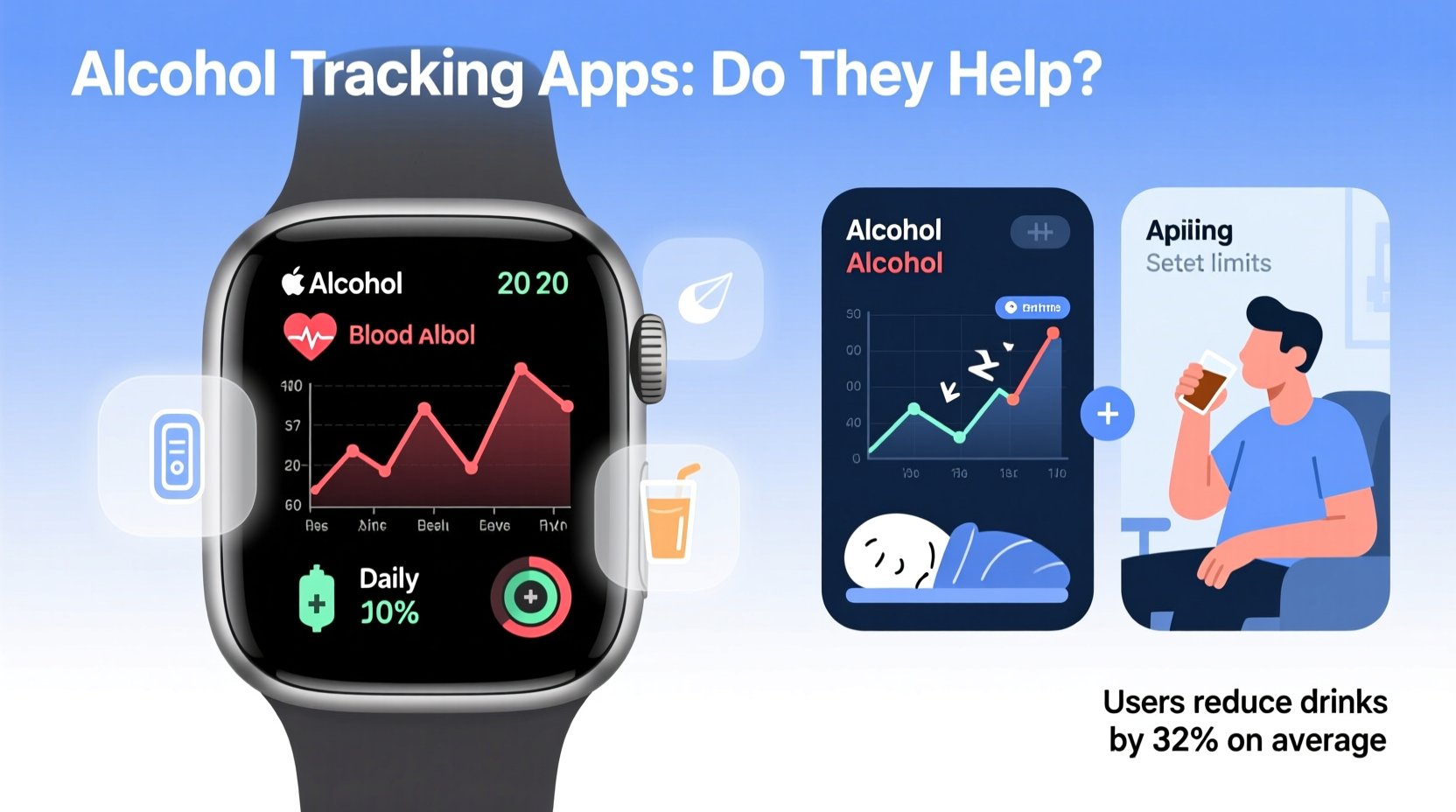
Most Apple Watch–compatible alcohol tracking apps—including DrinkTrack, AlcoDroid (via companion iOS app), and newer entrants like Sunnyside and Reframe—rely on a hybrid model. The watch itself rarely measures blood alcohol concentration (BAC); instead, it serves as a convenient input device and contextual sensor hub. When a user taps “Log 1 glass of red wine,” the app records timestamp, estimated standard drink count, mood (via quick emoji selection), location, and social context. Simultaneously, the watch feeds in passive data: elevated resting heart rate, reduced sleep efficiency, increased nighttime awakenings, or elevated skin temperature—all physiological correlates associated with alcohol metabolism and its downstream effects.
This dual-layered approach—self-report + biometric inference—is designed to surface patterns invisible to memory alone. For example, an app might flag that on nights when users log >2 drinks, their average deep sleep drops by 37% and morning heart rate variability (HRV) declines by 22%. Over time, this creates personalized feedback loops—not just “you drank,” but “here’s how your body responded.”
Tip: Avoid apps that claim to estimate BAC from wrist sensors alone. No FDA-cleared wearable currently measures ethanol in blood or breath. Any “BAC estimate” based solely on pulse oximetry or HRV is speculative and clinically unvalidated.What the Research Says: Evidence for Behavior Change
A 2023 systematic review published in JAMA Internal Medicine analyzed 22 digital interventions for hazardous alcohol use, including 9 with wearable integration. The findings were nuanced: apps with basic logging features showed modest short-term reductions (average 1.2 fewer drinks per week at 4 weeks), but effects faded by 12 weeks without additional support. In contrast, apps combining self-monitoring with evidence-based behavioral components—such as motivational interviewing prompts, cognitive restructuring exercises, or just-in-time adaptive interventions (JITAIs)—demonstrated clinically meaningful reductions: 3.4 fewer drinks per week sustained at 6 months.
Critically, the Apple Watch’s role was not as a standalone intervention, but as an engagement amplifier. Users who interacted with the watch interface ≥5 times per week were 2.8× more likely to complete 80% of assigned behavioral modules than those using iOS-only versions. The immediacy of wrist-based logging—bypassing phone unlocking, app launching, and typing—lowered the “effort barrier” to consistent self-monitoring, a known predictor of adherence in behavioral health tech.
“Self-monitoring is foundational—but only when paired with interpretation and actionable insight. A number logged on a screen is inert data. A trend visualized across biometrics, mood, and consequences becomes a catalyst for reflection.” — Dr. Lena Torres, Clinical Psychologist and Digital Health Researcher at Stanford Prevention Research Center
Real-World Effectiveness: A Mini Case Study
Consider Maya, 34, a project manager in Portland who began tracking alcohol after noticing fatigue and irritability on Mondays. She used the Sunnyside app with Apple Watch integration for 10 weeks. Initially, she logged every drink manually—a habit that lasted 12 days before lapsing. What shifted her trajectory was enabling automatic sleep and HRV tracking. One Sunday night, after three glasses of wine, her watch recorded only 3.2 hours of deep sleep (down from her 5.1-hour weekly average) and a 40% dip in morning HRV. The app displayed this not as a warning, but as a gentle question: “How did you feel upon waking? Tap to compare with other mornings.”
Maya selected “groggy, headachy” and saw a side-by-side chart: on low-alcohol nights, her energy rating averaged 7.4/10; on high-alcohol nights, it dropped to 3.1. That visual correlation—between her choice and her lived experience—sparked what clinicians call “cognitive dissonance”: the discomfort of holding two conflicting beliefs (“I enjoy wine” vs. “Wine consistently undermines my energy”). Within three weeks, Maya shifted from tracking *what* she drank to experimenting with *when*: she reserved wine for Friday evenings only and replaced Saturday night drinks with evening walks tracked by her watch. By week 10, her average weekly intake fell from 14 to 5 standard drinks—and she attributed the change less to accountability, and more to “finally seeing the cost written in my own physiology.”
Limitations and Common Pitfalls
Despite promise, Apple Watch alcohol tracking has well-documented constraints. First, accuracy hinges entirely on honest, timely self-reporting. Studies show underreporting increases with higher intake—users log only ~60% of drinks consumed during social events, especially when intoxicated. Second, biometric proxies (like HRV or sleep disruption) lack specificity: stress, caffeine, illness, or even a late meal can produce identical signals. Third, apps cannot address root drivers—loneliness, anxiety, trauma, or workplace culture—that sustain heavy drinking. Without concurrent therapeutic or social support, tracking often devolves into “surveillance without scaffolding.”
Worse, poorly designed feedback can backfire. Apps that emphasize “drinks over limit” alerts or daily “streak counters” may inadvertently reinforce shame-based motivation—a known risk factor for relapse in behavioral health. Similarly, gamified elements (badges for “dry days”) work for some but alienate others who perceive them as infantilizing or dismissive of complex emotional needs.
| Strength | Limitation | Mitigation Strategy |
|---|---|---|
| Real-time logging reduces recall bias | Underreporting escalates with intoxication | Use pre-event intention-setting (e.g., “I’ll have max 2 tonight”) + post-event reflection prompts |
| Biometric context reveals physiological impact | HRV/sleep changes aren’t alcohol-specific | Correlate trends over 3+ similar nights; avoid single-night interpretations |
| Wrist interface boosts consistency | No direct BAC or metabolism measurement | Treat biometrics as *indicators*, not diagnostics; pair with professional guidance |
| Pattern visualization builds insight | Does not address underlying drivers (e.g., anxiety) | Integrate with therapy, peer support, or evidence-based CBT modules |
What Actually Helps Reduce Drinking—Beyond the App
If tracking alone rarely sustains change, what does? Research points to three non-negotiable pillars:
- Personalized goals rooted in values: Reduction works best when tied to concrete, meaningful outcomes—not arbitrary limits. “Cutting to 7 drinks/week” is less motivating than “sleeping soundly enough to run a 5K without exhaustion” or “feeling present during my daughter’s soccer games.”
- Social reinforcement: People who share goals with one supportive person (not necessarily a partner or therapist—could be a friend, online group, or coach) are 2.3× more likely to maintain change at 6 months. Apple Watch apps that enable private sharing of trends (not just totals) support this.
- Behavioral substitution: Reducing alcohol isn’t about willpower—it’s about replacing a ritual. Successful users don’t just stop drinking; they install new cues (e.g., swapping wine at 6 p.m. for a walk + herbal tea tracked by the watch) and reward the new behavior with immediate positive feedback (e.g., watch vibration + message: “You chose energy today.”).
Step-by-Step: Building a Sustainable Reduction Plan Using Your Apple Watch
- Week 1: Baseline & Pattern Mapping — Log every drink, mood, and context for 7 days. Review nightly sleep and HRV trends. Note: Do not change behavior yet—observe only.
- Week 2: Identify Your “Why” & One Anchor Habit — Write down one specific, value-driven reason for reducing (e.g., “to have mental clarity for creative work”). Choose one replacement ritual (e.g., “after work, I’ll take a 10-minute walk and log it on my watch”).
- Week 3–4: Introduce Micro-Constraints — Apply one rule: no alcohol before 7 p.m., or only on weekends, or only with food. Use watch reminders to prompt pause-and-reflect before pouring.
- Week 5–6: Leverage Biometric Feedback — Compare sleep/HRV on low- vs. high-alcohol days. Journal one sentence linking physiology to experience: “When I slept 5.8 hours, I felt sharp in my 10 a.m. meeting.”
- Week 7+: Refine, Not Fix — Adjust rules based on what’s working. Celebrate consistency—not perfection. If you exceed limits, review context (stress? boredom?)—not character.
FAQ
Do any Apple Watch apps integrate with healthcare providers or therapists?
Yes—but selectively. Sunnyside and Ria Health offer HIPAA-compliant clinician dashboards where users can opt to share anonymized trend reports (e.g., weekly drink counts, sleep correlation charts). This is most valuable when combined with regular telehealth sessions, not as a substitute for clinical care.
Can these apps help someone with alcohol use disorder (AUD)?
No—not as standalone tools. While useful for early-stage reduction or moderate-risk drinking, apps lack crisis protocols, medical detox support, or evidence-based pharmacotherapy integration. Individuals with AUD require comprehensive care: medical evaluation, behavioral therapy, and often medication-assisted treatment. Tracking may complement treatment but should never delay seeking qualified help.
Are there privacy concerns with storing alcohol data on Apple devices?
Apple’s on-device encryption protects health data stored in the Health app (including third-party app syncs), but app-specific cloud storage varies. Review each app’s privacy policy: avoid those that sell anonymized data or share with advertisers. For maximum privacy, disable cloud backups for alcohol logs or use apps that store data locally only.
Conclusion
Apple Watch alcohol tracking apps are neither magic solutions nor meaningless gimmicks. They are precision instruments—capable of revealing hidden connections between choices and consequences, but powerless without skilled interpretation and intentional action. Their true value emerges not in counting drinks, but in illuminating the personal cost of each one: the lost sleep, the muted focus, the frayed patience, the deferred joy. When used with humility—as one tool among many, grounded in self-compassion and supported by human connection—they can catalyze change that lasts.
You don’t need perfect data to begin. You need curiosity about your own patterns, courage to see them clearly, and willingness to respond—not with judgment, but with kindness and practical adjustment. Start small: tonight, before your first drink, ask your watch to record your energy level. Tomorrow morning, check your sleep summary. Notice—not to criticize, but to understand. That moment of attention, repeated with consistency, is where real change begins.
💬 Your experience matters. Have you used Apple Watch alcohol tracking—and seen measurable shifts? Share one insight, tip, or lesson in the comments. Your story could help someone else find their turning point.








