Keeping track of everyday items has never been easier—thanks to Apple’s AirTag. Whether it’s your keys vanishing into the couch cushions or your wallet slipping out of your coat pocket, an AirTag can help you locate them in seconds using the Find My network. But once you’ve bought an AirTag, the next decision becomes critical: how do you carry it? The two most popular options are attaching it to a keychain or embedding it in a wallet. Each approach has distinct advantages and trade-offs. Choosing the right one depends on your lifestyle, what you tend to lose, and how you use your belongings daily.
Durability and Protection: Built to Last?
AirTags themselves are designed with IP67 water and dust resistance, meaning they can survive brief submersion and resist dirt. However, their longevity in real-world conditions depends heavily on how they’re carried.
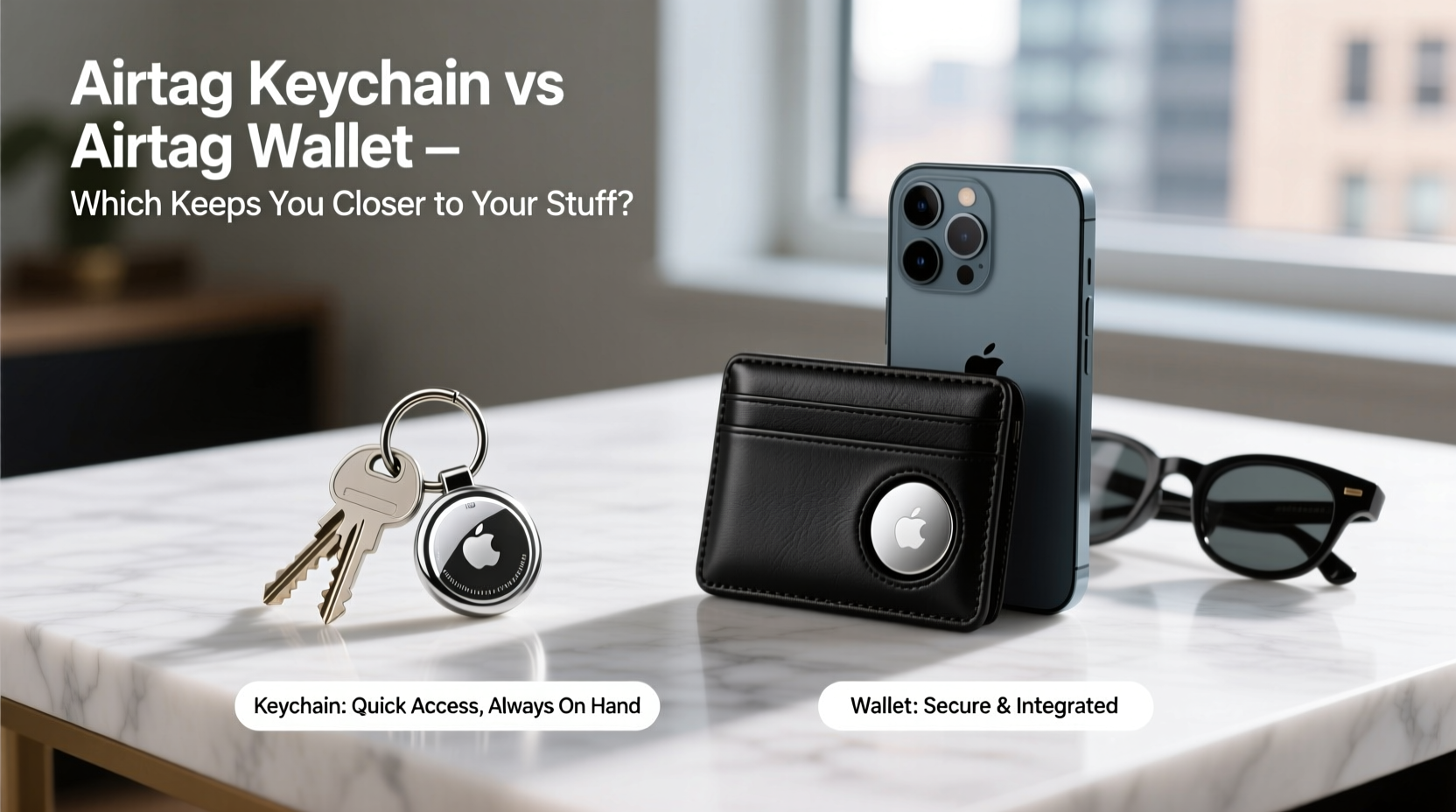
When attached to a keychain, an AirTag is exposed to constant jostling, drops, and contact with hard surfaces like concrete or metal tables. Over time, this leads to scratches, dents, and even loosening of the casing. Most third-party keychains don’t offer full enclosure—many are loop-style or have minimal housing—which leaves the AirTag vulnerable.
In contrast, wallets designed for AirTags (like those from Bellroy, Secrid, or Apple-certified brands) often feature padded slots or dedicated RFID-shielded pockets that cradle the AirTag securely. These materials—typically leather, polycarbonate, or impact-resistant synthetics—absorb shock and prevent direct impacts. If you frequently toss your wallet onto counters or drop it in public spaces, this protection matters.
Tip: If using a keychain, opt for a fully enclosed silicone or rugged polymer case that screws shut—this reduces damage from daily wear.Convenience and Daily Usability
How seamlessly an AirTag integrates into your routine determines whether you’ll actually benefit from it. A solution that feels clunky or inconvenient will likely be abandoned after a few weeks.
Keychains win in terms of simplicity. Most people already carry keys, so adding an AirTag to that bundle requires no behavior change. You’re less likely to forget your keys than your wallet, making them ideal for location tagging. Plus, if you misplace your bag or jacket, the jingle of keys—and now the precision finding feature on newer iPhones—can guide you directly to the source.
Wallets, however, serve a different purpose. They’re usually kept in front pockets or secure bags, reducing loss risk—but when lost, the consequences are higher. Losing a wallet means losing IDs, cards, and cash. An embedded AirTag gives peace of mind, especially in crowded areas. However, not all wallets accommodate AirTags easily. Thin bifold models may bulge or feel awkward with a 3mm-thick disc inside. And if your wallet lacks a snug slot, the AirTag can shift or fall out during removal.
“People underestimate how much small design differences affect long-term usage. A poorly placed AirTag can make a wallet uncomfortable to carry.” — Jordan Lee, Product Designer at Urban Gear Labs
Tracking Performance: Accuracy and Range
Both setups rely on Bluetooth and Ultra-Wideband (UWB) technology for tracking, but physical placement influences signal strength.
On a keychain, the AirTag is typically more exposed. There’s less material blocking the signal, which improves Bluetooth range and UWB precision finding. When you're searching for lost keys under a bed or behind furniture, this open exposure helps your iPhone detect the tag faster and more accurately.
Inside a wallet, especially one made of metal-reinforced leather or with RFID-blocking layers, signal attenuation can occur. Some users report weaker detection or delayed alerts when the wallet is buried in a backpack or placed near electronic devices. While modern AirTags compensate with crowd-sourced Find My updates via nearby Apple devices, immediate local tracking suffers slightly.
| Feature | AirTag Keychain | AirTag Wallet |
|---|---|---|
| Durability | Moderate (exposed to impact) | High (protected by wallet structure) |
| Signal Strength | Strong (minimal interference) | Moderate (material blockage possible) |
| Likelihood of Loss | Higher (often left behind) | Lower (carried more carefully) |
| Comfort & Portability | Minimal added bulk | Potential thickness increase |
| Replacement Cost if Lost | Low (keys replaceable) | High (wallet + contents) |
Real-World Scenario: Who Benefits More?
Consider Sarah, a freelance photographer who travels weekly. She once left her keys in a rental car in Lisbon. Thanks to her AirTag keychain, she received an alert when she moved out of Bluetooth range. Using Precision Finding on her iPhone 14 Pro, she retraced her steps and recovered the keys within minutes—avoiding a costly lockout fee.
Meanwhile, David, a financial analyst, had his slim leather wallet stolen at a concert. It contained credit cards, his driver’s license, and an AirTag tucked inside a card slot. Even though the thief ditched the wallet, the AirTag remained active. Within hours, David used the Find My app to locate it in a dumpster three blocks away. He retrieved his ID and canceled cards before any fraudulent charges occurred.
Their experiences highlight a crucial insight: the best choice isn’t universal. If you frequently misplace keys or leave them in cars, a keychain setup offers fast recovery. If your biggest fear is identity theft or losing payment methods, securing an AirTag in your wallet provides deeper security value.
Step-by-Step Guide to Choosing the Right Option
- Assess Your Habits: Do you lose keys more often than wallets? Track incidents over two weeks.
- Evaluate Your Current Accessories: Does your wallet have space for an AirTag without bulging?
- Check Material Compatibility: Avoid placing AirTags in wallets with metal linings or thick shielding that block signals.
- Test Signal Response: Place your phone across the room and see how quickly the AirTag responds in both configurations.
- Invest in Quality Housing: Use a screw-lock keychain case or a wallet with a dedicated AirTag pocket.
- Enable Lost Mode: Set up notifications and a custom message in the Find My app regardless of where you place it.
FAQ: Common Questions About AirTag Placement
Can I use the same AirTag for both my keys and wallet?
No. Each AirTag can only be assigned to one item at a time in the Find My app. To track both, you’ll need two separate AirTags.
Do wallets with built-in AirTag slots affect battery life?
Not directly. Battery life averages one year regardless of placement. However, poor signal due to shielding may cause the AirTag to transmit more frequently, slightly reducing lifespan.
Is it safe to put an AirTag in someone else’s belongings without telling them?
No. Apple has implemented anti-stalking features that alert nearby iOS users to unknown AirTags traveling with them. Always disclose AirTag use for ethical and legal reasons.
Final Verdict: Which One Is Actually Better?
There’s no single answer. The AirTag keychain excels in responsiveness, ease of access, and cost-effective protection for high-movement items. It’s ideal for people who frequently misplace keys, bags, or gear. The AirTag wallet, while slightly compromised in signal efficiency, offers superior safeguarding for high-value personal items and enables faster recovery of sensitive documents and cards.
The smartest approach? Use both—if your budget allows. Many tech-savvy users carry an AirTag in their wallet and attach one to their keys. This dual-layer system ensures that whichever item goes missing, you’re covered. For most, starting with the item they lose most often is the logical first step.
🚀 Ready to stop losing your essentials? Pick your most vulnerable item—keys or wallet—and pair it with an AirTag today. Share your experience or ask questions in the comments below.