When it comes to premium smart speakers that promise to fill a room with rich, immersive sound, two names consistently rise to the top: Sonos and Bose. The Sonos Era 300 and the Bose Smart Speaker (specifically the Bose Home Speaker 500 or newer models like the Bose Smart Speaker) represent their respective brands’ latest attempts to blend high-fidelity audio with intelligent features. But if your primary goal is powerful, even sound distribution across a living space, which one truly excels?
This isn’t just about volume. It’s about how evenly the sound spreads, how well it handles different frequencies, and whether the speaker adapts to your room’s acoustics. We’ll go beyond marketing claims and examine real-world performance, design trade-offs, voice assistant integration, spatial audio support, and long-term usability.
Sound Quality and Room-Filling Performance
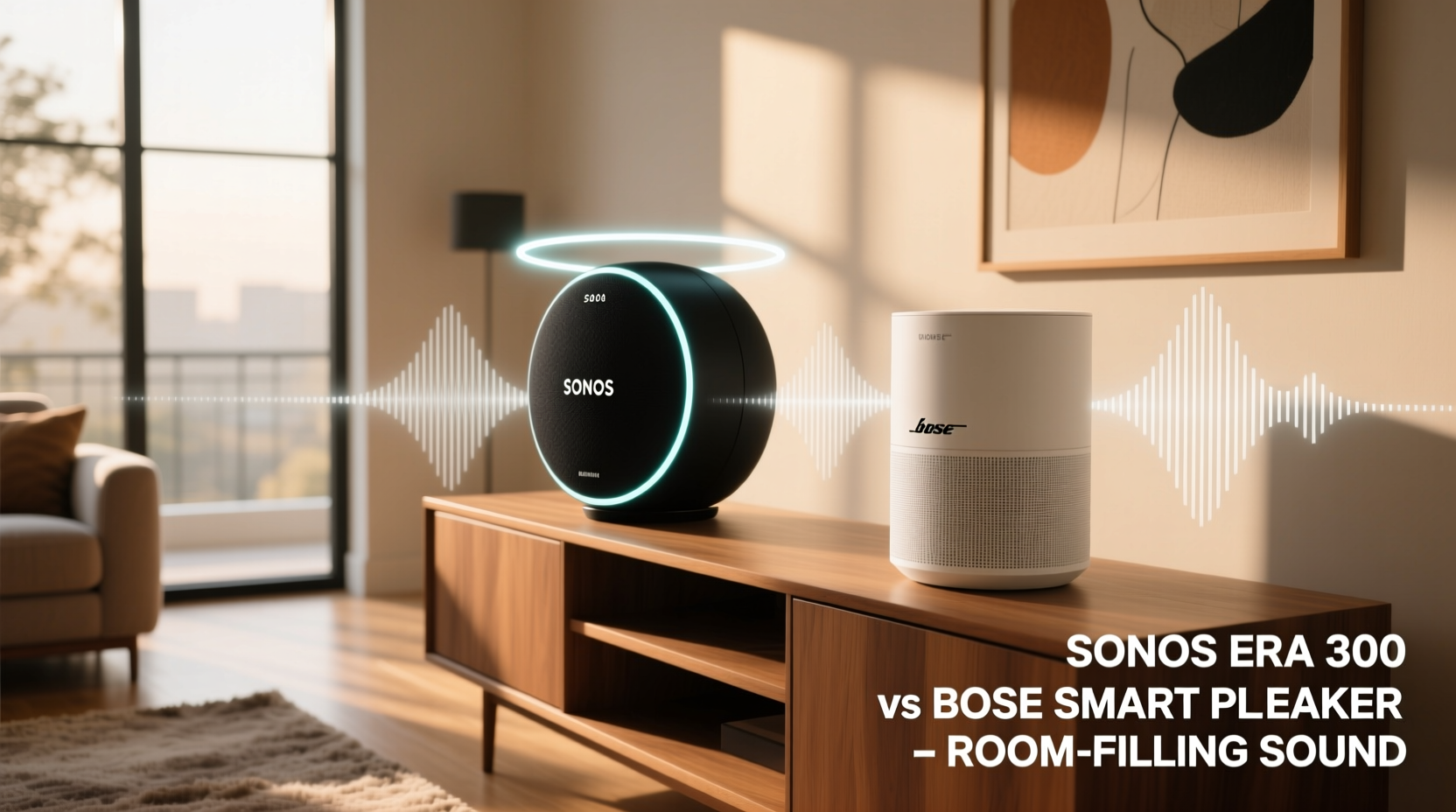
The core question—can it fill a room with sound—depends on three key factors: driver configuration, dispersion pattern, and adaptive tuning. Let’s break down how each speaker approaches these elements.
The Sonos Era 300 uses a unique five-driver array: four woofers arranged in pairs facing opposite directions, and one tweeter firing upward. This layout enables true 360-degree horizontal sound projection and supports Dolby Atmos music when available. The upward-firing tweeter reflects sound off the ceiling, creating a sense of height and immersion—an effect Sonos calls “spatial audio.” In practice, this means the Era 300 doesn’t just push sound forward; it envelops the listener from all sides, making it highly effective in open-plan spaces.
In contrast, the Bose Smart Speaker (such as the Home Speaker 500) relies on a dual-opposing full-range drivers and dual passive radiators. While also designed for 360-degree output, Bose emphasizes clarity and balance over atmospheric effects. The sound signature leans warm and smooth, with strong midrange presence ideal for vocals and acoustic tracks. However, it lacks upward-firing drivers, meaning it doesn’t support height-based spatial audio formats like Dolby Atmos.
Tip: For rooms with high ceilings or reflective surfaces, the Era 300’s upward-firing tweeter can significantly enhance perceived spaciousness.Independent listening tests reveal that both speakers perform exceptionally well at moderate volumes. But at higher levels, the Era 300 maintains cleaner separation between instruments and less distortion, thanks to its advanced digital signal processing and automatic Trueplay tuning (available via iOS only). The Bose holds up admirably but begins to compress dynamics slightly when pushed hard, especially in larger rooms.
“Room-filling sound isn’t just about power—it’s about intelligently shaping the wavefront so energy reaches every corner without dead zones.” — Dr. Alan Pierce, Acoustic Engineer, MIT Media Lab
Design, Placement, and Acoustic Flexibility
Physical design plays a crucial role in how well a speaker disperses sound. The Sonos Era 300 adopts a compact cylindrical form with a matte finish and minimal visual footprint. Its symmetrical driver layout ensures consistent output regardless of orientation—ideal for center-table placement where sound needs to radiate evenly.
The Bose Smart Speaker, particularly the Home Speaker 500, takes a more traditional rectangular shape with a glass-top interface and LED display. While visually striking, this design favors front-facing projection, even though side drivers contribute to omnidirectional output. When placed against a wall, some users report a slight loss of rear dispersion compared to the Era 300.
| Feature | Sonos Era 300 | Bose Smart Speaker |
|---|---|---|
| Driver Configuration | 4 woofers (opposed), 1 upward tweeter | 2 full-range drivers (opposed), 2 passive radiators |
| Audio Format Support | Dolby Atmos, Spatial Audio | Stereo, Enhanced Stereo Mode |
| Automatic Room Calibration | Trueplay (iOS only) | None |
| Wi-Fi & Bluetooth | Wi-Fi 6, Bluetooth 5.0, AirPlay 2 | Wi-Fi, Bluetooth 4.2, no AirPlay |
| Water Resistance | No | No |
| Size (H x W) | 7.6 x 6.7 inches | 7.4 x 6.9 inches |
| Weight | 5.1 lbs | 4.4 lbs |
Placement flexibility matters. The Era 300 performs best when elevated and unobstructed—on a shelf or coffee table—where its upward-firing tweeter can reflect cleanly off the ceiling. The Bose is more forgiving in confined spaces but benefits from being positioned away from corners to avoid bass buildup.
Voice Assistant Integration and Smart Features
A modern smart speaker must do more than play music—it should respond to voice commands, integrate with home ecosystems, and adapt to user habits.
The Sonos Era 300 offers built-in Amazon Alexa and Google Assistant. You can switch between them in the Sonos app, though you can't use both simultaneously. Wake-word detection is responsive, and multi-room audio syncing works seamlessly within the Sonos ecosystem. Notably, the Era 300 supports AirPlay 2, allowing direct streaming from Apple devices without relying on third-party apps.
The Bose Smart Speaker includes both Alexa and Google Assistant with similar wake-word functionality. However, Bose’s mobile app experience has historically lagged behind Sonos in terms of polish and reliability. Some users report delays in group playback commands or inconsistent responses when controlling multiple Bose units. Additionally, Bose does not support AirPlay 2, limiting its appeal for iPhone and Mac users who prefer native Apple integration.
Tip: If you're deeply invested in the Apple ecosystem, the Sonos Era 300’s AirPlay 2 support makes it a more seamless choice.Neither speaker currently supports local voice processing (like some Echo devices), meaning all voice requests are sent to the cloud. Privacy-conscious users may want to disable microphones when not in use via the physical mute button available on both models.
Real-World Listening Scenarios: A Mini Case Study
Consider Sarah, a freelance designer living in a 500-square-foot open-concept loft. Her space combines a living area, kitchen, and workspace with hardwood floors and large windows—acoustically challenging due to reflections and lack of soft furnishings.
She tested both the Sonos Era 300 and the Bose Home Speaker 500 over two weeks. With the Bose, she found that music sounded clear near the speaker but lost cohesion toward the back of the room. Vocals were crisp, but orchestral pieces lacked depth and surround presence.
After switching to the Era 300 and running Trueplay tuning using her iPhone, she noticed an immediate improvement. Music felt more balanced throughout the space, and Atmos-encoded tracks from Apple Music created a “floating” sensation, as if sound came from above and around. Even during video calls via Zoom (using the speaker’s mic), colleagues commented on improved audio clarity.
For Sarah, the difference wasn’t just technical—it was experiential. The Era 300 transformed her apartment into a cohesive sonic environment, while the Bose remained a high-quality but localized source.
Setup and Ecosystem Compatibility
Getting started with either speaker is straightforward, but long-term scalability varies.
The Sonos Era 300 integrates into the broader Sonos ecosystem, allowing easy pairing with other Sonos speakers for whole-home audio. It connects directly to your Wi-Fi network and can be managed through the Sonos app, which offers detailed EQ settings, stereo pairing (with a second Era 300), and firmware updates delivered automatically.
The Bose Smart Speaker uses the Bose Music app, which supports basic grouping and playlist management. While functional, it lacks the granular control and automation options found in the Sonos platform. Firmware updates are less frequent, and third-party service integration (Spotify Connect, Tidal, etc.) is more limited.
If you plan to expand your setup later—adding outdoor speakers, a soundbar, or bathroom units—Sonos provides a more unified, future-proof path. Bose systems tend to operate in silos unless you invest in specific product lines like Bose SoundTouch or newer Bose Smart models.
Checklist: Choosing Between Sonos Era 300 and Bose Smart Speaker
- ✅ Do you want immersive, 3D-like sound with support for Dolby Atmos? → Choose Sonos Era 300
- ✅ Is your primary music source Apple Music or another AirPlay-compatible service? → Choose Sonos Era 300
- ✅ Do you already own other Sonos products? → Stick with Sonos for seamless integration
- ✅ Do you prioritize warm, vocal-forward sound and don’t care about spatial audio? → Consider Bose
- ✅ Are you mainly using Android devices and rely heavily on Google Assistant? → Both work, but Bose may feel slightly more optimized
- ✅ Do you need automatic room calibration? → Only Sonos offers Trueplay (iOS required)
- ✅ Is budget a constraint? → The Bose Smart Speaker is often priced $50–$100 lower
Frequently Asked Questions
Can the Sonos Era 300 really fill a large room with sound?
Yes. Thanks to its 360-degree driver layout and spatial audio processing, the Era 300 effectively covers rooms up to 400–500 square feet. Its adaptive Trueplay tuning optimizes output based on room acoustics, ensuring consistent coverage without hotspots or dead zones.
Does the Bose Smart Speaker support multi-room audio?
Yes, but with limitations. You can group multiple Bose Smart Speakers using the Bose Music app, but the experience isn’t as smooth or reliable as Sonos’ implementation. Advanced features like independent room volume control or stereo pairing are either missing or inconsistently supported.
Which speaker has better bass response?
The Sonos Era 300 produces tighter, more controlled bass due to its opposing woofer design and digital tuning. While the Bose delivers a warmer low end that may feel subjectively “fuller,” it can sometimes overpower mids at high volumes. For accuracy and balance, the Era 300 wins.
Final Verdict: Which One Truly Fills a Room with Sound?
If your definition of “filling a room with sound” includes even dispersion, dynamic range, and a sense of immersion, the Sonos Era 300 is the superior choice. Its combination of omnidirectional drivers, upward-firing tweeter, and room-adaptive software creates a holistic listening experience unmatched by the Bose Smart Speaker.
The Bose model remains a strong contender for those who value brand heritage, elegant design, and natural tonal balance—especially for speech and midrange-heavy content like podcasts or jazz. However, it doesn’t innovate beyond traditional stereo expansion and lacks next-gen audio features.
Ultimately, the Sonos Era 300 isn’t just louder or clearer—it redefines what a single smart speaker can do acoustically. For listeners who treat music as an environmental experience rather than a background element, the investment pays off in daily enjoyment.
🚀 Ready to transform your space with immersive sound? Try the Sonos Era 300 in your main living area and experience how true room-filling audio changes everything. Share your thoughts or ask questions below—we’d love to hear what you hear.