
In modern vehicles, antennas are no longer just long metal rods protruding from the fender. Today’s cars often feature sleek shark fin antennas or compact mini antennas integrated into the roofline or rear window. While aesthetics play a role in this shift, many drivers wonder: does the shape actually affect signal strength? Is one truly better than the other when it comes to AM/FM radio, GPS, satellite navigation, or cellular connectivity? The answer isn’t as simple as “bigger is better.” Design, placement, internal components, and integration all influence performance—sometimes more than external appearance.
The Evolution of Car Antennas
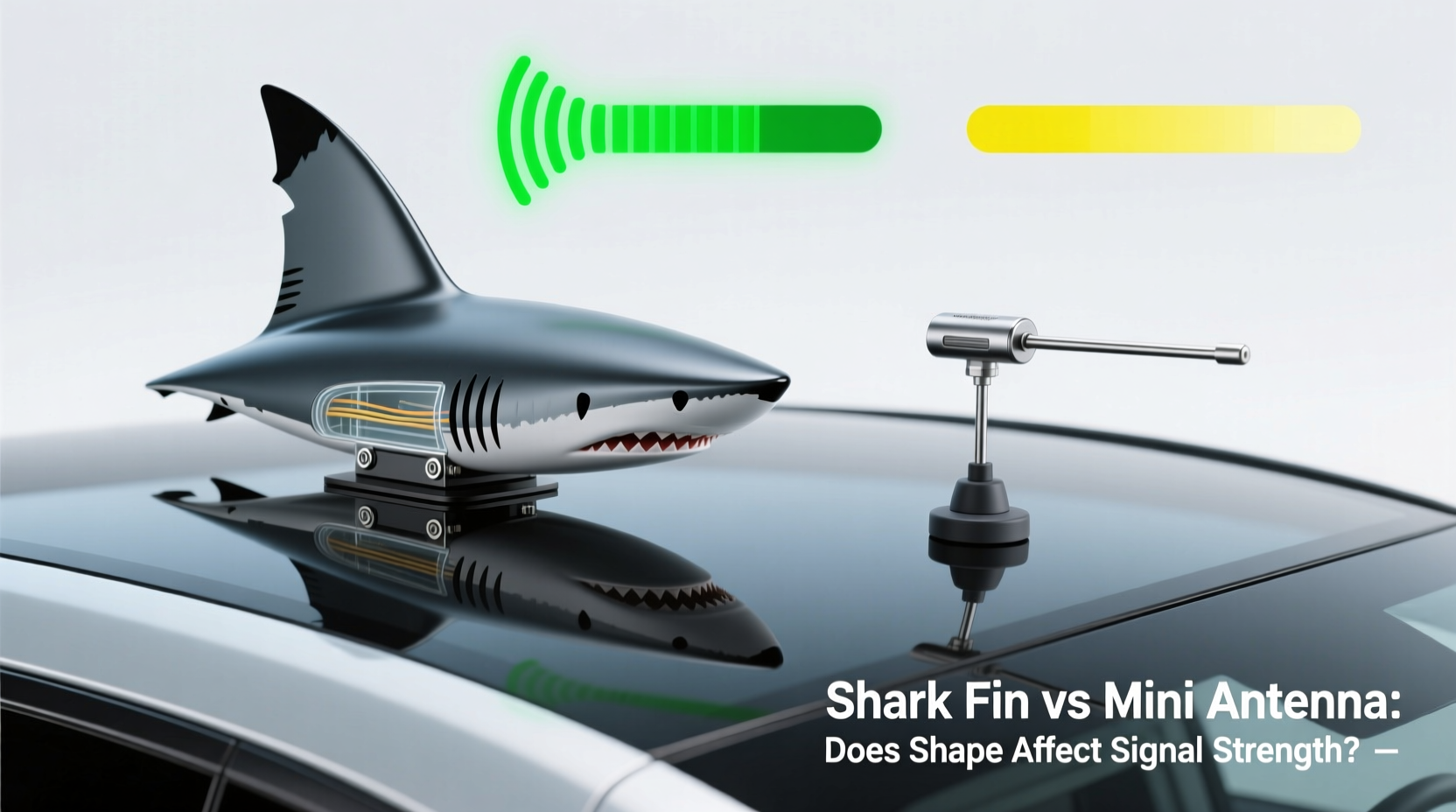
Car antennas have evolved significantly since the early days of AM radio. Traditional whip antennas were effective but prone to damage and theft. As vehicle design prioritized aerodynamics and clean lines, manufacturers began embedding antennas into glass or relocating them to less obtrusive areas. The shark fin antenna emerged in the 2000s as a stylish, multifunctional housing unit that could support multiple signals—GPS, Bluetooth, cellular, and keyless entry—all within a single module mounted on the roof.
Mini antennas, on the other hand, are even more discreet. Often embedded in rear windows, side pillars, or under bumpers, they rely on printed circuitry or thin film technology rather than metallic rods. These designs prioritize minimalism and integration over visibility.
Tip: Signal quality depends more on antenna placement and grounding than sheer size or shape.How Antenna Shape Influences Performance
At first glance, the shark fin appears superior due to its prominent position and larger surface area. But shape alone doesn't determine effectiveness. What matters most is how well the antenna captures electromagnetic waves across different frequencies. Here's where physics meets practical engineering:
- Resonance and Wavelength: Antennas perform best when their physical dimensions match the wavelength of the target frequency. For FM radio (~88–108 MHz), an ideal quarter-wave antenna is about 75 cm tall—close to traditional whip lengths. Shark fins are much shorter, so they use internal tuning circuits to compensate.
- Directionality: Whip antennas are omnidirectional, receiving signals equally from all directions. Shark fins and mini antennas may be slightly directional depending on internal element layout, which can affect reception in hilly or urban areas.
- Ground Plane Effect: Metal roofs act as reflectors, improving signal capture. Shark fins benefit from being centrally mounted on large metal surfaces, while mini antennas placed near edges or plastic panels may suffer reduced efficiency.
“Antenna form follows function—but in modern cars, function is distributed. A shark fin isn’t inherently stronger; it’s smarter in how it integrates multiple systems.” — Dr. Alan Reeves, RF Systems Engineer at Automotive Connectivity Labs
Shark Fin vs Mini Antenna: A Direct Comparison
| Feature | Shark Fin Antenna | Mini Antenna |
|---|---|---|
| Visibility & Design | Prominent, modern look | Nearly invisible |
| Signal Coverage (FM/AM) | Good to excellent (with tuning) | Fair to good (varies by location) |
| GPS Accuracy | High (central roof placement) | Moderate (can be obstructed) |
| Multifunction Support | Yes (GPS, cellular, keyless, DAB+) | Limited (often single-purpose) |
| Durability | Robust, but vulnerable to impact | Protected, but hard to replace |
| Aftermarket Upgrade Ease | Moderate (standardized mounts) | Difficult (integrated systems) |
Real-World Example: Urban Commuter vs Rural Driver
Consider two drivers: Maria commutes daily through a dense city with tall buildings and frequent tunnel passages. Her SUV has a factory-installed shark fin antenna handling GPS navigation, HD Radio, and Wi-Fi hotspot functions. Despite signal shadows from skyscrapers, the shark fin maintains stable connectivity thanks to its elevated position and multi-element design that supports diversity reception (using multiple internal antennas to reduce dropouts).
Meanwhile, Tom drives a compact hatchback in rural Montana. His car uses a mini antenna embedded in the rear windshield. While AM/FM reception is adequate near towns, he experiences GPS drift and spotty Bluetooth streaming in remote valleys. The mini antenna struggles due to poor grounding on the glass surface and lack of redundancy in weak-signal zones.
This contrast shows that environment and usage patterns heavily influence which antenna type performs better—even if both are technically “modern” solutions.
Key Factors That Matter More Than Shape
While shape affects aerodynamics and visual appeal, several underlying factors have greater impact on actual signal strength:
- Placement: Center-mounted roof antennas outperform those near edges or behind metal structures.
- Grounding: Solid electrical connection to the vehicle chassis improves signal reflection and reduces noise.
- Internal Circuitry: Active amplifiers and impedance-matching networks can boost weak signals regardless of size.
- Frequency Band Support: Some mini antennas only handle FM, while shark fins may support LTE, 5G, and satellite radio.
- Integration with Head Unit: Modern infotainment systems process signals digitally, allowing software-based enhancements like error correction and adaptive filtering.
Checklist: Choosing the Right Antenna for Your Needs
- ✅ Assess your primary use: city driving, off-road, long-distance travel?
- ✅ Determine required signals: AM/FM, GPS, satellite radio, cellular data?
- ✅ Check OEM integration: Can you add external modules without voiding warranty?
- ✅ Evaluate upgrade potential: Are connectors standardized or proprietary?
- ✅ Consider climate: Salt, moisture, and temperature swings affect exposed components.
FAQ: Common Questions About Car Antennas
Do shark fin antennas improve GPS accuracy?
Yes, generally. Their central roof location provides unobstructed sky visibility, reducing multipath interference from buildings or terrain. Many also include dedicated GPS patches with low-noise amplifiers for faster lock-on times.
Can I replace a mini antenna with a shark fin?
Possible, but not always practical. Retrofitting requires drilling, proper grounding, and potentially adding signal combiners if multiple bands are involved. Aftermarket kits exist for popular models, but professional installation is recommended.
Are smaller antennas worse for reception?
Not necessarily. Advances in materials and signal processing allow compact antennas to perform nearly as well as larger ones in strong-signal areas. However, in fringe zones, larger or externally mounted options still hold an advantage.
Conclusion: Shape Matters Less Than You Think—But Context Is Key
The debate between shark fin and mini antennas ultimately comes down to application, not just appearance. While shark fins offer superior integration, placement, and multi-band support, mini antennas serve well in vehicles where subtlety and cost-efficiency take priority. The shape itself doesn’t dictate performance—it’s the engineering inside and the context of use that make the difference.
If you're shopping for a new car, consider what connectivity features matter most: seamless navigation, reliable hands-free calling, or uninterrupted music streaming. Look beyond the silhouette on the roof and examine what systems the antenna supports. For older vehicles, aftermarket upgrades can bridge gaps left by outdated or minimalist designs.
🚀 Ready to optimize your car’s signal strength? Start by testing reception in your regular routes, then explore compatible upgrades. Share your experience or ask questions in the comments—your insight could help others find the perfect balance between form and function.