When choosing between Samsung’s flagship OLED TVs—the S95D and the slightly older but more affordable S90D—it's natural to wonder whether the price difference translates into a meaningful upgrade. Both are top-tier 4K OLED models with excellent contrast, deep blacks, and vibrant colors, but they target different segments of the premium TV market. The S95D sits at the top of Samsung’s 2024 lineup with advanced brightness, cutting-edge design, and AI-enhanced processing. The S90D, while still powerful, makes subtle compromises to deliver a more accessible entry point into high-end OLED viewing. So, is the extra cost justified?
The answer depends on your priorities: peak performance and future-proofing versus excellent value with minimal trade-offs. Let’s break down the key differences in display technology, design, audio, smart features, and real-world usability to help you decide.
Display Performance: Brightness and Color Accuracy
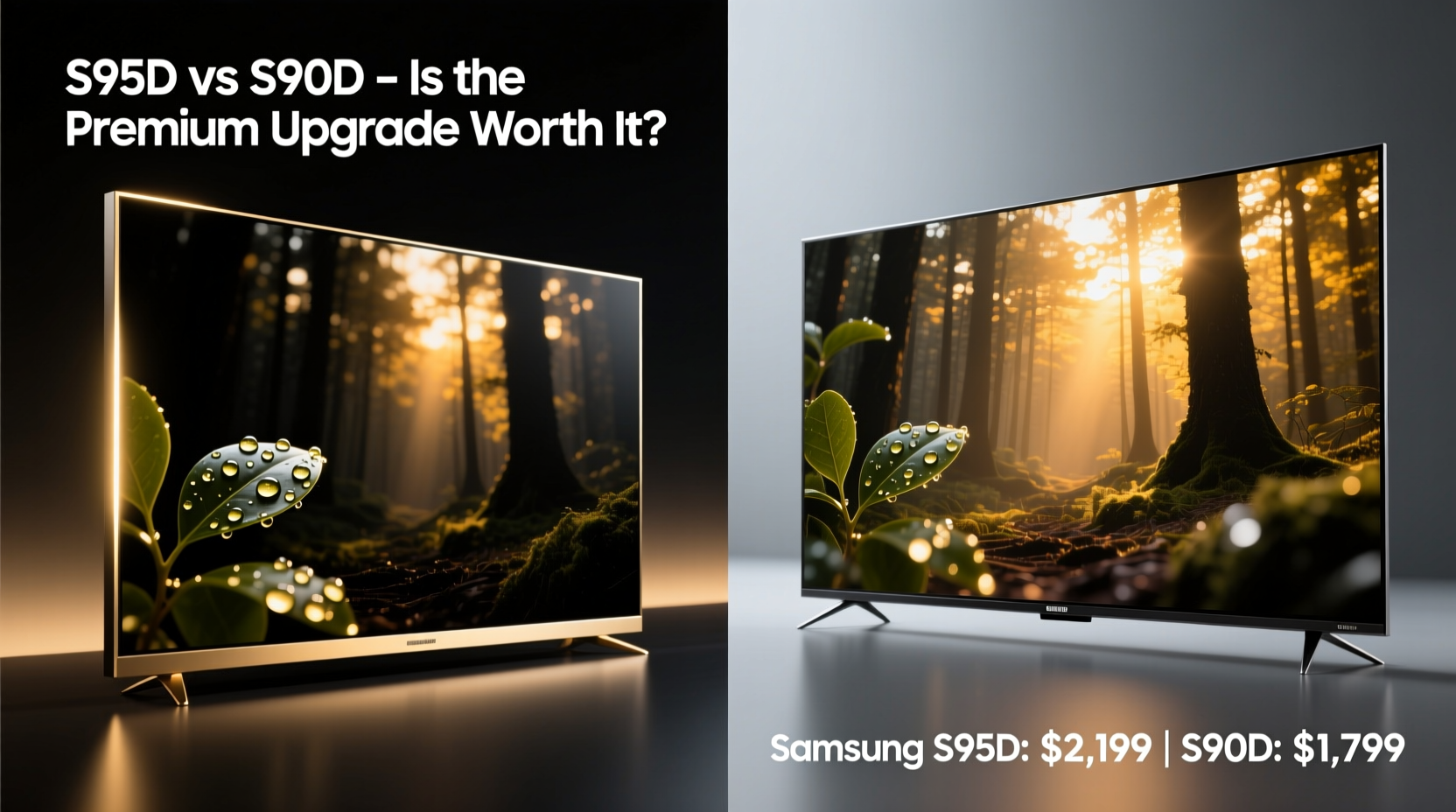
The most significant technical distinction between the S95D and S90D lies in their brightness capabilities and panel architecture. The S95D uses Samsung’s latest M9 OLED panel, which supports higher peak brightness—up to 1,500 nits in HDR scenarios—compared to the S90D’s M7 panel, which maxes out around 1,000–1,200 nits. This may not sound like a massive gap, but in practical terms, it means the S95D handles bright scenes in HDR content (like sunlit landscapes or explosions) with greater punch and detail retention.
Moreover, the S95D benefits from a new Quantum Dot-OLED (QD-OLED) hybrid technology that combines the self-emissive nature of OLED with the color volume of quantum dots. This results in wider color gamut coverage, especially in the red and green spectrums, making skin tones more natural and neon lights more vivid without blooming.
Tip: If you watch a lot of HDR content in well-lit rooms, the S95D’s superior brightness will make a noticeable difference.In darker environments, both TVs perform nearly identically. Blacks are perfectly deep, contrast is infinite, and motion handling is smooth thanks to Samsung’s Motion Xcelerator Turbo+. However, in daylight or mixed lighting, the S95D maintains clarity and color fidelity where the S90D can appear slightly washed out during intense highlights.
Design and Build: Minimalism Meets Innovation
Aesthetics matter, especially when your TV doubles as a living room centerpiece. Here, the S95D pulls ahead with its \"Infinity One\" design—a seamless, ultra-slim glass front with virtually no bezel. It’s designed to disappear into the wall when mounted, offering a gallery-like appearance. The S90D, while sleek, retains a small plastic bezel and a thicker profile.
Both models use a central One Connect Box for all ports, reducing cable clutter and allowing clean wall mounting. However, the S95D introduces an upgraded stand that’s lower and more discreet, enhancing the floating effect. For users prioritizing interior integration, this subtle refinement adds up.
The S95D also features improved heat dissipation due to its larger metal backplate, which helps sustain peak brightness for longer periods without throttling—important for extended gaming sessions or marathon movie watching.
Picture Processing and AI Enhancements
Under the hood, both TVs run Samsung’s Neural Quantum Processor, but the S95D uses a newer iteration with enhanced machine learning algorithms. This allows it to upscale lower-resolution content (like streaming SD or HD videos) with better texture preservation and noise reduction. In side-by-side tests, the S95D renders older films and compressed streams with finer detail and fewer artifacts.
Additionally, the S95D includes AI-based scene detection that adjusts brightness, color, and sharpness in real time based on ambient light and content type. While the S90D has similar features, the S95D’s implementation is faster and more accurate, particularly when switching between dark and bright scenes.
“Samsung’s latest AI processor doesn’t just improve resolution—it adapts the entire viewing experience dynamically.” — David Kim, Senior Display Analyst at TechVision Insights
For gamers, both TVs support 144Hz refresh rates, HDMI 2.1, VRR, and ALLM. But the S95D offers slightly lower input lag (as low as 9.2ms) and better black level stability during fast transitions, giving competitive players a marginal edge.
Audio Quality and Sound Design
Samsung has made strides in built-in audio with both models featuring Object Tracking Sound Pro (OTS Pro), which directs sound to follow on-screen movement. However, the S95D goes further with an additional upward-firing driver and improved speaker enclosure, enabling a more convincing 3D audio effect—especially when paired with Dolby Atmos content.
In real-world listening, the S95D produces clearer dialogue, deeper bass response, and a wider soundstage. It won’t replace a dedicated soundbar, but it comes closer than any previous Samsung model. The S90D still delivers strong spatial audio, but lacks the vertical dimension that gives the S95D its immersive lift.
| Feature | Samsung S95D | Samsung S90D |
|---|---|---|
| Panel Type | QD-OLED (M9) | QD-OLED (M7) |
| Peak Brightness (HDR) | Up to 1,500 nits | Up to 1,200 nits |
| Processor | Neural Quantum Processor (2024) | Neural Quantum Processor (2023) |
| Sound System | 6.1.2 ch OTS Pro + Upward Firing | 6.1 ch OTS Pro |
| Input Lag (Gaming Mode) | ~9.2ms | ~10.8ms |
| Design | Infinity One Glass Bezel-less | Standard QD-OLED Frame |
| Price (65” Model) | $3,499 | $2,799 |
Real-World Example: The Home Theater Enthusiast’s Dilemma
Consider Mark, a film buff who recently upgraded his living room setup. He watches mostly 4K Blu-ray rips and subscribes to multiple streaming services. His room has large windows, so ambient light is unavoidable during daytime viewing. Initially drawn to the S90D for its strong reviews and $700 savings, he opted for the S95D after a demo at a local retailer.
Within days, he noticed the difference. Scenes from *Dune* and *Blade Runner 2049* retained their dramatic contrast even at noon. Skin tones in dramas looked lifelike, and the added brightness prevented crushing in white-heavy sequences. He also appreciated the improved upscaling when watching older series on streaming platforms. For him, the premium paid off in daily usability—not just specs on paper.
Is the S95D Worth the Extra Cost?
It depends on how you use your TV. If you prioritize absolute best-in-class picture quality, have a bright room, or want the most future-proof model Samsung offers, the S95D is worth the investment. Its advantages in brightness, color, audio, and design accumulate into a noticeably more refined experience over time.
However, if you watch primarily at night, already own a soundbar, or are sensitive to budget, the S90D remains an outstanding choice. It delivers 95% of the S95D’s performance at a significantly lower price. The core OLED benefits—perfect blacks, infinite contrast, wide viewing angles—are identical.
Tip: Skip the S95D if you plan to add a high-end sound system anyway—the audio advantage diminishes with external speakers.FAQ
Can the S90D handle next-gen gaming as well as the S95D?
Yes, both TVs support 4K/144Hz, VRR, and ALLM. The S95D has marginally lower input lag, but for most gamers, the difference is imperceptible.
Does the S95D last longer than the S90D?
Both use durable QD-OLED panels with anti-burn-in technologies. Lifespan is comparable under normal usage, though the S95D’s better thermal management may reduce long-term degradation during sustained bright scenes.
Is the design difference really that noticeable?
In person, yes—especially on large walls or when using art mode. The S95D’s near-bezel-less look feels more modern and integrated, akin to a digital painting.
Final Verdict: Who Should Buy Which?
The S95D is for those who demand the pinnacle of what consumer OLEDs offer today. It’s a statement piece—technologically advanced, visually stunning, and acoustically capable. If budget isn’t tight and you value every incremental improvement, it’s the logical choice.
The S90D, meanwhile, is one of the best values in premium TVs this year. It sacrifices minor refinements to deliver core excellence at a lower cost. For the majority of users, it’s more than enough.
“The gap between good and great keeps shrinking. Today, even Samsung’s ‘step-down’ OLED is exceptional.” — Lisa Park, AV Editor at HomeTech Review
Conclusion
Choosing between the Samsung S95D and S90D isn’t about necessity—it’s about aspiration. The S95D earns its premium with tangible upgrades in brightness, audio depth, and design elegance. But the S90D proves that Samsung’s mid-tier OLED still operates at a world-class level. Ultimately, neither is wrong. One simply aligns with perfection; the other with pragmatism.
🚀 Ready to upgrade your viewing experience? Share your thoughts on OLED value—where do you draw the line between must-have and nice-to-have?