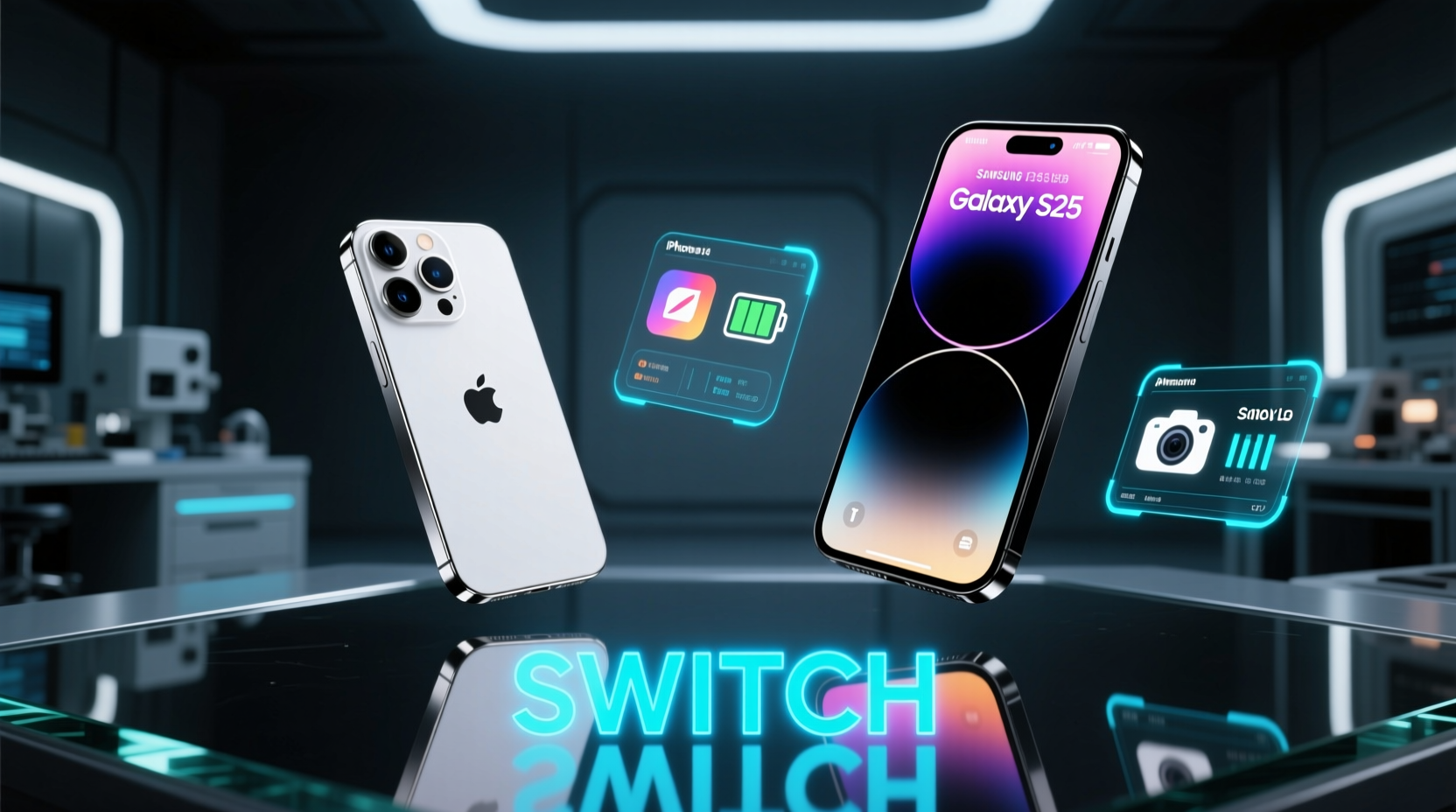
For years, the smartphone divide has been clear: Apple users on one side, Samsung loyalists on the other. But with the release of the Samsung Galaxy S25 and the continued dominance of the iPhone 14 in everyday use, more people are reconsidering their allegiance. If you've spent years in the iOS ecosystem but are now eyeing the latest Galaxy flagship, you're not alone. The question isn't just about specs—it's about lifestyle, longevity, ecosystem integration, and whether switching now makes sense.
The iPhone 14, while no longer Apple’s newest model, remains a powerful daily driver with strong software support, excellent camera performance, and seamless integration across Apple devices. Meanwhile, the Galaxy S25 represents Samsung’s most refined Android experience yet—featuring AI enhancements, superior hardware customization, and cutting-edge display technology. So, is this the moment to cross the digital aisle?
Performance and Hardware: Power vs Longevity
The Galaxy S25 is expected to launch with Qualcomm’s Snapdragon 8 Gen 3 (or a next-gen variant), offering top-tier processing power, improved thermal efficiency, and advanced AI capabilities. With up to 12GB of RAM and storage options reaching 1TB, the S25 is built for multitaskers, creators, and power users who demand responsiveness and future-proofing.
In contrast, the iPhone 14 runs on Apple’s A15 Bionic chip—a processor still regarded as exceptionally efficient. While it lacks the raw benchmark numbers of newer Android chips, iOS optimization ensures smooth performance even under heavy loads. Apps open quickly, background tasks are managed efficiently, and battery life remains consistent over time.
Tip: If you frequently edit videos, run multiple apps, or use AR tools, the S25’s superior multitasking may justify the switch.However, where the iPhone excels is long-term software support. Apple guarantees five to six years of iOS updates, meaning an iPhone 14 purchased in 2022 could still receive updates into 2028. Samsung has improved its update policy, now offering seven years of OS and security updates for the Galaxy S25—finally closing the gap. This change alone makes switching far more appealing than it was even two years ago.
Camera Comparison: Real-World Results Over Specs
Both phones deliver exceptional photo quality, but they approach photography differently. The iPhone 14 captures natural color tones, excellent dynamic range, and consistent low-light performance thanks to computational photography fine-tuned over generations. Its video recording—especially Dolby Vision HDR at 4K—is unmatched in the industry.
The Galaxy S25, meanwhile, features a triple-lens setup with a 200MP main sensor, advanced zoom capabilities (up to 10x optical and 100x digital), and AI-powered scene optimization. In daylight, photos often appear sharper and more vivid. Nightography modes have improved dramatically, reducing noise and enhancing detail without oversaturation.
“Android flagships now match or exceed iPhones in still image resolution, but Apple still leads in video consistency and skin tone accuracy.” — David Lin, Mobile Imaging Analyst at DXOMARK
For social media creators or travelers who value zoom flexibility and high-resolution output, the S25 offers tangible advantages. But if your priority is effortless point-and-shoot reliability—especially for family moments or quick videos—the iPhone 14 remains remarkably dependable.
Ecosystem Integration: Can You Leave Apple Behind?
This is often the biggest hurdle for switchers. If you own a MacBook, iPad, AirPods, or Apple Watch, leaving iOS means sacrificing deep integration. Features like Handoff, Universal Clipboard, iMessage syncing, and AirDrop create a frictionless experience that Android still struggles to replicate.
Samsung has made strides with its “Seamless Ecosystem” strategy. With Smart Switch, you can transfer data easily from iPhone to Galaxy. Once set up, the S25 works well with Windows PCs via Link to Windows, supports multi-device workflows, and integrates with Galaxy Buds and Watches effectively. However, there’s no true equivalent to iMessage or FaceTime—though Google Messages with RCS and third-party apps like WhatsApp help bridge the gap.
| Feature | iPhone 14 + Apple Ecosystem | Galaxy S25 + Samsung/Android |
|---|---|---|
| File Sharing | AirDrop (fast, secure) | Quick Share (cross-platform) |
| Messaging | iMessage (end-to-end encrypted) | RCS via Google Messages |
| Device Sync | Handoff, iCloud, Continuity | Smart View, Multi Control |
| Wearables | Apple Watch deep integration | Galaxy Watch optimized pairing |
| Laptop Integration | Universal Control with Mac | Link to Windows (limited) |
If you’re deeply embedded in Apple’s world, switching requires rethinking how you interact with your devices daily. But if you’re open to new workflows—or already use non-Apple computers—the transition is smoother than ever.
Software Experience: Customization vs Simplicity
One of Android’s greatest strengths is personalization. On the Galaxy S25, you can customize everything: app icons, home screen layouts, themes, default apps, and even system-wide navigation gestures. Samsung’s One UI 6.1 (based on Android 14) introduces enhanced privacy controls, better dark mode scaling, and improved accessibility features.
iOS, by contrast, prioritizes simplicity and consistency. The interface is clean, predictable, and easy to navigate—even for less tech-savvy users. While recent versions allow some customization (widgets, App Library), it remains more restrictive than Android.
For users frustrated by iOS limitations—such as inability to change the default browser or remove pre-installed apps—switching to the S25 feels liberating. You can sideload apps, use alternative app stores (with caution), and automate tasks using Bixby Routines or third-party tools like Tasker.
Tip: Use Samsung DeX to turn your S25 into a desktop-like experience when connected to a monitor.Real Example: Why Sarah Switched After 10 Years
Sarah, a graphic designer from Austin, used iPhones exclusively from the iPhone 4S through the iPhone 14. She loved the camera and her iPad-Mac-iPhone workflow. But after receiving a Galaxy S24 Ultra as a loaner device for a project, she noticed something unexpected: the S Pen integration allowed her to sketch directly on her phone, and DeX let her edit designs on a large monitor without opening her laptop.
She tested the waters by transferring her data to a demo S25. Using Microsoft 365 and Adobe Creative Cloud across platforms minimized disruption. While she missed iMessage at first, switching to WhatsApp and encouraging close contacts to follow helped. After three months, she sold her iPhone and bought a Galaxy Watch 6. “I didn’t realize how much I wanted control over my device until I had it,” she said. “The learning curve was worth the freedom.”
Frequently Asked Questions
Will my iCloud photos transfer to Samsung?
Yes. Use the Google Photos app on your iPhone to back up your library, then restore it on your Galaxy S25. Alternatively, Samsung’s Smart Switch can migrate photos directly, though it may not preserve albums perfectly.
Can I use AirPods with the Galaxy S25?
Absolutely. AirPods work via Bluetooth with any Android phone. You’ll lose features like automatic switching and spatial audio with head tracking, but basic playback, calls, and Siri-free voice assistant access remain functional.
Is the Galaxy S25 more future-proof than the iPhone 14?
In hardware terms, yes—the S25 has newer components and higher expandability. In software longevity, both now offer around seven years of updates, making them equally future-proof. However, resale value tends to hold better for iPhones.
Final Verdict: Should You Switch?
The answer depends on what you value most. If you prioritize ecosystem cohesion, video quality, and long-term stability, sticking with the iPhone 14 (or upgrading to a newer iPhone) is still a smart choice. But if you crave customization, cutting-edge hardware, multitasking flexibility, and a truly modern Android experience, the Galaxy S25 makes switching not only possible—but compelling.
Samsung has addressed many of the historical weaknesses that kept Android users from defecting to Apple: inconsistent updates, bloated software, poor integration. Now, for the first time, the balance has shifted. The S25 isn’t just competitive; in several key areas, it surpasses what the iPhone 14 offers.
“The era of Android playing catch-up is over. We’re now seeing feature divergence, not deficiency.” — Jan Dawson, Chief Analyst at Jackdaw Research
Your Move: Take the Leap or Stay Put?
If you’ve been curious about Android, now is the best time to explore. Try the Galaxy S25 for 14 days using Samsung’s trial program. Migrate your essential data, test core workflows, and see how it fits your rhythm. You might discover that the grass isn’t just greener—it’s more customizable, powerful, and adaptable than you thought.
🚀 Ready to break free from iOS? Rent or test a Galaxy S25 this week and experience the shift firsthand. Your next phone shouldn’t just work—it should empower you.