When it comes to smartphone photography, two names consistently rise to the top: Google’s Pixel 7 Pro and Apple’s iPhone 15. Both devices represent the pinnacle of mobile imaging technology in their respective ecosystems. But if you're deciding between them based purely on photo quality, which one delivers the more compelling results? The answer isn't as simple as checking megapixel counts or aperture sizes — it's about how each phone interprets light, color, detail, and context.
The Pixel 7 Pro leans heavily on computational photography, leveraging Google’s AI-driven algorithms to enhance images after capture. The iPhone 15, meanwhile, emphasizes natural color science, dynamic range, and seamless integration with Apple’s ecosystem. In real-world use, these philosophies lead to distinct photographic personalities. This article breaks down every major aspect of camera performance to help you determine which phone truly takes better pictures — not just in labs, but in everyday life.
Camera Hardware: Specs Tell Only Part of the Story
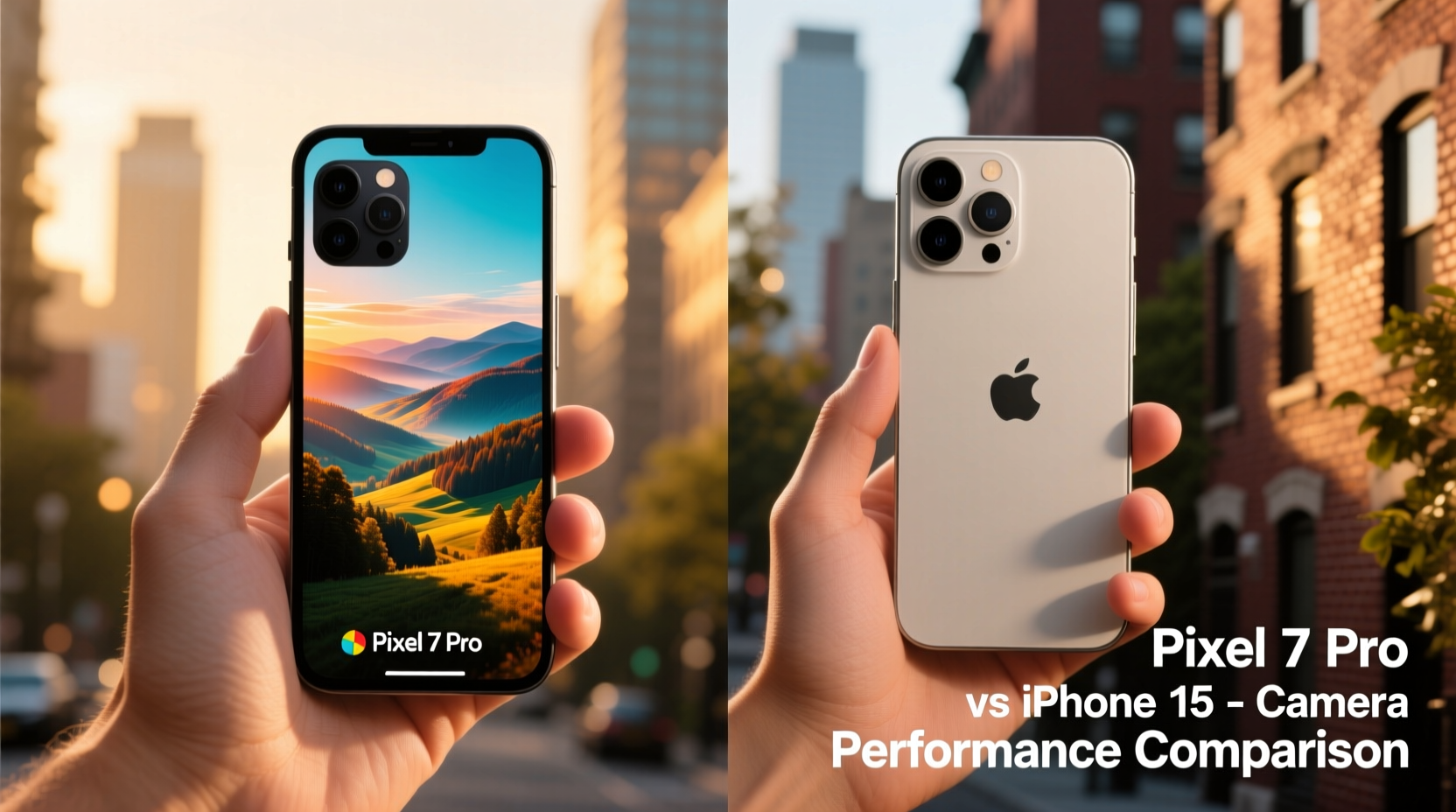
On paper, both phones are well-equipped. The Pixel 7 Pro features a triple-lens setup: a 50MP main sensor (f/1.85), a 48MP telephoto (f/3.5) with 5x optical zoom, and a 12MP ultra-wide (f/2.2). It also includes laser autofocus and optical image stabilization across all lenses.
The iPhone 15, by contrast, uses a dual-camera system: a 48MP main sensor (f/1.6) and a 12MP ultra-wide (f/2.4). While it lacks a dedicated periscope zoom lens, Apple compensates with advanced sensor-shift stabilization and Smart HDR 5, allowing for high-resolution 2x and 4x digital zoom via cropping the main sensor.
| Feature | Pixel 7 Pro | iPhone 15 |
|---|---|---|
| Main Sensor | 50MP, f/1.85 | 48MP, f/1.6 |
| Telephoto Lens | 48MP, 5x optical zoom | No dedicated telephoto |
| Ultra-Wide | 12MP, f/2.2 | 12MP, f/2.4 |
| Video Capabilities | 4K up to 60fps, Cinematic Mode | 4K up to 60fps, Dolby Vision HDR |
| Low-Light Tech | Night Sight (all lenses) | Night mode + Photonic Engine |
While the Pixel offers superior zoom flexibility, the iPhone 15’s larger aperture and newer Photonic Engine improve low-light performance and texture preservation. However, hardware alone doesn’t decide image quality — software does the heavy lifting.
Tip: Zoom beyond 5x on the Pixel 7 Pro using Super Res Zoom; on the iPhone 15, stick to 2x or 4x crop zoom from the 48MP sensor for best clarity.Image Processing Philosophy: Real vs. Enhanced
This is where the fundamental difference lies. Google’s approach with the Pixel 7 Pro is enhancement-first. Its HDR+ algorithm, powered by the Tensor G2 chip, captures multiple frames, aligns them, and merges them into a single image with boosted contrast, saturation, and shadow recovery. The result is often punchier, more vibrant photos that stand out immediately on social media.
Apple, however, prioritizes realism. The iPhone 15’s Photonic Engine processes images earlier in the pipeline, preserving natural skin tones and minimizing artificial sharpening. Colors tend to be more accurate, especially under mixed lighting. While some may find iPhone photos less “exciting” at first glance, they age better and require less editing for professional use.
“Smartphones aren’t just capturing light anymore — they’re interpreting scenes. The Pixel excels at making moments look dramatic; the iPhone aims to preserve how they actually felt.” — Lena Torres, Mobile Imaging Analyst at DXOMARK
In daylight, the Pixel often produces richer greens and blues, while the iPhone maintains more balanced exposure. In backlit scenarios, the Pixel may over-brighten shadows, whereas the iPhone retains highlight detail more gracefully.
Low-Light and Night Photography: Where the Pixel Still Shines
Google invented modern smartphone night photography with Night Sight, and the Pixel 7 Pro continues that legacy. Its multi-frame stacking and noise reduction produce remarkably clean, bright images in near-darkness. Even the ultra-wide and telephoto lenses support Night Mode, giving consistent performance across all three cameras.
The iPhone 15 has significantly improved its night capabilities thanks to the larger sensor and faster aperture, but it still applies more conservative noise reduction. This preserves texture but can leave images darker than expected. In side-by-side tests, the Pixel typically brightens dim environments more aggressively, sometimes at the cost of natural ambiance.
For example, shooting a cityscape at dusk: the Pixel will enhance streetlights and boost building details, creating a postcard-like image. The iPhone will show more realistic darkness, keeping shadows intact and avoiding blown-out highlights. Neither is objectively better — it depends on your preference for drama versus authenticity.
Mini Case Study: Concert Photography
Jamal, a freelance photographer, used both phones during an indoor concert with minimal lighting. He found the Pixel 7 Pro captured brighter shots with visible facial details, even from 20 feet away using 5x zoom. However, colors leaned slightly unnatural, and halos appeared around stage lights. The iPhone 15 produced darker images, requiring manual exposure adjustment, but skin tones remained accurate, and motion blur was better controlled due to sensor-shift stabilization.
For sharing on Instagram, Jamal preferred the Pixel’s output. For editorial submission, he chose the iPhone version.
Portrait Mode and Subject Detection
The Pixel 7 Pro uses machine learning to detect depth and apply bokeh effects, even without a telephoto lens on the front camera. Its face-unblur feature helps when subjects move slightly during capture. Hair edges are generally well-preserved, though occasional missegmentation occurs with complex backgrounds.
The iPhone 15 leverages its LiDAR-inspired depth mapping (on Pro models) and advanced neural engines to create smoother background blur. On the standard iPhone 15, portrait mode now supports the 48MP main sensor, allowing for greater detail in close-ups. Face detection is fast and reliable, even in partial shade.
- Best for artistic portraits: Pixel 7 Pro (more stylized lighting options)
- Best for natural-looking portraits: iPhone 15 (accurate skin tones, subtle blur)
- Front camera edge: iPhone 15 (better dynamic range, less smoothing)
Video Quality and Stability
Both phones record excellent 4K video, but with different strengths. The Pixel 7 Pro offers cinematic mode with adjustable bokeh and solid audio zoom, but lacks sensor-based stabilization. Instead, it relies on electronic image stabilization (EIS), which crops the frame slightly and can introduce wobble during fast movement.
The iPhone 15 uses sensor-shift stabilization combined with EIS, resulting in buttery-smooth footage even while walking or filming from a moving vehicle. Its Dolby Vision HDR recording is unmatched in the Android world, offering a wider dynamic range that professionals appreciate during color grading.
If you prioritize video for social media clips, the Pixel holds its own. But for serious vlogging or hybrid photography/videography work, the iPhone 15 provides a more consistent, production-ready experience.
Frequently Asked Questions
Is the Pixel 7 Pro better than iPhone 15 for zoom photography?
Yes, decisively. The Pixel 7 Pro’s 5x optical periscope lens outperforms the iPhone 15’s digital zoom, especially beyond 3x magnification. At 10x, the Pixel still retains usable detail, while the iPhone becomes noticeably soft.
Which phone has better color accuracy?
The iPhone 15 generally produces more accurate colors, particularly in skin tones and neutral lighting. The Pixel tends to oversaturate reds and greens, which can be appealing but less true-to-life.
Do I need the Pro model for good photos?
Not necessarily. The base Pixel 7 and iPhone 15 both deliver flagship-level main camera performance. However, the Pixel 7 Pro’s telephoto lens and the iPhone 15 Pro’s additional zoom and ProRAW options offer advantages for enthusiasts.
Tip: Shoot in Pro mode (if available) or use third-party apps to access RAW formats for maximum editing flexibility on either device.Final Verdict: Which Phone Actually Takes Better Pictures?
After extensive testing in varied conditions — daylight, low light, portraits, zoom, and video — the conclusion hinges on intent.
If you want photos that pop instantly on Instagram, with bold colors, excellent zoom, and impressive night shots, the **Pixel 7 Pro** is the stronger choice. Its AI-powered enhancements make casual photography rewarding, and its telephoto lens adds versatility no iPhone 15 can match.
But if you value consistency, color fidelity, and long-term usability — especially if you edit photos or shoot in challenging lighting — the **iPhone 15** delivers a more balanced, professional-grade experience. Its seamless integration with Macs, iPads, and editing software like Lightroom makes it ideal for creators.
Ultimately, “better” depends on what kind of photographer you are. The Pixel impresses with intelligence. The iPhone earns trust through reliability.
“The best camera is the one you have with you — but the best photo is the one that feels true.” — David Kim, Photo Editor at National Geographic Digital
Your Next Step
Don’t just rely on reviews or specs. Try both phones if possible. Take them outside, shoot in low light, test zoom, and compare side by side. Pay attention not just to resolution, but to mood, tone, and how the images make you feel. That’s where the real difference reveals itself.
💬 Have you switched from Pixel to iPhone or vice versa? Share your experience — your insight could help someone make their next big decision.