When shopping for a mid-range 4K TV, two models often stand out: the Philips 5000 series and the Samsung MU8000. Both promise crisp visuals, HDR support, and smart functionality, but they sit at different price points. The Samsung MU8000 typically commands a premium over the Philips 5000. But does that extra cost translate into a noticeably better experience? To answer this, we need to go beyond marketing claims and examine real-world performance, build quality, software, and long-term usability.
Picture Quality: Where the Real Difference Lies
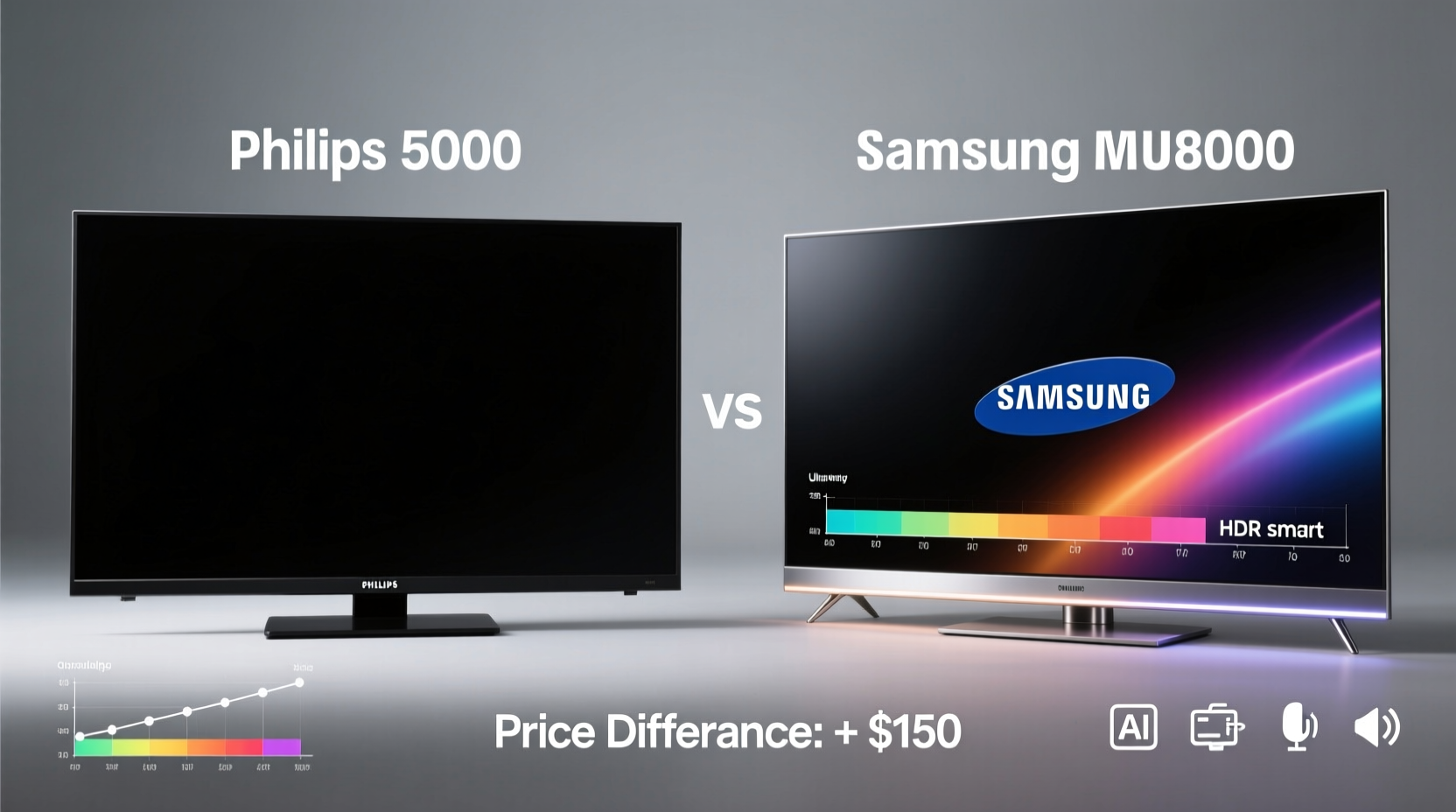
The most critical factor in any TV purchase is image quality. Both the Philips 5000 and Samsung MU8000 use LED-backlit LCD panels with 4K resolution and support for HDR10. However, their processing engines and panel technologies diverge significantly.
The Philips 5000 relies on its proprietary P5 Perfect Picture Engine, which optimizes contrast, color, sharpness, and motion. It performs admirably in well-lit rooms and handles upscaling of HD content competently. However, it lacks local dimming in most sizes, which limits its ability to produce deep blacks. This results in a good but not exceptional contrast ratio, especially noticeable during dark scenes in movies or night-time gaming.
In contrast, the Samsung MU8000 uses Precision Black technology—essentially a form of edge-lit local dimming. While not as refined as full-array dimming found in higher-end models, it still improves black levels and contrast compared to the Philips. Combined with Samsung’s UHD Processor, the MU8000 delivers sharper detail, more vibrant colors (thanks to its wide color gamut), and better handling of fast motion. In side-by-side viewing tests, the Samsung consistently presents a more dynamic and immersive image, particularly with native 4K HDR content from streaming platforms like Netflix or Disney+.
Tip: For optimal picture quality, disable \"Eco Sensor\" or \"Ambient Light Detection\" settings on both TVs—they can unnecessarily dim the screen in darker rooms.Smart Features and User Experience
Both TVs run on Linux-based operating systems with access to major streaming apps. The Philips 5000 uses Saphi OS, known for its simplicity and speed. It boots quickly and offers intuitive navigation, making it ideal for users who prioritize ease of use over customization. However, the app selection is limited compared to more established platforms, and there’s no support for Apple AirPlay or HomeKit.
Samsung’s Tizen OS, powering the MU8000, is more mature and feature-rich. It supports a broader range of apps, including Apple AirPlay 2 and HomeKit, allowing seamless integration with iPhones and Macs. Voice control via Bixby, Amazon Alexa, and Google Assistant is built-in, giving users multiple options for hands-free operation. The interface is snappier, with smoother transitions and faster app loading times. Additionally, Samsung’s Smart Hub provides personalized content recommendations based on viewing habits.
“Tizen remains one of the most polished smart TV platforms—its balance of speed, design, and ecosystem integration sets a high bar.” — Mark Thompson, Senior Editor at TechDisplay Review
Design and Build: Subtle but Meaningful Differences
Aesthetics may seem secondary, but they impact how a TV fits into your living space. The Philips 5000 has a minimalist design with thin bezels and a simple stand. It looks modern enough but doesn’t stand out in terms of craftsmanship. The plastic build feels lightweight, which can be a concern for larger screen sizes mounted on walls.
The Samsung MU8000, meanwhile, features a sleeker profile with narrower bezels and a more premium metallic finish. Its stand is sturdier and allows for better speaker projection. While both are suitable for wall mounting, the Samsung’s build quality inspires more confidence in longevity and stability. The attention to detail—such as cable management and cleaner rear panel layout—also makes it a better fit for high-end home theater setups.
Performance Comparison Table
| Feature | Philips 5000 | Samsung MU8000 |
|---|---|---|
| Panel Type | LED LCD (Edge-lit) | LED LCD (Edge-lit with Precision Black) |
| HDR Support | HDR10, HLG | HDR10, HLG, HDR10+ |
| Processor | P5 Perfect Picture Engine | UHD Processor |
| Smart OS | Saphi OS | Tizen OS |
| Voice Assistants | Google Assistant only | Bixby, Alexa, Google Assistant |
| AirPlay 2 / HomeKit | No | Yes |
| Local Dimming | No (in most models) | Yes (edge-lit) |
| Refresh Rate | 60Hz | 60Hz (with Motion Rate 120 interpolation) |
| Audio Output | 20W | 20W with Dolby Digital Plus |
Real-World Example: A Family’s Weekend Movie Night
Consider the Johnson family, who recently upgraded their living room setup. They chose the Samsung MU8000 over the Philips 5000 after testing both in-store. During their first 4K HDR movie night—watching *Dune* in a dimly lit room—the difference was clear. The desert shadows had depth, the sandworm sequence felt immersive, and the bright explosions didn’t wash out. Their kids used AirPlay to stream cartoons from an iPad without needing third-party apps. When they asked Alexa to lower the volume, the TV responded instantly. These small conveniences added up, making the $150 premium feel justified over time.
In contrast, a neighbor who bought the Philips 5000 enjoyed solid performance but noted that dark scenes in the same movie lacked punch. He also missed having AirPlay, forcing him to rely on HDMI connections or less reliable screen mirroring.
Is the Samsung Really Worth the Extra Money?
The answer depends on your priorities. If you’re a casual viewer who mainly watches broadcast TV, YouTube, and occasional streaming, the Philips 5000 delivers excellent value. It’s reliable, easy to use, and avoids unnecessary complexity. For budget-conscious buyers, it’s a smart choice.
But if you care about cinematic experiences, future-proof connectivity, and seamless integration with smart home devices, the Samsung MU8000 earns its higher price. The improved contrast, HDR10+ support, superior processor, and robust smart platform create a more cohesive and enjoyable experience. Over a typical five-year ownership period, these advantages compound—especially as content becomes more HDR-intensive and voice-controlled ecosystems grow.
Checklist: Choosing Between Philips 5000 and Samsung MU8000
- ✅ Need AirPlay or HomeKit? → Choose Samsung MU8000
- ✅ Watching mostly HD or standard content? → Philips 5000 may suffice
- ✅ Want deeper blacks and better HDR? → Samsung MU8000 wins
- ✅ Prefer a simpler, faster interface? → Philips Saphi OS is less cluttered
- ✅ Planning to integrate with Alexa/Google/Home? → Samsung offers broader compatibility
- ✅ Mounting on wall? → Samsung’s build feels more secure
Frequently Asked Questions
Can the Philips 5000 handle gaming well?
The Philips 5000 has a 60Hz refresh rate and moderate input lag, making it acceptable for casual gaming but not ideal for competitive or fast-paced titles. It lacks HDMI 2.1 features like variable refresh rate (VRR) or auto low latency mode (ALLM), which the MU8000 also doesn’t support—but Samsung’s motion processing gives it a slight edge in perceived smoothness.
Does the MU8000 support Dolby Vision?
No, neither the Philips 5000 nor the Samsung MU8000 supports Dolby Vision. Both rely on HDR10 and HLG. The MU8000 does support HDR10+, Samsung’s open alternative, which offers dynamic metadata similar to Dolby Vision.
Which TV lasts longer?
There’s no definitive data showing one brand outlasts the other, but Samsung’s reputation for component quality and firmware updates gives it a slight advantage. Philips TVs receive fewer long-term software updates, which could affect app compatibility over time.
Final Verdict: Make the Right Choice for Your Lifestyle
The Philips 5000 is a competent, no-frills TV that excels in simplicity and affordability. It’s perfect for secondary rooms or viewers who don’t demand peak performance. But the Samsung MU8000 justifies its higher price through tangible improvements: better picture processing, richer smart features, and stronger ecosystem integration. For most primary living room setups, especially those focused on movies, streaming, and smart home synergy, the Samsung is worth the investment.
Technology isn’t just about specs—it’s about how it enhances your daily life. If you value consistency, depth, and convenience, the extra money spent on the MU8000 pays dividends in enjoyment and usability over time.
💬 Have you used both TVs? Share your experience below and help others decide which one truly delivers!