In the early 2010s, smartphone photography was still finding its footing. While most manufacturers focused on slim designs and app ecosystems, Nokia took a bold detour with the Lumia 1020 — a device built around a staggering 41-megapixel camera. At the same time, Apple released the iPhone 5s, a refined flagship that emphasized speed, consistency, and ecosystem integration. Today, many look back at the Lumia 1020 with reverence, claiming its camera \"blew away\" the competition. But was it actually better than the iPhone 5s in real-world use, or is nostalgia painting an exaggerated picture?
The answer isn’t simple. It depends on how you define “better.” Was it resolution? Image quality in low light? Consistency? Usability? Each phone approached photography differently, and their strengths reflect the philosophies of their creators.
The Camera Specifications: A Stark Contrast
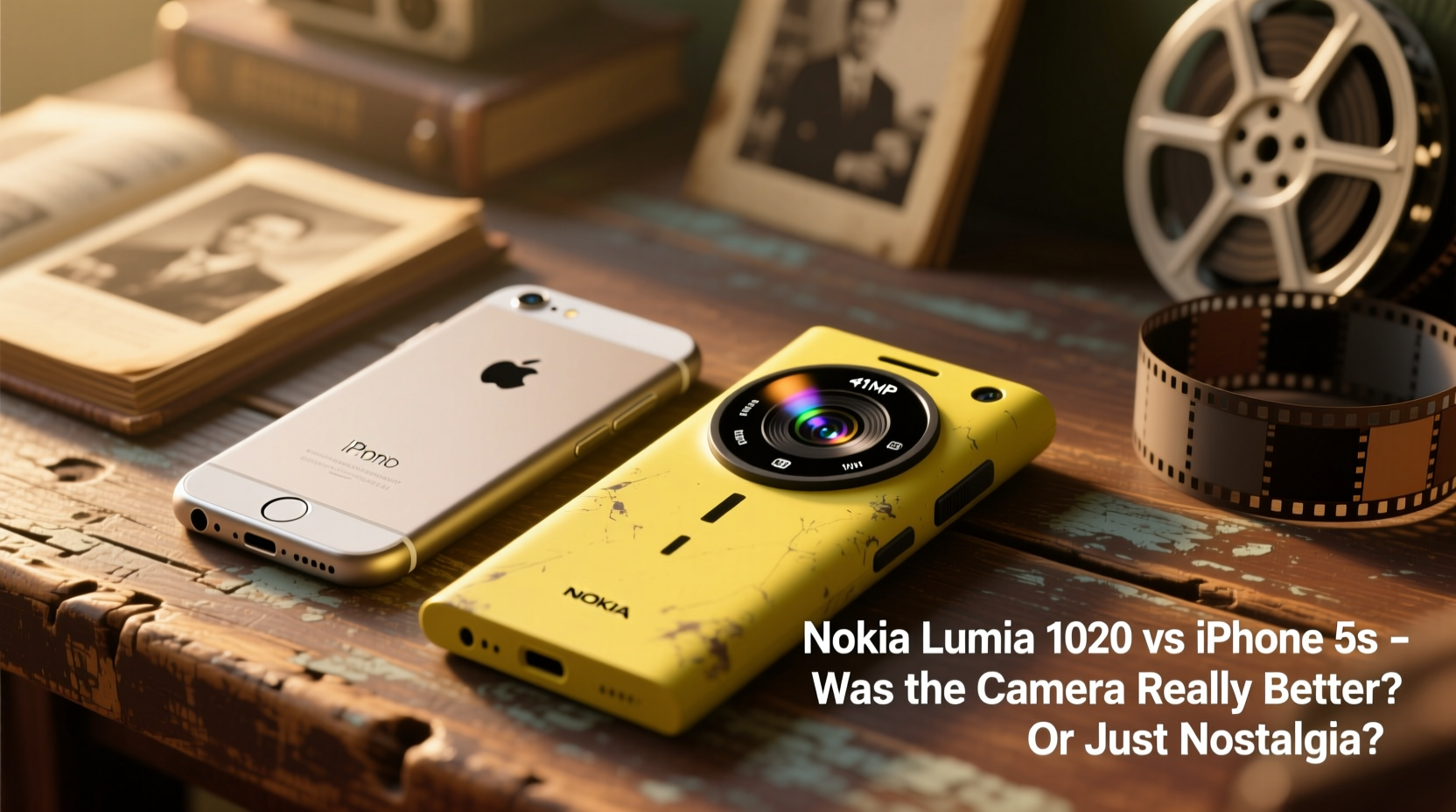
On paper, the Nokia Lumia 1020’s camera specs were nothing short of revolutionary. Its 41-megapixel sensor, paired with Carl Zeiss optics and optical image stabilization (OIS), made it an outlier in 2013. The key innovation was oversampling: combining multiple pixels into one to produce cleaner, more detailed 5MP images with exceptional dynamic range and low noise.
In contrast, the iPhone 5s featured an 8-megapixel iSight camera — modest by megapixel count but backed by Apple’s signature software optimization. It used larger pixels (1.5µm) compared to the Lumia’s smaller ones (though spread across a much larger sensor), and introduced dual-LED flash with white and amber tones for more natural skin color rendering.
“Megapixels aren’t everything. Pixel size, processing, and software matter just as much.” — Dr. Janice Chen, Imaging Scientist at MIT Media Lab
| Feature | Nokia Lumia 1020 | iPhone 5s |
|---|---|---|
| Rear Camera | 41 MP, 1/1.5\", f/2.0, OIS | 8 MP, 1/3.2\", f/2.2, no OIS |
| Front Camera | 1.2 MP | 1.2 MP |
| Video Recording | 1080p at 30fps, stereo audio | 1080p at 30fps, slow motion 120fps |
| Image Processing | Nokia PureView, oversampling | Apple A7 ISP, Smart HDR (early version) |
| Zoom Capability | Digital zoom up to 4x lossless (via cropping) | Basic digital zoom |
Real-World Performance: Where Each Phone Shined
In daylight, the Lumia 1020 could capture breathtaking detail. Its oversampled 5MP images retained far more texture and color accuracy than the iPhone 5s. Zoomed crops from a single shot often rivaled what other phones produced at full frame. For enthusiasts who wanted to crop heavily or print large, the Lumia offered unmatched flexibility.
However, the iPhone 5s excelled in consistency and usability. Its photos had balanced exposure, accurate colors, and minimal processing artifacts. Apple’s image signal processor (ISP) prioritized pleasing results over technical specs, making it ideal for social sharing. The iPhone also handled mixed lighting more gracefully, avoiding the blown-out highlights or crushed shadows sometimes seen on the Lumia.
In low-light conditions, the story becomes nuanced. The Lumia’s OIS allowed for longer shutter speeds, reducing blur in dim environments. But because of its tiny individual pixels, noise could creep in when not using oversampling. The iPhone 5s, while lacking OIS, used aggressive noise reduction and faster shutter speeds, resulting in cleaner but softer images.
Tip: The Lumia 1020 performed best when held steady — even slight movement could blur long-exposure shots despite OIS.A Mini Case Study: Travel Photography in Lisbon, 2014
Consider a travel blogger in 2014 visiting Lisbon. She carried both the Lumia 1020 and iPhone 5s to document narrow alleyways, sun-drenched plazas, and candle-lit restaurants.
During the day, her Lumia shots stood out. A photo of azulejo tiles, when cropped to highlight a single pattern, revealed intricate brushwork invisible in the iPhone’s version. Similarly, a wide shot of the Tagus River retained crisp detail even after zooming in digitally.
But at dinner in a dimly lit tavern, the iPhone delivered more usable images. The Lumia captured more ambient light, but required a tripod-like grip to avoid blur. The iPhone’s faster processing meant instant shots without lag, crucial in fleeting moments. Her audience preferred the iPhone’s warm, consistent tones over the Lumia’s occasionally over-sharpened output.
This scenario illustrates the core divide: the Lumia rewarded patience and skill; the iPhone favored spontaneity and ease.
The Role of Software and Ecosystem
Hardware alone doesn’t define camera quality. The iPhone 5s benefited from iOS’s seamless integration. Photos uploaded instantly to iCloud, editing tools were intuitive, and sharing to Instagram or email was frictionless. The camera app launched quickly and responded reliably.
The Lumia 1020 ran Windows Phone 8, which, while sleek, lacked third-party app support. Instagram didn’t exist on the platform until late 2013, and even then, it was limited. Pro photographers could use Nokia Pro Camera, but casual users often stuck to the default app, missing the full potential.
Moreover, post-processing options were scarce. Adobe Photoshop Express arrived later, but filters and adjustments weren’t as refined as those on iOS. This software gap diminished the real-world impact of the Lumia’s superior hardware.
Was the Lumia 1020 Really Better?
Yes — but only under specific conditions.
- If you valued resolution, cropping flexibility, and technical prowess, the Lumia 1020 was objectively better.
- If you prioritized consistency, ease of use, and ecosystem integration, the iPhone 5s delivered a superior everyday experience.
Nostalgia plays a role in how we remember the Lumia 1020. It was a rare device that dared to be different — a camera with a phone attached, rather than the other way around. That uniqueness earns admiration, especially today, when most flagships rely on computational photography rather than bold hardware experiments.
Yet, for the average user in 2013, the iPhone 5s simply worked better. It didn’t require learning curves, special grips, or delayed shots. It produced reliable results every time.
Checklist: What Made Each Camera Stand Out
- Lumia 1020 Advantages
- 41MP sensor with lossless zoom via cropping
- Optical image stabilization for sharper low-light shots
- Oversampling for cleaner, more detailed images
- Manual controls via Pro Camera app
- Superior dynamic range in well-lit scenes
- iPhone 5s Advantages
- Faster camera launch and shot-to-shot speed
- Better color science and exposure balancing
- More natural skin tones thanks to dual-LED flash
- Tighter integration with editing and sharing apps
- Greater app ecosystem for photography tools
FAQ
Could the Lumia 1020 shoot true 41MP photos?
Yes, but only in a special mode. Most users relied on oversampled 5MP or 8MP images, which combined pixel data for better quality. Full-resolution shots were massive (over 20MB) and required a computer for editing.
Why didn’t the Lumia 1020 become more popular?
Despite its camera, it ran Windows Phone, which had limited app support. Consumers preferred Android and iOS ecosystems, regardless of hardware advantages.
Is the Lumia 1020 still usable today?
As a camera, yes — if you can transfer files via USB or SD card. But as a phone, no. App support ended years ago, and modern web browsing is nearly impossible.
Conclusion: Beyond Nostalgia, Toward Understanding
The Nokia Lumia 1020 wasn’t just better on paper — it was a legitimate technological leap in mobile imaging. But being technically superior doesn’t always translate to a better user experience. The iPhone 5s may have had fewer megapixels, but it delivered photos people loved to take and share.
Nostalgia amplifies the Lumia’s legacy, and rightly so. It represented a vision of mobile photography that few have pursued since. But dismissing the iPhone 5s as inferior overlooks the importance of balance, usability, and ecosystem — factors that ultimately shape how we use technology.
🚀 What do you think? Was the Lumia 1020’s camera truly ahead of its time, or did the iPhone 5s win by focusing on what matters most? Share your memories and opinions in the comments.