When the Moto Z Play and Samsung Galaxy S7 Edge launched in 2016, they occupied overlapping price points in the premium mid-range to high-end smartphone market. One offered modular innovation and exceptional battery life; the other delivered a luxurious design and top-tier brand reputation. But for consumers deciding between them, the real question remained: Was paying more for the Galaxy S7 Edge actually justified?
This article breaks down both devices across key categories—design, display, performance, camera, battery, and software—to determine whether Samsung’s flagship truly outperformed Motorola’s compelling alternative, or if the Moto Z Play quietly offered better value all along.
Design and Build: Premium vs Practical
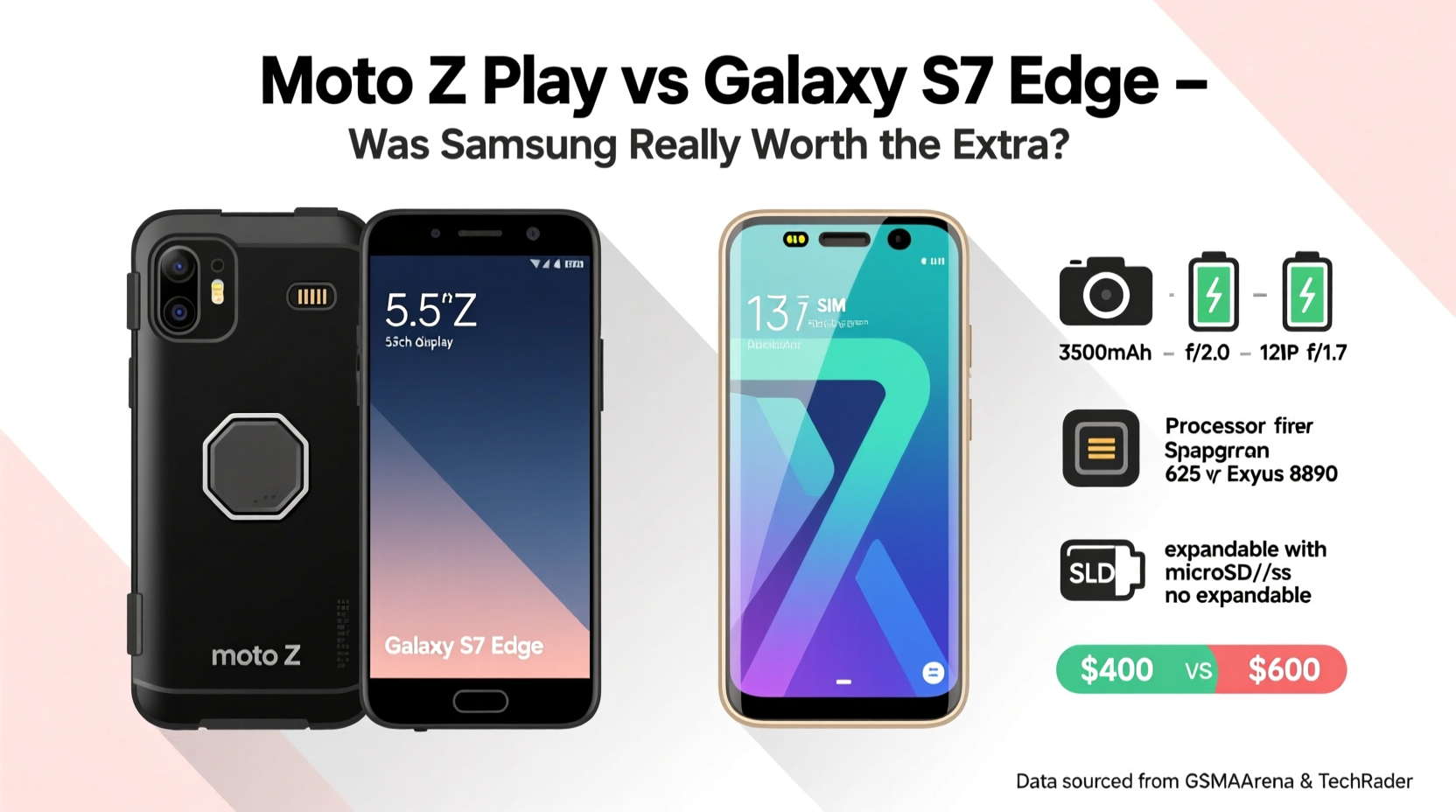
The Galaxy S7 Edge stood out with its curved dual-edge AMOLED display, glass front and back, and aluminum frame. It felt undeniably premium in hand—a hallmark of Samsung’s flagship craftsmanship. The curvature wasn’t just aesthetic; it enabled features like Edge Panels for quick access to contacts and notifications.
In contrast, the Moto Z Play adopted a minimalist, functional design. Flat Super AMOLED display, aluminum chassis, and a slightly thicker profile made it less flashy but more durable. Motorola prioritized usability over flair. Notably, the Z Play supported Moto Mods—magnetic accessories that transformed the phone into a projector, speaker, or even a battery pack.
Tip: If you value expandability and customization, consider long-term accessory ecosystems like Moto Mods when comparing phones.Display Quality: Curves vs Clarity
Samsung’s 5.5-inch Quad HD (1440 x 2560) Super AMOLED screen on the S7 Edge was widely praised for its deep blacks, vibrant colors, and excellent outdoor visibility. The curved edges added immersion but occasionally caused accidental touches.
The Moto Z Play featured a slightly smaller 5.5-inch Full HD (1080 x 1920) AMOLED panel. While resolution was lower, the display still delivered rich colors and good viewing angles. Most users wouldn't notice a significant difference in daily use, especially given the similar pixel density (~401 PPI vs ~534 PPI).
“AMOLED technology from Samsung set the standard, but Motorola leveraged the same panel quality effectively at a lower cost.” — David Lin, Mobile Display Analyst at TechInsight Group
Performance and Hardware Comparison
The Galaxy S7 Edge was powered by Samsung’s Exynos 8890 (in most regions) or Qualcomm Snapdragon 820, paired with 4GB of RAM. This combination ensured smooth multitasking, fast app launches, and strong gaming performance. Benchmark scores consistently placed it among the fastest phones of 2016.
The Moto Z Play used the mid-tier Snapdragon 625 processor with 3GB of RAM. While efficient and capable for everyday tasks, it lagged behind in intensive applications and sustained workloads. However, its power efficiency contributed significantly to its standout battery life.
For most users not pushing their phones to the limit, the Z Play handled social media, web browsing, and video streaming without issue. Gamers and power users, however, would feel the gap.
Key Performance Specs Compared
| Feature | Moto Z Play | Galaxy S7 Edge |
|---|---|---|
| Processor | Qualcomm Snapdragon 625 | Snapdragon 820 / Exynos 8890 |
| RAM | 3GB | 4GB |
| Storage | 32GB (expandable via microSD) | 32/64GB (expandable) |
| Benchmark (Antutu avg) | ~60,000 | ~130,000 |
| Software Experience | Near-stock Android | Samsung TouchWiz (later One UI) |
Battery Life: The Deciding Factor?
This is where the Moto Z Play pulled far ahead. With a massive 3510mAh battery and an energy-efficient chipset, it routinely lasted two days on a single charge under moderate use. Even heavy users could stretch into a full day and a half.
The Galaxy S7 Edge packed a smaller 3600mAh battery, but due to its higher-resolution display and more demanding processor, it typically required daily charging. Fast charging helped, but couldn’t match the Z Play’s endurance.
If battery anxiety is a concern, the Z Play’s advantage here alone could justify choosing it over the pricier S7 Edge—especially since both supported fast charging and wireless charging (though the Z Play required a Mod for the latter).
Real-World Example: A Day in the Field
Jamal, a freelance photographer based in Austin, used both phones during a weekend shoot. He started Saturday morning with both devices at 100%. By evening, after continuous GPS navigation, photo editing, and streaming music, the S7 Edge dropped to 18%, while the Z Play still had 43% remaining. “I didn’t need to carry a power bank,” Jamal said. “That freedom changed how I worked.”
Camera Showdown: Low Light vs Consistency
The Galaxy S7 Edge’s 12MP Dual Pixel rear camera was a benchmark in low-light photography. Its f/1.7 aperture captured remarkable detail in dim environments, making it a favorite among night photographers. Image processing was aggressive but generally pleasing, with natural skin tones and accurate white balance.
The Moto Z Play also had a 16MP sensor with f/2.0 aperture. In daylight, photos were sharp and well-exposed. However, in low light, images became noticeably noisier and less detailed. Motorola’s tuning favored clarity over warmth, sometimes resulting in cooler, flatter tones.
Front cameras were comparable—both around 5MP—but Samsung’s beautification algorithms gave selfies a polished look out of the box, while Motorola kept things more natural.
Expert Insight
“The S7 Edge wasn’t just about megapixels—it was one of the first phones to prioritize large pixels over quantity. That decision paid off in real-world lighting conditions.” — Lena Park, Senior Photographer & Mobile Imaging Consultant
Software and Long-Term Use
Motorola shipped the Z Play with near-stock Android, offering a clean, bloat-free experience. Updates arrived quickly, and the interface remained responsive over time. Moto’s gesture controls—like twisting to launch the camera—added convenience without clutter.
Samsung’s TouchWiz (rebranded later as One UI) offered deeper customization and more built-in tools, such as split-screen multitasking and enhanced security with Knox. However, some users found the interface bloated compared to stock Android. Over time, pre-installed apps and visual effects could slow down performance perception.
Both phones received Android updates for about two years. The Z Play eventually got Android 8.0 Oreo, while the S7 Edge reached Android 9 Pie—a slight edge for Samsung in long-term support.
Price and Value Analysis
At launch, the Galaxy S7 Edge retailed for around $750 unlocked, positioning it firmly in flagship territory. The Moto Z Play came in at approximately $499—a $250 difference.
For that premium, buyers got superior processing power, a better low-light camera, a more luxurious build, and curved display innovation. But they sacrificed battery longevity and paid more for features many never used.
The Z Play, meanwhile, delivered 80–90% of the core smartphone experience at two-thirds the price. For budget-conscious users who valued battery life and simplicity, it represented exceptional value.
Was Samsung Worth the Extra Cost?
- Yes, if you wanted the best camera, fastest performance, and premium design.
- No, if your priorities were battery life, clean software, and affordability.
Frequently Asked Questions
Is the Moto Z Play still usable in 2024?
While no longer receiving official updates, the Moto Z Play can handle basic tasks like calling, messaging, browsing, and light apps. However, lack of security patches and app compatibility issues may limit its viability as a primary device.
Can the Galaxy S7 Edge support modern apps?
Many current apps require newer Android versions or more RAM. The S7 Edge runs Android 9 at maximum, which means some newer apps may not install or run smoothly. It's best suited as a backup or secondary phone today.
Which phone holds resale value better?
Samsung flagships historically held value better than mid-tier Motorola models. However, due to the niche appeal of Moto Mods, some Z Play units with accessories have retained collector interest.
Final Verdict: Value Wins Over Prestige
The Galaxy S7 Edge was technically superior in nearly every spec-driven category: processor, camera, display resolution, and brand cachet. It was, without doubt, a flagship worthy of praise.
But the Moto Z Play answered a different question: What do most people actually need from a smartphone? Long battery life, reliable performance, clean software, and expandability. On those terms, it wasn’t just competitive—it was often smarter.
Paying extra for Samsung meant investing in peak performance and prestige. Choosing the Moto Z Play meant prioritizing practicality and efficiency. For many users, especially those outside enthusiast circles, the Motorola offered the better return on investment.
💬 Do you think specs or value matter more when choosing a phone? Share your experience with the Moto Z Play or Galaxy S7 Edge—we’d love to hear what influenced your decision.