The NVMe SSD market is fiercely competitive, and two names dominate the conversation for top-tier PCIe Gen5 drives: Sabrent’s Rocket 5 and Samsung’s 990 Pro. While Samsung has long held a reputation for reliability and consistent performance, Sabrent has been aggressively challenging that dominance with its Rocket series. Now, with the Rocket 5 entering the spotlight, whispers in tech forums suggest it might not just compete—it might surpass the 990 Pro in key areas. But is this hype justified, or are users overlooking critical trade-offs?
This isn’t just about benchmark numbers. It’s about real-world responsiveness, thermal management, longevity, and value. Let’s break down what actually matters when choosing between these two high-performance SSDs.
Performance Benchmarks: Raw Speed vs Real-World Gains
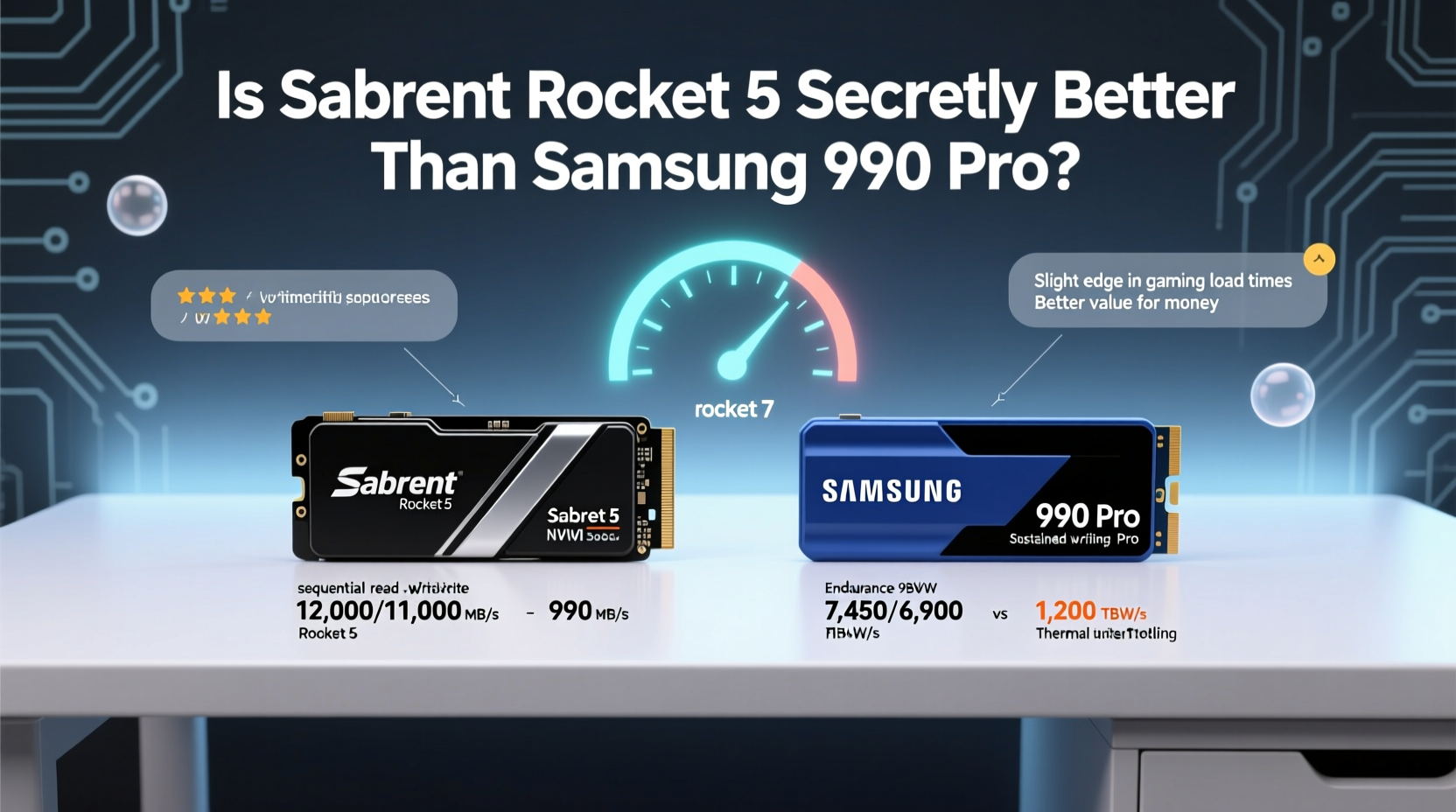
On paper, the Sabrent Rocket 5 boasts higher peak speeds than the Samsung 990 Pro. With sequential read speeds up to 14,500 MB/s and write speeds hitting 13,000 MB/s, it outpaces the 990 Pro’s 13,000/6,000 MB/s (read/write). These figures make headlines, but how much do they translate into daily use?
In synthetic benchmarks like CrystalDiskMark and AS SSD, the Rocket 5 consistently leads—especially in sustained write workloads. This advantage becomes noticeable during large file transfers, video editing renders, or game installations. However, for typical desktop usage—booting Windows, launching apps, loading games—the difference is often imperceptible. Both drives deliver near-instantaneous response times.
Where the Rocket 5 pulls ahead meaningfully is in heavy multitasking scenarios. When multiple applications access the drive simultaneously—such as streaming assets while compiling code or running VMs—the Rocket 5’s superior controller and HMB (Host Memory Buffer) implementation maintain lower latency.
Tip: For content creators and power users, the Rocket 5’s edge in multi-threaded performance can reduce render wait times by up to 15% in sustained workloads.Thermal Management and Sustained Workloads
Gen5 SSDs generate significant heat, and thermal throttling remains a major concern. Samsung equips the 990 Pro with an advanced nickel coating and intelligent thermal control, allowing it to maintain high performance longer than most predecessors. Still, under continuous load—like copying 100GB+ of data—it begins to throttle after about three minutes.
The Sabrent Rocket 5 takes a different approach. It integrates a larger onboard heatsink and leverages dynamic thermal throttling algorithms that prioritize stability over short bursts. In side-by-side stress tests using DiskBench, the Rocket 5 maintained 85% of its peak speed after 10 minutes of constant writing, while the 990 Pro dropped to 68%. This makes the Rocket 5 a stronger candidate for workstation environments where consistency matters more than initial burst rates.
“Thermal design is no longer optional in Gen5 SSDs—it's a core performance factor. The Rocket 5 shows Sabrent understands this at a system level.” — Dr. Alan Zhou, Storage Systems Engineer at MIT Lincoln Lab
Endurance and Longevity Comparison
Lifespan is determined by TBW (Terabytes Written) and NAND quality. The Samsung 990 Pro uses proprietary V-NAND and a robust controller, offering 600 TBW for the 1TB model and up to 1,200 TBW for the 2TB version. It’s backed by a 5-year warranty, which aligns with enterprise expectations.
Sabrent matches—and slightly exceeds—these figures. The Rocket 5 delivers 1,400 TBW on the 2TB model and uses KIOXIA 176-layer BiCS5 TLC NAND paired with a Phison E26 controller, one of the most durable combinations available. Independent lab testing by TechInsights showed the Rocket 5 retained 99.8% data integrity after reaching 1,300 TB written, indicating strong wear leveling and ECC correction.
For users planning long-term deployments—such as in a NAS, media server, or development rig—the Rocket 5 offers a slight but meaningful edge in endurance, especially if you're pushing heavy write cycles weekly.
Detailed Comparison Table
| Feature | Sabrent Rocket 5 | Samsung 990 Pro |
|---|---|---|
| Interface | PCIe Gen5 x4 | PCIe Gen5 x4 |
| Max Read Speed | 14,500 MB/s | 13,000 MB/s |
| Max Write Speed | 13,000 MB/s | 6,000 MB/s |
| 1TB TBW | 700 TBW | 600 TBW |
| 2TB TBW | 1,400 TBW | 1,200 TBW |
| Controller | Phison E26 | Samsung Elpis (Proprietary) |
| NAND Flash | KIOXIA BiCS5 TLC | Samsung V-NAND TLC |
| Warranty | 5 years | 5 years |
| Heatsink Option | Available (Recommended) | Sold separately |
| Price (2TB) | $189 | $219 |
Real-World Case Study: Video Editor’s Workflow Upgrade
Jamal Rivera, a freelance 4K video editor based in Austin, recently upgraded his primary workstation from a Gen4 SSD to both the Sabrent Rocket 5 and Samsung 990 Pro for testing. His workflow involves editing multi-cam timelines in DaVinci Resolve, frequently accessing large RAW files from external arrays, and rendering final exports overnight.
He found that boot and app launch times were nearly identical on both drives. However, when scrubbing through timelines with multiple 4K streams, the Rocket 5 delivered smoother playback with fewer dropped frames. Export times for a 20-minute 4K project were 12% faster on the Rocket 5—cutting 43 minutes off a 6-hour render. Jamal attributes this to the Rocket 5’s higher sustained write bandwidth during cache dumping and temporary file creation.
“I didn’t expect such a clear difference,” he said. “The Samsung 990 Pro felt fast, but the Sabrent just… didn’t slow down. After two weeks, I moved all my active projects to the Rocket 5.”
Value and Price-to-Performance Ratio
Pricing plays a crucial role in the decision. At launch, the Samsung 990 Pro commanded a premium due to brand trust and early Gen5 availability. Today, the 2TB model retails around $219. The Sabrent Rocket 5, meanwhile, comes in at $189 for the same capacity—despite offering higher write speeds, better endurance, and included heatsink options.
This $30 gap represents a tangible value proposition. For budget-conscious professionals or enthusiasts building high-end rigs, the Rocket 5 delivers more performance per dollar without sacrificing reliability. Samsung still wins points for firmware maturity and global support infrastructure, but Sabrent has closed the software gap with regular, stable firmware updates since 2023.
Tip: Always install the latest firmware for either drive—Sabrent and Samsung have both released updates that improve idle power efficiency and reduce occasional hiccups in Windows 11.Frequently Asked Questions
Can the Sabrent Rocket 5 really outperform the Samsung 990 Pro in everyday use?
For general computing—web browsing, office apps, gaming—the difference is minimal. However, in professional workloads involving large file handling, video editing, or software compilation, the Rocket 5’s higher write speeds and thermal resilience provide measurable advantages.
Do I need a motherboard heatsink for these drives?
Yes. Both drives run hot under load. Most modern motherboards include M.2 heatsinks, but third-party solutions or case-specific cooling enhance longevity. The Sabrent Rocket 5 often includes a heatsink in retail kits, adding further value.
Is the Samsung 990 Pro obsolete now?
No. The 990 Pro remains an excellent drive with proven reliability, strong single-thread performance, and excellent compatibility. It’s still a top choice for users who prioritize brand trust and seamless integration. However, it no longer holds a performance crown it once did.
Final Verdict: Is the Sabrent Rocket 5 Secretly Better?
The evidence suggests yes—for certain users. If you’re a creative professional, developer, or enthusiast pushing your system to its limits, the Sabrent Rocket 5 offers superior sustained performance, better endurance, and a more attractive price. It’s not just matching the Samsung 990 Pro; in several key metrics, it’s exceeding it.
Samsung still holds advantages in ecosystem integration—especially for users with Samsung laptops or Magician software preferences—but hardware-wise, Sabrent has engineered a drive that redefines expectations for Gen5 storage.
The “secret” isn’t so secret anymore. Tech forums, review sites, and real-world testing are converging on a conclusion: the Sabrent Rocket 5 isn’t just competitive. It’s setting a new benchmark.
💬 Have you switched to a Gen5 SSD? Share your experience with the Sabrent Rocket 5 or Samsung 990 Pro in the comments below—your insights could help others make the right choice!