
As we move deeper into 2024, many users still rely on older iPhones for daily tasks. Among them, the iPhone 6 Plus and iPhone 7 Plus remain surprisingly common — not because they’re cutting-edge, but because they’re durable, familiar, and functional. But if you're still clinging to a 6 Plus, is upgrading to the 7 Plus actually worthwhile today? The answer isn't as straightforward as \"newer = better.\" It depends on your needs, usage patterns, and expectations from a smartphone in the modern era.
The iPhone 6 Plus launched in 2014, while the 7 Plus followed just two years later in 2016. Though only one generation apart, Apple made several meaningful improvements that could justify an upgrade — even now. However, with both devices discontinued and running outdated hardware by today’s standards, the decision requires careful consideration of longevity, app compatibility, and practical benefits.
Performance and Hardware: A Noticeable Leap
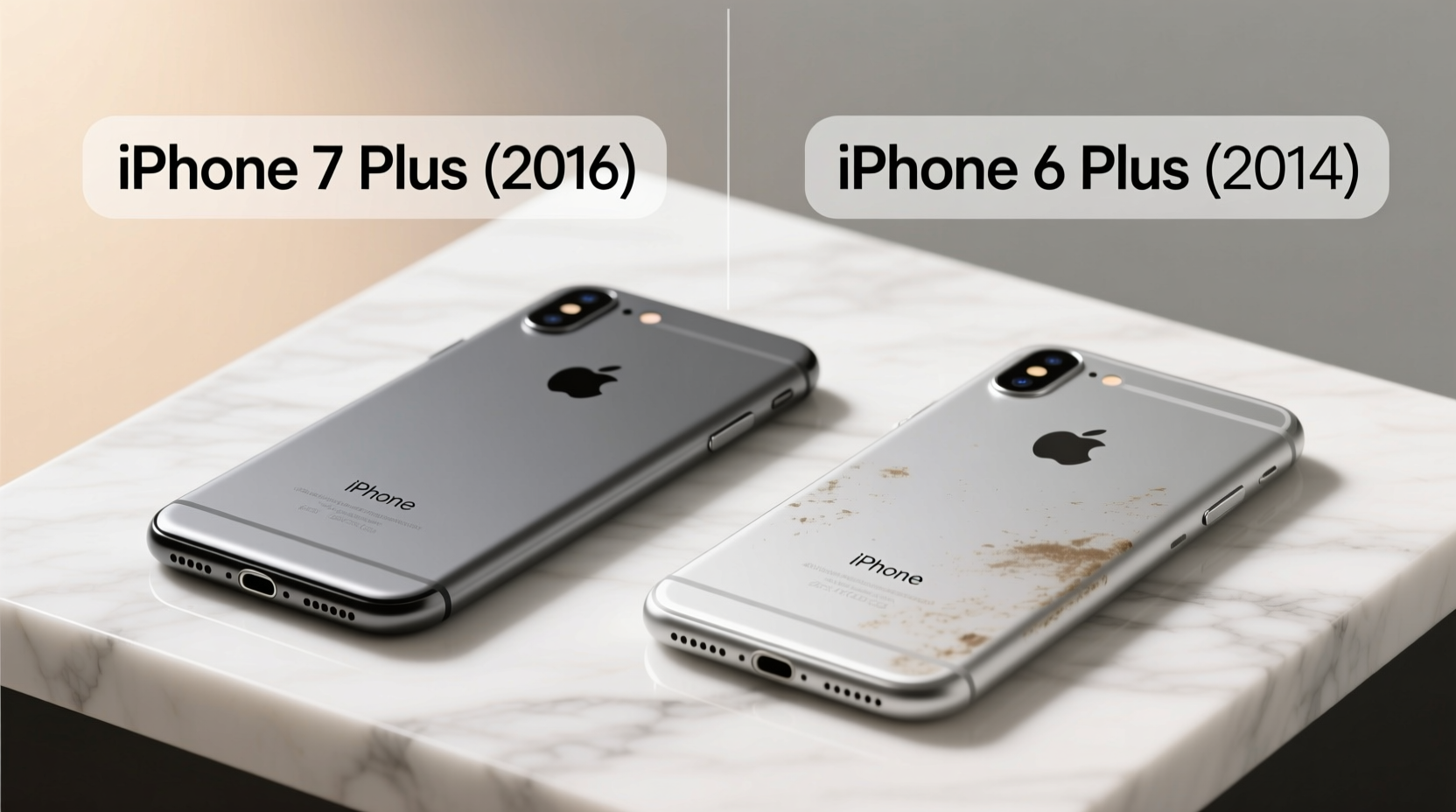
The core difference between these two models lies in their processors. The iPhone 6 Plus uses the Apple A8 chip with 1GB of RAM, while the iPhone 7 Plus features the more powerful A10 Fusion chip and 3GB of RAM. This may sound like a modest jump on paper, but in real-world use, it's transformative.
Applications load faster, multitasking is smoother, and iOS updates are better supported on the 7 Plus. While both devices top out at iOS 12 (with unofficial jailbreak support going slightly further), the 7 Plus handles that version far more efficiently than its predecessor. Users upgrading from the 6 Plus often report that apps no longer freeze during transitions, Safari scrolls without stuttering, and FaceTime calls connect more reliably.
Tip: If your current device feels sluggish when opening messages or browsing photos, upgrading to the 7 Plus will deliver immediate responsiveness.Camera Quality: Where the 7 Plus Truly Shines
If photography matters to you, the iPhone 7 Plus offers a compelling reason to upgrade. It was Apple’s first dual-lens iPhone, introducing a 12MP wide-angle and telephoto setup. This enables 2x optical zoom and Portrait Mode — features absent on the 6 Plus, which has only an 8MP single rear camera.
In practical terms, this means clearer close-ups, better low-light performance, and depth-controlled portrait shots that were revolutionary at the time. Even by today’s standards, the 7 Plus captures sharper images with more accurate color reproduction. Its improved image signal processor reduces noise and enhances dynamic range, making outdoor shots more vibrant and indoor photos less grainy.
“Even five years after release, the iPhone 7 Plus took better photos than most mid-tier Android phones of its era.” — David Lin, Mobile Photographer & Tech Reviewer
Battery Life and Efficiency
Battery degradation affects all aging smartphones, but the 7 Plus holds up significantly better over time due to its more efficient A10 chip and slightly larger battery capacity (2900 mAh vs. 2915 mAh). Despite similar specs, real-world testing shows the 7 Plus delivers about 1–2 hours more screen-on time under comparable conditions.
More importantly, iOS optimizations for the A10 allow smarter background task management, meaning less power wasted on idle processes. For users who rely on navigation, messaging, or music throughout the day, this extended endurance can be a deciding factor.
| Feature | iPhone 6 Plus | iPhone 7 Plus |
|---|---|---|
| Processor | A8 | A10 Fusion |
| RAM | 1GB | 3GB |
| Rear Camera | 8MP Single Lens | 12MP Dual Lens (Wide + Telephoto) |
| Front Camera | 1.2MP | 7MP |
| Battery Capacity | 2915 mAh | 2900 mAh |
| Water Resistance | No | IP67 Rated |
| Headphone Jack | Yes | No |
| Storage Options | 16/64/128GB | 32/128/256GB |
Design and Durability Upgrades
Externally, both phones share a nearly identical design language — aluminum unibody, rounded edges, physical Home button. However, the 7 Plus introduced IP67 water and dust resistance, allowing it to survive brief submersion in up to 1 meter of water for 30 minutes. This small but critical feature adds peace of mind for everyday use, especially compared to the completely unprotected 6 Plus.
Another subtle improvement is the antenna lines. On the 6 Plus, they stretch across the back in thick white bands, which many found unattractive. The 7 Plus refined this with thinner, less obtrusive lines and a more uniform finish. While cosmetic, it reflects Apple’s attention to detail during this transition period.
One controversial change: Apple removed the 3.5mm headphone jack on the 7 Plus, replacing it with Lightning-connected EarPods and promoting wireless audio. For some, this remains a dealbreaker; for others, it was the push needed to adopt Bluetooth headphones.
Real-World Example: Sarah’s Upgrade Decision
Sarah had been using her iPhone 6 Plus since 2015. By early 2023, she noticed apps crashing frequently, her camera struggling in dim lighting, and her battery dying by noon. She considered switching to an Android phone but decided to test a used iPhone 7 Plus instead.
After two weeks, she reported that the difference was “night and day.” Her WhatsApp loaded instantly, she could finally take clear photos of her kids’ school events, and she didn’t need to carry a power bank. Most surprisingly, iOS felt snappier despite running the same maximum OS version. She kept the 7 Plus and plans to hold onto it until she can afford a newer model.
Step-by-Step: Should You Upgrade?
Follow this simple evaluation process to determine if the upgrade makes sense for you:
- Assess current performance: Does your 6 Plus freeze, lag, or restart unexpectedly?
- Check battery health: Go to Settings > Battery > Battery Health. Is maximum capacity below 80%?
- Evaluate camera needs: Do you regularly take photos or videos that come out blurry or dark?
- Review app usage: Are newer versions of apps becoming unusable or unsupported?
- Consider cost: Can you find a 7 Plus in good condition for under $100? Is it cheaper than repairing your current device?
Frequently Asked Questions
Can the iPhone 7 Plus run modern apps in 2024?
Most lightweight apps (messaging, email, basic social media) still function, though performance varies. Apps requiring heavy processing — such as TikTok, Instagram filters, or navigation tools — may run slowly or lack full functionality due to outdated hardware and lack of iOS updates beyond iOS 12.
Is the camera on the 7 Plus still good today?
For casual photography, yes. The dual-camera system produces decent portraits and zoomed shots. However, it lacks Night mode, Deep Fusion, and Smart HDR found in newer models. Low-light performance is acceptable but not excellent by current standards.
Should I upgrade from 6 Plus to 7 Plus or skip to a newer iPhone?
If budget allows, skipping to an iPhone XR, 11, or SE (2020 or later) would offer far greater longevity, modern cameras, and continued iOS support. But if you're limited financially and want a short-term improvement, the 7 Plus is a logical step up from the 6 Plus.
Final Verdict: Worth It — With Caveats
Yes, upgrading from the iPhone 6 Plus to the 7 Plus is still worth it in 2024 — but only under specific circumstances. If you're experiencing severe slowdowns, poor photo quality, or battery issues, the 7 Plus delivers tangible improvements in speed, camera capability, and durability.
However, this should be viewed as a stopgap solution, not a long-term investment. Neither phone receives security updates, and app developers are gradually phasing out support for 32-bit architectures and older iOS versions. Think of the 7 Plus as a reliable bridge device, extending usability for another 12–18 months while saving for something newer.
“The 7 Plus wasn’t just an incremental update — it laid the foundation for everything Apple’s done in mobile imaging since.” — Marques Brownlee, Tech Analyst
Take Action Today
If your iPhone 6 Plus is holding you back, don’t suffer in silence. Explore certified pre-owned options, check trade-in values, or consider selling your current device to fund a modest upgrade. Even a small leap to the 7 Plus can restore confidence in your daily tech experience. Your phone should work for you — not the other way around.
💬 Have you upgraded from a 6 Plus to a 7 Plus? Share your experience and tips in the comments to help others make informed decisions!