The iPhone 6s was once a flagship device that defined mobile excellence. Released in 2015, it gained a cult following for its build quality, performance, and long iOS support. Fast forward nearly a decade, and users still ask: should they upgrade from this durable classic? On the other side of the spectrum sits the Samsung Galaxy A11, an entry-level Android phone released in 2020. At first glance, comparing these two devices might seem like apples to oranges—but for budget-conscious consumers clinging to aging iPhones, the Galaxy A11 represents one of the most affordable modern alternatives.
This comparison isn’t just about specs. It’s about real-world usability in 2024 and beyond—app compatibility, security updates, battery life, and whether either device can handle daily tasks like browsing, messaging, streaming, and light photography. Let’s break down what each phone offers today and determine if stepping up from the iPhone 6s to the Galaxy A11 is truly worthwhile.
Performance and Hardware: A Generational Leap
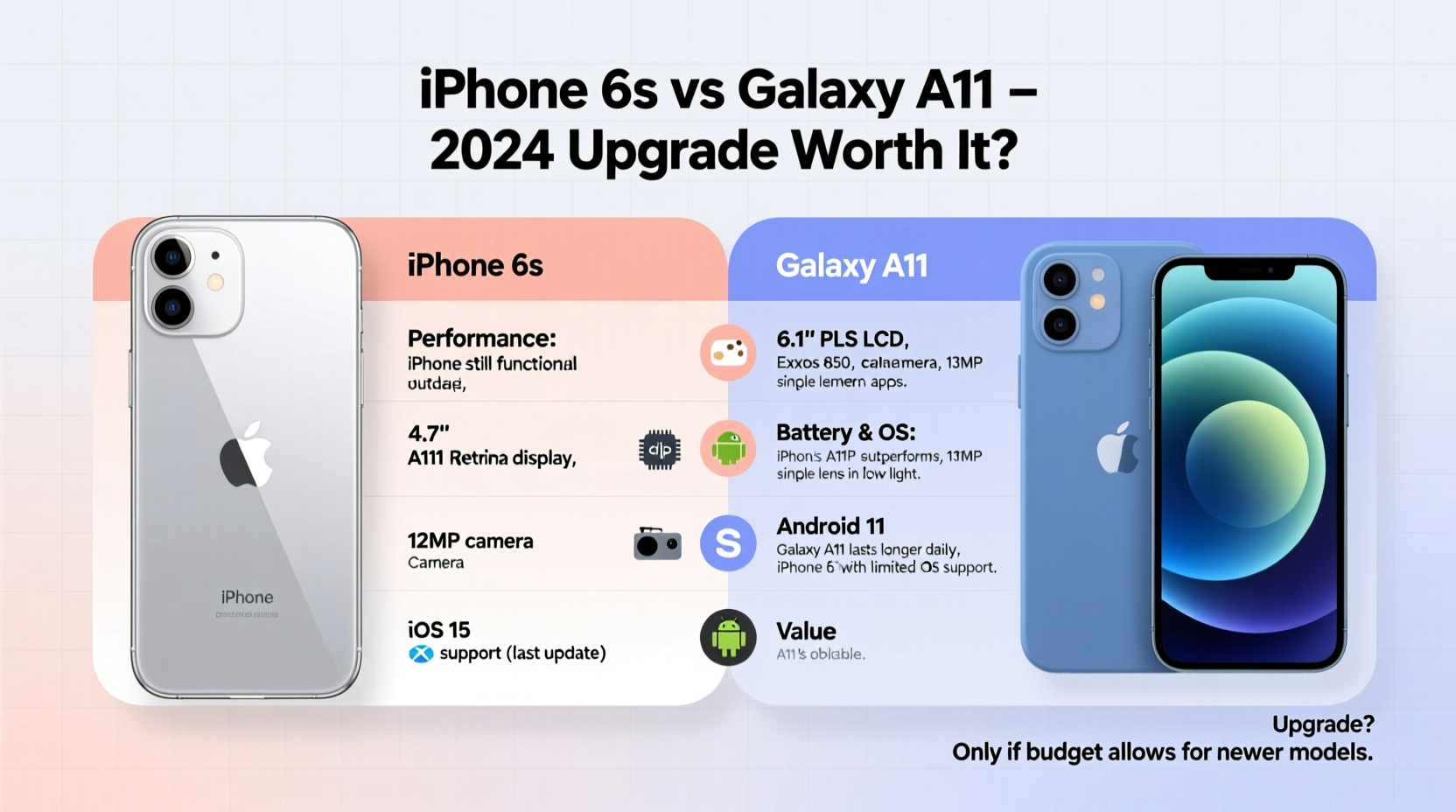
The iPhone 6s runs on Apple’s A9 chip with 2GB of RAM. In its time, this combination delivered smooth performance across apps and games. Even by 2024 standards, some users report that basic functions still work—calls, texts, and simple web browsing remain functional. However, app loading times are slow, multitasking is limited, and newer versions of iOS (beyond iOS 15) are unsupported. That means no security patches, no feature updates, and increasing incompatibility with modern apps.
In contrast, the Galaxy A11 uses Qualcomm’s Snapdragon 450 processor with options of 2GB or 3GB RAM. While not powerful by today’s standards, this chipset outperforms the aging A9 in sustained usage thanks to better thermal management and more efficient architecture. Android 10 (upgradable to Android 11) ensures broader app compatibility and access to Google services without major hiccups.
Tip: If your iPhone 6s frequently freezes or fails to install app updates, it's already falling behind in core functionality—time to consider replacement.Benchmark Reality Check
Real-world performance matters more than raw numbers. The Galaxy A11 handles YouTube, WhatsApp, Facebook, and even light gaming like Candy Crush without stuttering. The iPhone 6s struggles with video autoplay on social media feeds and often crashes when multiple tabs are open in Safari.
“Devices stuck on outdated operating systems become security liabilities, not just performance laggards.” — David Lin, Mobile Security Analyst at TechShield Insights
Software Support and Longevity
One of the iPhone 6s’s greatest strengths was its software longevity. Apple supported it with updates until 2022—seven years after launch. But now, it receives no further updates. This means vulnerabilities discovered post-iOS 15 remain unpatched, putting personal data at risk, especially when using banking apps or logging into sensitive accounts.
The Galaxy A11, while not receiving monthly updates anymore, completed its three-year software lifecycle with Android 11. Samsung also provided bi-monthly security patches until mid-2022. Though no longer updated, Android 11 is significantly more modern than iOS 15 in terms of underlying system architecture and background process handling.
More importantly, many essential apps—including Google Chrome, Gmail, and Zoom—have dropped support for older OS versions. As of 2024, several require at least Android 8 or iOS 16, making the iPhone 6s increasingly obsolete.
Upgrade Consideration: Future-Proofing
While neither phone is future-proof, the Galaxy A11 offers a slightly more sustainable platform. Its microSD slot allows storage expansion, and replaceable battery design (though rare today) makes repairs easier. The iPhone 6s, though praised for durability, suffers from degraded batteries that are costly to replace and lack official support.
📋Comparison Table: iPhone 6s vs Galaxy A11 (2024 Perspective)
| Feature | iPhone 6s | Galaxy A11 |
|---|---|---|
| Release Year | 2015 | 2020 |
| Operating System | iOS 15 (final) | Android 11 (final) |
| Processor | Apple A9 | Snapdragon 450 |
| RAM | 2GB | 2GB / 3GB |
| Storage Options | 16GB, 32GB, 64GB, 128GB | 32GB / 64GB (expandable via microSD) |
| Battery Capacity | 1715 mAh | 4000 mAh |
| Camera (Rear) | 12MP | Triple: 13MP + 5MP + 2MP |
| Front Camera | 5MP | 8MP |
| Display Size & Type | 4.7\" LCD | 6.4\" PLS LCD |
| Fingerprint Sensor | Touch ID (front) | Rear-mounted |
| Current Usability (2024) | Limited (outdated OS, slow apps) | Moderate (usable for basics) |
User Experience: Daily Use in 2024
Size and screen real estate play a crucial role in modern smartphone use. The iPhone 6s’s 4.7-inch display feels cramped for reading articles, watching videos, or navigating maps. Text appears small, and touch targets are tighter. The Galaxy A11’s 6.4-inch screen provides much-needed breathing room, even if resolution is only HD+ (720p). Larger screens reduce eye strain and improve interaction accuracy.
Battery life is another decisive factor. The iPhone 6s, even when new, offered modest endurance. Today, with aged lithium-ion cells, most units last half a day with minimal use. Charging speed is limited to 5W, meaning full charges take over three hours. The Galaxy A11, despite average efficiency, benefits from a 4000mAh battery and faster charging (15W support), delivering consistent all-day usage under normal conditions.
💡Checklist: Signs You Should Upgrade from iPhone 6s
- Your phone fails to update to the latest iOS version
- Apps crash frequently or refuse to install
- Battery dies within 4–5 hours of light use
- You can't log into certain banking or messaging apps due to OS restrictions
- Camera produces blurry or delayed photos
- Wi-Fi or Bluetooth connections drop unexpectedly
Mini Case Study: Maria’s Upgrade Dilemma
Maria, a 58-year-old teacher from Portland, used her iPhone 6s since 2016. She resisted upgrading due to cost and familiarity. By early 2023, she noticed her banking app stopped working. Her school’s communication platform wouldn’t load properly. After spending $70 on a battery replacement, the phone lasted only three more months before becoming unusable. Reluctantly, she purchased a Galaxy A11 for $120. Though the interface felt different, she appreciated the larger screen for reading assignments and the longer battery life during school days. Within weeks, she adapted and found herself using video calls with grandchildren more often—something previously frustrating on the smaller screen.
Maria’s story reflects a growing trend: emotional attachment to reliable old devices often delays necessary upgrades, ultimately leading to greater inconvenience.
Is the Galaxy A11 Worth It as an Upgrade?
For users coming directly from the iPhone 6s, the Galaxy A11 represents a meaningful leap in usability—not because it’s powerful, but because it meets minimum thresholds for modern digital life. It supports recent versions of WhatsApp, Google Meet, and navigation apps. Its camera, while mediocre, captures usable daylight photos and records 1080p video. The headphone jack remains—a small but valuable feature absent in newer iPhones.
However, it’s important to be realistic. The Galaxy A11 has limitations: dim display in sunlight, lag when switching between apps, and no water resistance. It won’t run heavy games or edit videos smoothly. But for calls, messaging, email, social media, and occasional photos, it performs adequately in 2024.
🕒Step-by-Step Guide: Transitioning from iPhone 6s to Android
- Back up your iPhone: Use iCloud or iTunes to save contacts, messages, and photos.
- Download Move to Android app: Available on the App Store, this tool transfers content to your new Android device over Wi-Fi.
- Sign in to Google Account: Ensure your contacts, calendar, and emails sync automatically.
- Install essential apps: Download WhatsApp, Instagram, banking apps, etc., from the Google Play Store.
- Adjust settings: Enable dark mode, set up fingerprint unlock, and customize notification preferences.
- Test core functions: Make a call, send a message, use GPS, and verify app logins before retiring the old phone.
FAQ
Can I use my iPhone accessories with the Galaxy A11?
No, Lightning cables and AirPods (without Bluetooth pairing) aren’t compatible. You’ll need USB-C cables and standard Bluetooth headphones. The Galaxy A11 includes a headphone jack, so existing 3.5mm earbuds will work.
Will the Galaxy A11 receive any more updates?
No. Samsung ended software support in 2022. While the phone remains functional, avoid storing highly sensitive data without additional security apps.
Is there a better alternative than the Galaxy A11?
Yes. For slightly more ($150–$200), phones like the Moto G Power (2023) or Samsung Galaxy A14 offer better displays, longer support, and improved performance. But if budget is tight, the A11 is a logical step up from the iPhone 6s.
🚀Conclusion
Upgrading from the iPhone 6s to the Galaxy A11 in 2024 isn’t about chasing cutting-edge technology—it’s about reclaiming reliability. The Galaxy A11 may be an entry-level device, but it delivers what the aging iPhone 6s no longer can: stable app performance, acceptable battery life, and sufficient screen size for modern interfaces. While neither phone is ideal long-term, the jump from 2015 to 2020 hardware closes critical gaps in usability and security.
If you're still holding onto an iPhone 6s, recognize that continued use comes with trade-offs: missed updates, shrinking app support, and growing frustration. Taking the step—even to a modest device like the Galaxy A11—can restore confidence in your daily tech. Evaluate your needs honestly, consider the checklist above, and don’t let nostalgia compromise functionality. Your next phone doesn’t have to be perfect. It just has to work.
💬 Have you upgraded from an iPhone 6s? What did you move to and how was your experience? Share your story in the comments below and help others navigate this common digital transition.