
The iPhone X was a landmark device—Apple’s first with Face ID, an edge-to-edge OLED display, and no home button. Released in 2017, it redefined smartphone design. Three years later, the iPhone 11 arrived as its true successor: more affordable, better performing, and built for longevity. But nearly seven years after the X launched, many users still rely on it daily. So if you're weighing whether to upgrade from the iPhone X to the iPhone 11—or deciding between them secondhand—the question remains: is the newer model actually worth it?
This isn’t just about specs. It’s about real-world usability, software support, camera quality, battery life, and long-term value. Let’s break down how these two iPhones compare across key areas that matter most to everyday users.
Design and Build: Evolution of Form
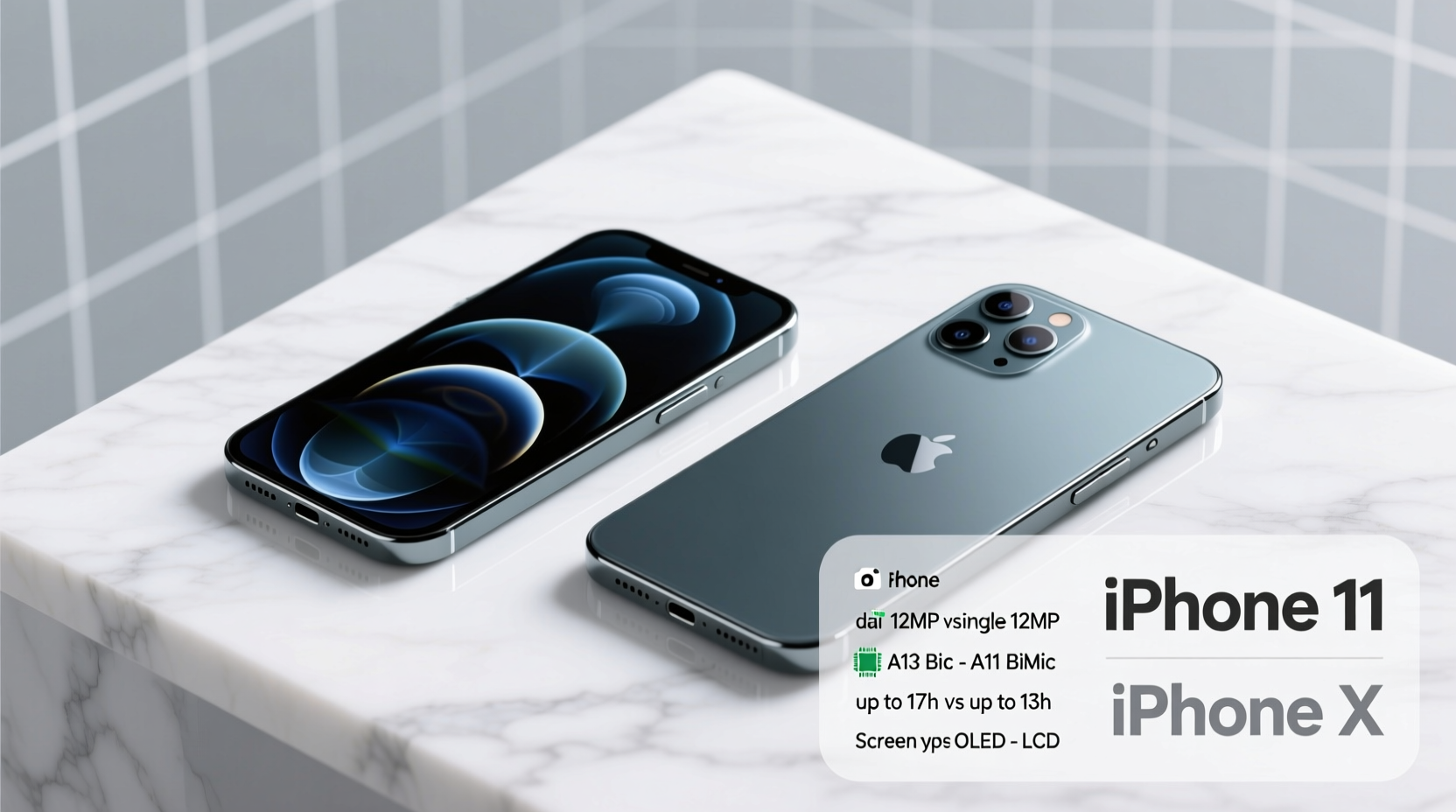
The iPhone X introduced a sleek stainless steel and glass design with a 5.8-inch OLED Super Retina display. Its notch became iconic, housing the TrueDepth camera system for Face ID. The build felt premium, though the glossy back attracted fingerprints and was prone to cracks if dropped.
The iPhone 11 retains a similar front layout but swaps stainless steel for aluminum sides, making it lighter and slightly less luxurious in feel—but also more durable in practice. It uses a 6.1-inch Liquid Retina LCD display, which while not OLED, benefits from improved color accuracy and brightness over time. The screen resolution is lower than the X’s, but for most users, the difference in sharpness is negligible in daily use.
Both phones are rated IP67 for water and dust resistance (up to 1 meter for 30 minutes), so neither has a clear advantage there. However, the iPhone 11's matte glass back is less slippery and shows fewer smudges, offering subtle ergonomic improvements.
Tip: If you prioritize screen quality over size, the iPhone X’s OLED still delivers deeper blacks and better contrast—ideal for dark-room media viewing.Performance: A Generational Leap
This is where the iPhone 11 pulls decisively ahead. It runs on Apple’s A13 Bionic chip, one of the most efficient and powerful mobile processors of its era. The iPhone X, by contrast, uses the A11 Bionic—impressive in 2017, but now showing its age when multitasking or running modern apps.
In real-world testing, the iPhone 11 handles demanding games, AR experiences, and photo editing far more smoothly. Apps launch faster, background app refresh is more reliable, and iOS updates continue to run optimally even in 2024. The iPhone X, while still capable of running iOS 17, often stutters during transitions and takes longer to process large photos or videos.
“Even two generations can make a huge difference in sustained performance. The A13 in the iPhone 11 wasn’t just faster—it was built for machine learning and future-proofing.” — David Kim, Mobile Hardware Analyst at TechPulse
RAM is another differentiator: the iPhone 11 has 4GB compared to the X’s 3GB. This may seem minor, but it translates into better app retention, smoother Safari tab switching, and improved camera processing speed.
Camera Comparison: Night Mode and Dual-Lens Advantage
The iPhone X features a single 12MP wide rear camera and a 12MP front-facing TrueDepth camera. In daylight, it captures excellent dynamic range and natural colors. Low-light performance, however, is limited—no Night mode, and minimal noise reduction.
The iPhone 11 changes the game with a dual-camera setup: a 12MP ultra-wide lens joins the standard wide lens. This allows for 0.5x zoomed-out shots, adding creative flexibility. More importantly, Apple introduced Night mode on the 11, automatically activating in low light to brighten scenes without flash, preserving detail and color.
Front camera upgrades matter too. The 12MP TrueDepth camera on the iPhone 11 supports 4K video recording at 60fps and slow-motion selfies (1080p at 120fps), features absent on the X. For social media creators or vloggers, this is a meaningful improvement.
| Feature | iPhone X | iPhone 11 |
|---|---|---|
| Rear Cameras | 12MP Wide (f/1.8) | 12MP Wide (f/1.8) + 12MP Ultra-Wide (f/2.4) |
| Night Mode | No | Yes (rear and front) |
| Front Camera Video | 1080p at 30fps | 4K at 60fps |
| Slofies (slow-mo selfie video) | No | Yes |
| Deep Fusion Processing | No | Yes (improves texture and detail) |
Battery Life and Charging: Practical Gains
The iPhone X offers around 12–13 hours of mixed usage—a respectable figure in its day. The iPhone 11 extends that to approximately 17–18 hours, thanks to a larger battery and power-efficient A13 chip. That extra half-day of endurance makes a tangible difference for travelers, commuters, or heavy users.
Neither phone includes fast charging in the box (though both support it with a compatible adapter), but the iPhone 11 charges slightly faster out of the gate due to optimizations. Both support Qi wireless charging and reverse charging for AirPods, though Apple never officially enabled the latter feature.
Tip: Use Low Power Mode strategically during travel days. On the iPhone 11, it can extend battery life by up to 4 additional hours.Software Support and Longevity Outlook
As of 2024, both devices support iOS 17. However, historical patterns suggest the iPhone 11 will receive one to two more major iOS updates than the iPhone X. Apple typically supports iPhones for five to six years post-launch. The X launched in 2017, meaning its final update could come with iOS 18 or 19. The iPhone 11, released in 2019, has a strong chance of reaching iOS 20.
This matters for security patches, new features like StandBy mode or NameDrop, and compatibility with future versions of popular apps. Developers increasingly optimize for newer hardware, leaving older models behind. If you plan to keep your phone beyond 2025, the iPhone 11 is the safer bet.
Mini Case Study: Sarah’s Upgrade Dilemma
Sarah has used her iPhone X since 2018. By early 2023, she noticed apps taking longer to open, frequent crashes in Instagram Reels, and poor low-light photos during family events. She considered buying a used iPhone XR to save money but opted for a refurbished iPhone 11 instead.
Within weeks, she reported “night and day” differences: smoother scrolling, clearer night photos, and being able to record birthday parties in 4K without overheating. Most surprisingly, the battery lasted through her workday without needing a mid-afternoon charge. For Sarah, the $100 premium over the XR was justified by three more years of reliable service.
Checklist: Should You Upgrade from iPhone X to iPhone 11?
- ✅ Are you experiencing slow app launches or frequent restarts?
- ✅ Do you struggle with poor low-light photos?
- ✅ Is your battery dying before bedtime with moderate use?
- ✅ Do you want to keep your phone for 2+ more years?
- ✅ Are you paying for cloud storage due to limited local space? (iPhone 11 starts at 64GB, same as X)
If three or more apply, upgrading to the iPhone 11 is a practical investment—not just a luxury.
Frequently Asked Questions
Can the iPhone X still run the latest apps?
Yes, most current apps still support the iPhone X. However, some newer titles—especially graphics-heavy games or AI-powered tools—may run slowly or not be optimized at all. Over time, compatibility will decline.
Is the iPhone 11 waterproof?
It’s water-resistant (IP67 rated), meaning it can survive brief submersion in up to 1 meter of water for 30 minutes. But this isn’t permanent protection—seals degrade over time, especially after drops.
Does the iPhone 11 have Touch ID?
No. Like the iPhone X, it relies solely on Face ID for biometric authentication. While convenient in landscape mode or lying down, Face ID can struggle with masks or in direct sunlight.
Conclusion: Balancing Value and Future-Proofing
The iPhone X was revolutionary in 2017, and credit is due: it aged remarkably well. But technology moves quickly. The iPhone 11 isn’t just a modest upgrade—it brings meaningful advancements in camera capability, battery life, processing power, and long-term software support.
If you’re clinging to your iPhone X because it “still works,” ask yourself: is it working well enough? Or are you compensating for its limitations every day? For under $300 on the refurbished market, the iPhone 11 delivers a noticeably better experience and likely two more years of full functionality.
🚀 Ready to make the switch? Evaluate your current pain points, check trade-in values, and consider how much smoother your digital life could be. The upgrade isn’t just about new features—it’s about reclaiming time, confidence, and joy in using your phone.