
The smartphone market today offers a vast spectrum of choices, from budget-friendly powerhouses to premium flagships with elite engineering. When comparing the Apple iPhone 11 Pro and the Xiaomi Redmi Note 11 Pro, the decision isn’t just about specs—it’s about value, longevity, ecosystem integration, and personal priorities. One costs nearly double the other at launch, but does that translate into twice the experience? For many consumers, the real question is whether paying extra for the iPhone still makes sense when Android phones like the Redmi Note 11 Pro deliver so much on paper.
This comparison dives deep into build quality, performance, camera capabilities, software support, battery life, and long-term ownership to help you decide if the iPhone 11 Pro remains a worthy investment over its more affordable counterpart.
Build Quality and Design
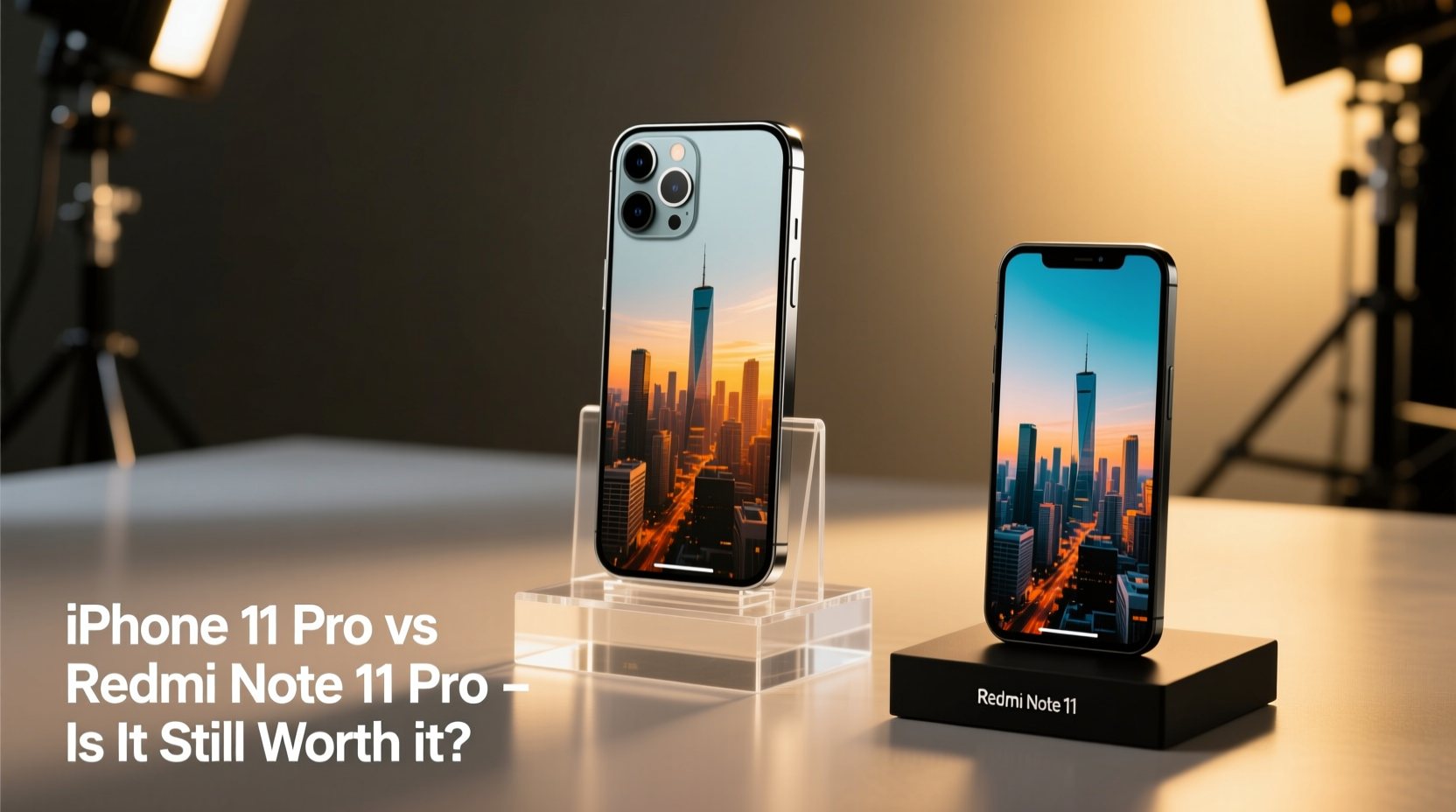
The iPhone 11 Pro immediately sets itself apart with a refined, minimalist design. Its surgical-grade stainless steel frame, matte glass back, and IP68 water resistance give it a premium feel that's both durable and elegant. The device fits comfortably in hand despite its compact size, and Apple’s attention to detail in finish and materials conveys a sense of lasting quality.
In contrast, the Redmi Note 11 Pro opts for a plastic frame and glossy plastic back. While this keeps the phone lightweight and lowers production costs, it feels less substantial and more prone to fingerprints and scratches. It does include an IP53 rating for splash resistance—decent for occasional spills—but falls short of full submersion protection. The overall design leans toward function over form, which suits its mid-range positioning.
Tip: If durability and long-term aesthetics matter, prioritize phones with metal frames and IP68 ratings—even if they cost more upfront.Performance and Real-World Speed
Under the hood, these two devices take very different approaches. The iPhone 11 Pro runs on Apple’s A13 Bionic chip—an architecture designed specifically for iOS efficiency. Even years after release, the A13 handles multitasking, gaming, and intensive apps with ease. iOS optimization ensures smooth animations, minimal lag, and consistent responsiveness over time.
The Redmi Note 11 Pro uses the Qualcomm Snapdragon 680 or MediaTek Helio G96 (depending on region), paired with up to 6GB of RAM. These chips are competent for everyday tasks like browsing, messaging, and streaming, but show limitations under sustained load. Apps may reload more frequently, and high-end games often require reduced settings. Over time, especially with heavier usage, users may notice performance degradation due to Android memory management and software bloat.
“Apple’s tight hardware-software integration allows older iPhones to remain usable and fast far longer than most Android counterparts.” — David Lin, Senior Mobile Analyst at TechInsight Weekly
Camera Comparison: Photos That Matter
Both phones feature triple-camera setups, but their execution differs significantly.
The iPhone 11 Pro includes three 12MP sensors: wide, ultra-wide, and telephoto. What sets it apart is computational photography—Smart HDR, Deep Fusion, and Night mode work seamlessly across all lenses. Colors are natural, dynamic range is excellent, and low-light shots retain detail without excessive noise. Video recording supports 4K at 60fps with cinematic stabilization, making it a favorite among mobile content creators.
The Redmi Note 11 Pro also has a 108MP main sensor (on some variants), which sounds impressive on paper. However, pixel binning reduces actual output to 12MP, and image processing often oversharpenens or oversaturates photos. Low-light performance lags behind, with grainy results and slower focusing. While versatile in daylight, it struggles to match the consistency and realism of the iPhone’s imaging system.
| Feature | iPhone 11 Pro | Redmi Note 11 Pro |
|---|---|---|
| Main Sensor | 12MP f/1.8 | 108MP f/1.9 (binning to 12MP) |
| Ultra-Wide | 12MP f/2.0 | 8MP f/2.2 |
| Telephoto | 12MP f/2.0 (2x optical zoom) | No dedicated telephoto lens |
| Video Recording | 4K@60fps, extended dynamic range | 1080p@30fps, limited stabilization |
| Night Mode | Yes (all cameras) | Limited, only on main camera |
Software Experience and Longevity
This is where the gap widens dramatically. The iPhone 11 Pro launched with iOS 13 and has received updates through iOS 17—with potential support extending into 2024 or beyond. Apple guarantees five years of major OS updates, ensuring access to new features, security patches, and app compatibility.
Xiaomi promises about 2–3 years of Android OS upgrades and four years of security updates for the Redmi Note 11 Pro. In practice, update delivery can be inconsistent across regions, and custom MIUI skin sometimes introduces bugs or delays. After two years, many Redmi users find their phones incompatible with newer apps or lacking critical optimizations.
If you plan to keep your phone for more than two years, the iPhone’s software lifecycle offers a clear advantage. It maintains relevance longer, resists obsolescence, and integrates smoothly with other Apple devices like Macs, AirPods, and Apple Watch.
Mini Case Study: Two Years Later
Consider Sarah, a freelance photographer who bought an iPhone 11 Pro in 2019. She still uses it daily in 2024 for client previews, social media posting, and editing via Lightroom Mobile. Despite its age, the phone runs smoothly, receives updates, and her photos are consistently publication-ready. Meanwhile, her colleague Mark purchased a Redmi Note 11 Pro in 2022. By late 2023, he noticed frequent app crashes, slow boot times, and no update path beyond Android 13. He had to upgrade sooner than expected, increasing his long-term cost.
Battery Life and Charging
The Redmi Note 11 Pro wins on raw numbers: a 5000mAh battery versus the iPhone’s 3046mAh. On paper, this suggests significantly longer endurance. And indeed, in typical use—social media, video playback, light browsing—the Redmi lasts well into a second day for moderate users.
However, the iPhone 11 Pro compensates with extreme efficiency. iOS manages background processes tightly, and the OLED display adapts brightness intelligently. In real-world mixed use, it reliably lasts a full day, even with heavy camera or navigation use. Fast charging is supported (up to 50% in 30 minutes with an 18W adapter, sold separately), while wireless charging adds convenience.
The Redmi charges quickly via 33W wired charging but lacks wireless charging. Its larger battery comes at the cost of a thicker profile and slower standby optimization, meaning it may lose charge faster overnight than the iPhone.
Value Over Time: Total Cost of Ownership
At launch, the iPhone 11 Pro started at $999, while the Redmi Note 11 Pro retailed around $300–$350. That’s a $650+ difference. But value isn't just about initial price—it's about how long the device serves you well.
An iPhone used for 4–5 years spreads the cost to roughly $6–$8 per month. The Redmi, replaced every 2–3 years, may cost $12–$15 monthly when factoring in earlier replacement. Add in accessories, data migration, and downtime, and the savings diminish.
Moreover, iPhones retain resale value exceptionally well. A used iPhone 11 Pro in good condition can fetch $200–$300 on the secondhand market. The Redmi Note 11 Pro typically sells for under $100 after one year, limiting recovery options.
Checklist: Choosing Between iPhone 11 Pro and Redmi Note 11 Pro
- ✅ Prioritize long-term software updates? → iPhone
- ✅ Need best-in-class camera consistency? → iPhone
- ✅ Want to keep the phone for 4+ years? → iPhone
- ✅ On a tight budget with immediate needs? → Redmi
- ✅ Prefer large battery and fast charging? → Redmi
- ✅ Use other Apple devices? → iPhone
- ✅ Editing videos or creating content? → iPhone
Frequently Asked Questions
Can the Redmi Note 11 Pro replace an iPhone for most users?
For basic tasks like calling, texting, social media, and streaming, yes. But power users, creatives, or those invested in the Apple ecosystem will miss the seamless integration, camera quality, and long-term reliability of the iPhone.
Is the iPhone 11 Pro outdated in 2024?
Not functionally. While newer models offer better batteries and cameras, the iPhone 11 Pro still runs modern iOS versions, supports current apps, and performs reliably. It remains a viable daily driver for many.
Does the higher megapixel count on the Redmi mean better photos?
No. Megapixels aren’t everything. Sensor size, lens quality, image processing, and software tuning matter more. The iPhone produces more balanced, natural-looking photos despite lower resolution.
Final Verdict: Is the iPhone Still Worth It?
The iPhone 11 Pro isn’t the fastest or cheapest phone available today, but it represents a philosophy of enduring quality. It excels in areas that matter most over time: consistent performance, superior camera science, reliable updates, and strong resale value. The Redmi Note 11 Pro delivers remarkable specs for the price and suits users seeking affordability and decent functionality.
But if you value peace of mind, longevity, and a frictionless digital experience, the iPhone 11 Pro continues to justify its premium—even years after release. It’s not just about what the phone does today, but how well it serves you tomorrow.
🚀 Ready to make a confident choice? Assess your usage patterns, ecosystem needs, and long-term goals. Share your thoughts below—what matters most to you in a smartphone?