The tablet market has long been dominated by Apple’s iPad lineup, with its seamless integration, polished software, and robust app ecosystem. But in recent years, Samsung has closed the gap—particularly with the Galaxy Tab S9 series. Now, with the release of the iPad Air 2024, a critical question emerges: Is Apple still leading, or has Samsung finally overtaken it in key areas that matter most to users?
This isn’t just about specs on paper. It’s about real-world performance, versatility, value, and how each device fits into modern workflows—whether you're a student, creative professional, or casual user. Let’s break down where each tablet excels and whether Apple is showing signs of slowing down.
Design and Build: Refinement vs Innovation
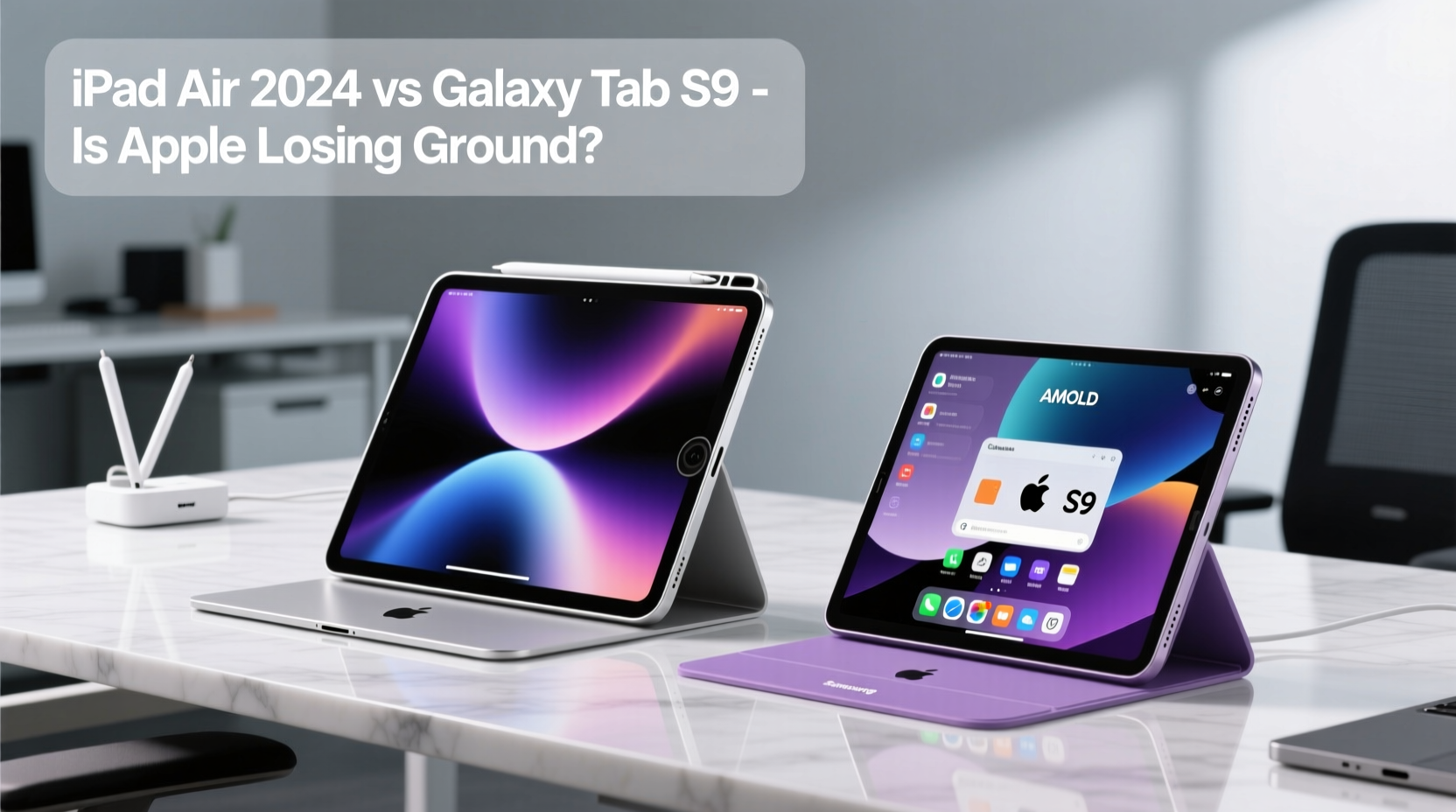
The iPad Air 2024 continues Apple’s tradition of minimalist elegance. It features a sleek aluminum unibody, flat edges, and a 10.9-inch Liquid Retina display with slim bezels. At 461 grams (Wi-Fi model), it’s lightweight and comfortable for extended use. The landscape-mounted front camera remains a thoughtful touch for video calls when using a keyboard.
Samsung’s Galaxy Tab S9, meanwhile, packs an 11-inch LTPS LCD panel (or optional OLED on the S9+) with even thinner bezels and a slightly more compact footprint despite the larger screen. It weighs 498 grams but feels balanced thanks to its symmetrical design. The standout here is durability: the Tab S9 is IP68-rated for dust and water resistance—a feature no iPad currently offers.
Tip: If you frequently use your tablet near water or outdoors, the Tab S9’s IP68 rating gives it a clear edge in peace of mind.While both tablets feel premium, Samsung pushes boundaries with material innovation and ruggedness, whereas Apple prioritizes consistency and familiarity. For some, that reliability is reassuring; for others, it may signal stagnation.
Performance and Software: iPadOS vs Android with DeX
Under the hood, the iPad Air 2024 is powered by Apple’s M2 chip—the same processor found in high-end MacBooks. This ensures exceptional performance for multitasking, creative apps, and gaming. However, iPadOS still imposes limitations on file management, external peripherals, and true desktop-class workflows. Despite Stage Manager improvements, iPadOS often feels like a mobile OS stretched beyond its original intent.
In contrast, the Galaxy Tab S9 runs on Qualcomm’s Snapdragon 8 Gen 2 with Android 13 (upgradable to Android 14) and Samsung DeX. DeX transforms the tablet into a desktop-like environment when connected to a monitor or used with a keyboard and mouse. You can run multiple resizable windows, drag-and-drop files, and even access Linux environments via Termux. For productivity-focused users, this flexibility is transformative.
“Samsung’s DeX provides a level of desktop parity that iPadOS still struggles to match—even with the M2 chip.” — David Lin, Mobile Product Analyst at TechPulse
Apple’s hardware advantage is undeniable, but Samsung’s software vision offers more functional depth. The M2 powers smoother animations and faster rendering, yet if the operating system doesn’t let you fully utilize that power, does it matter as much?
Display and Audio: Clarity vs Immersion
The iPad Air 2024’s Liquid Retina display delivers excellent color accuracy, brightness (up to 500 nits), and True Tone support. It’s ideal for media consumption and digital art, especially with the second-gen Apple Pencil’s low latency.
The Galaxy Tab S9 matches this with a 120Hz refresh rate across all models—an advantage over the iPad Air’s 60Hz panel. The higher refresh rate makes scrolling, drawing, and gaming noticeably smoother. On the S9+, the Dynamic AMOLED 2X display reaches 800 nits peak brightness and supports HDR10+, offering superior contrast and deeper blacks.
| Feature | iPad Air 2024 | Galaxy Tab S9 |
|---|---|---|
| Screen Size | 10.9 inches | 11 inches |
| Resolution | 2360 × 1640 | 2560 × 1600 |
| Refresh Rate | 60Hz | 120Hz |
| Brightness | 500 nits | 600 nits (800 on S9+) |
| Audio | Quad speakers (landscape) | Quad speakers with Dolby Atmos |
Audio quality favors Samsung as well. All Tab S9 models include quad speakers tuned with Dolby Atmos, delivering richer spatial sound. The iPad Air’s speakers are strong but lack the immersive depth, particularly in portrait mode where two drivers are blocked by hands.
Productivity and Accessories: Ecosystem Lock-In vs Open Flexibility
Apple’s ecosystem remains a major selling point. The Magic Keyboard Folio offers a stable typing experience and trackpad support. The second-gen Apple Pencil magnetically attaches and charges seamlessly. However, the keyboard lacks a trackpad on non-Pro models, and third-party accessory support is limited due to proprietary connectors and licensing (MFi).
Samsung takes a more open approach. The Book Cover Keyboard is affordable and widely compatible. The S Pen is included with the Tab S9 and stores directly in the chassis. It supports Bluetooth shortcuts and works across Galaxy devices. Most importantly, the Tab S9 supports USB-C peripherals—including external drives, Ethernet adapters, and HDMI output—making it viable as a laptop replacement.
Mini Case Study: Freelance Designer Maria Chen
Maria switched from an iPad Pro to a Galaxy Tab S9+ after landing a remote job requiring frequent client presentations and cross-platform collaboration. “I was frustrated trying to manage project files across cloud services on iPad,” she said. “With DeX, I can plug into my TV, open three document windows, and present live edits without switching devices. The S Pen pressure sensitivity is on par with the Apple Pencil, and now I don’t need to carry my laptop.”
Her experience highlights a growing trend: professionals who value interoperability and desktop-like control are finding iPadOS too restrictive, even with powerful hardware.
Battery Life and Charging: Real-World Endurance
The iPad Air 2024 boasts up to 10 hours of web browsing or video playback. It charges via USB-C but only supports 20W fast charging, meaning a full charge takes over two hours. There’s no official battery percentage indicator on the home screen without enabling accessibility settings—a small but persistent annoyance.
The Galaxy Tab S9 also offers around 10–12 hours of mixed usage but supports 45W fast charging (with compatible adapter). You can reach 50% in under 30 minutes. Battery percentage is visible by default, and adaptive battery learning extends longevity over time.
Tip: Always use a high-wattage charger with the Tab S9 to maximize convenience—especially if you're on the move.FAQ
Can the Galaxy Tab S9 replace a laptop?
Yes, especially with Samsung DeX, external monitor support, and USB-C peripheral compatibility. For tasks like document editing, coding, email management, and video conferencing, it functions as a capable laptop alternative.
Is the iPad Air 2024 worth upgrading to from an older iPad?
If you’re on an iPad Air 3 or earlier, the M2 chip and USB-C port offer meaningful gains. However, if you rely heavily on pencil input and iOS apps, consider whether iPadOS limitations outweigh the performance boost.
Which tablet has better stylus support?
Both the Apple Pencil (2nd gen) and S Pen offer excellent precision and low latency. The S Pen has the edge in convenience (included, no extra cost), while the Apple Pencil integrates more tightly with creative apps like Procreate.
Checklist: Choosing Between iPad Air 2024 and Galaxy Tab S9
- ✅ Need seamless Apple ecosystem integration? → iPad Air 2024
- ✅ Want a built-in stylus? → Galaxy Tab S9
- ✅ Prioritize file management and multitasking? → Galaxy Tab S9
- ✅ Use mostly iOS-exclusive apps (e.g., Procreate, Final Cut)? → iPad Air 2024
- ✅ Work in harsh environments or near water? → Galaxy Tab S9 (IP68)
- ✅ Prefer higher screen refresh rate and better audio? → Galaxy Tab S9
- ✅ Value fast charging and USB peripheral support? → Galaxy Tab S9
Conclusion: Is Apple Losing Ground?
The iPad Air 2024 is a technically impressive device—fast, well-built, and deeply integrated into the Apple universe. But being good isn’t enough anymore. Samsung’s Galaxy Tab S9 delivers not just competitive specs, but meaningful innovations in usability, flexibility, and openness.
Apple isn’t losing ground because its hardware is inferior; it’s losing relevance because iPadOS hasn’t evolved to match user expectations for productivity and adaptability. Meanwhile, Samsung has positioned the Tab S9 as a true hybrid device—one that bridges mobile and desktop worlds without compromise.
If Apple wants to maintain leadership, it needs to rethink iPadOS as more than a phone interface scaled up. Until then, consumers seeking versatility, future-proofing, and desktop-grade functionality have a compelling alternative.
🚀 Ready to rethink what a tablet can do? Share your thoughts on the iPad Air 2024 vs Galaxy Tab S9 debate—have you made the switch, or are you staying loyal to Apple? Join the conversation below.