
In 2019, three smartphones dominated India’s mid-range conversation: the Honor 8X, Samsung Galaxy M30, and Redmi Note 7 Pro. Each arrived with aggressive marketing, strong specs for the price, and a promise to redefine what budget phones could deliver. But years later, with user experiences accumulated and software updates completed, which one actually justified the buzz?
This isn’t just about spec sheets or launch-day excitement. It’s about long-term usability, build quality, camera consistency, and whether the device still holds up when used daily by average consumers. Let’s break down each contender not as they were hyped, but as they performed in reality.
Design and Build Quality: First Impressions Matter
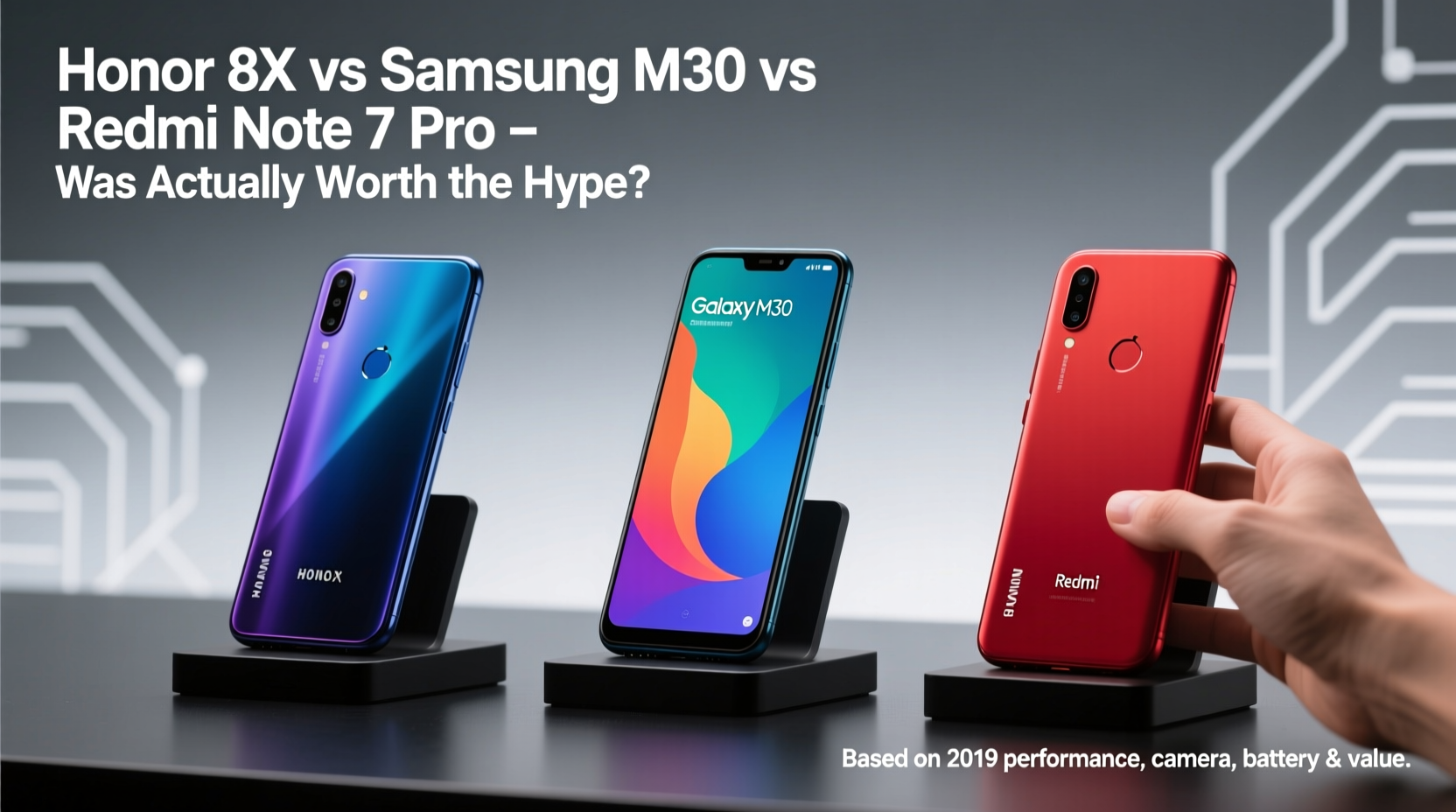
The Honor 8X stood out immediately with its glossy gradient back panel and slim bezels. At the time, its nearly all-screen front design—thanks to a small notch—felt premium. Constructed with polycarbonate and glass elements, it offered a sleek look but was prone to fingerprints and scratches without a case.
The Samsung M30 adopted a more conservative approach. Its plastic body felt sturdy, if uninspired. The triple rear camera layout was neatly aligned, and the side-mounted fingerprint sensor was responsive. While not flashy, it exuded durability, especially important for users who drop their phones frequently.
Xiaomi’s Redmi Note 7 Pro took a middle path. It featured a glass-like finish on plastic, giving it a high-end appearance at a fraction of the cost. The dual-tone gradient was eye-catching, and the vertical dual cameras sat flush, reducing wobble on flat surfaces. However, like the Honor, it attracted smudges easily.
Tip: For any of these devices, use a protective case early—especially the Honor 8X and Redmi Note 7 Pro, whose slippery backs make them prone to drops.Performance and Real-World Speed
Under the hood, these phones diverged significantly. The Honor 8X ran on Huawei’s Kirin 710 chipset, paired with up to 4GB RAM. It handled everyday tasks smoothly but struggled with heavy multitasking and sustained gaming. GPU performance lagged behind competitors, making games like PUBG run at medium settings only.
The Redmi Note 7 Pro was a game-changer thanks to the Qualcomm Snapdragon 675. This chip brought better CPU efficiency and superior graphics handling. Apps launched faster, background processes stayed active longer, and gaming performance was noticeably smoother than both rivals. With up to 6GB RAM, it remained fluid even after months of use.
Samsung’s M30 used Exynos 7904, a capable but underpowered processor compared to the Snapdragon. While sufficient for browsing and social media, it faltered during prolonged usage. Multitasking between five or more apps often triggered reloads. Still, Samsung’s One UI (then Experience) optimized memory usage better than most skins at the time.
“Chipset choice made the biggest difference in longevity. The Snapdragon 675 in the Redmi Note 7 Pro aged far better than mid-tier Exynos or Kirin chips.” — Arjun Mehta, Mobile Tech Analyst at GadgetPulse
Battery Life and Charging: Who Lasts the Longest?
All three phones came with large batteries, but endurance varied due to software optimization and screen technology.
| Phone | Battery Capacity | Screen Type | Real-World Battery Life | Charging Speed |
|---|---|---|---|---|
| Honor 8X | 3,750 mAh | LCD | 1.2 days (light use) | 10W (slow) |
| Samsung M30 | 5,000 mAh | Super AMOLED | Up to 2 days | 15W (fast) |
| Redmi Note 7 Pro | 4,000 mAh | LCD | 1.5 days | 18W (fastest among trio) |
The Samsung M30 clearly wins in battery stamina. Its massive 5,000 mAh cell combined with power-efficient AMOLED display meant fewer charges per week. Even with moderate gaming, it rarely needed a top-up before bedtime on day two.
The Redmi Note 7 Pro balanced capacity and charging speed well. Though smaller than the M30’s battery, its 18W fast charging allowed a 0–70% charge in 45 minutes—ideal for users with tight schedules.
Honor’s offering, while adequate, lacked fast charging and drained quicker under screen-on use due to less efficient display drivers.
Camera Performance: Beyond Megapixel Marketing
Marketing heavily emphasized megapixels, especially with the Redmi Note 7 Pro boasting a 48MP primary sensor. In daylight, this translated to sharp, detailed images with good dynamic range. Low-light performance was decent for its class, though noise crept in quickly without Night Mode.
The Honor 8X used a 20MP + 2MP dual setup. Photos were softer, with inconsistent HDR and poor low-light output. Edge detection in portrait mode was erratic, often blurring parts of the subject's hair or face.
The Samsung M30 had a triple camera: 13MP main, 5MP ultra-wide, and 5MP depth. While the resolution wasn’t headline-grabbing, Samsung’s image processing delivered natural colors and reliable autofocus. The ultra-wide lens added versatility rare in this segment at the time.
Tip: Don’t trust megapixel counts alone. Software tuning and sensor size matter more for consistent photo quality across lighting conditions.A Real-World Example: Priya’s Photography Journey
Priya, a college student and amateur photographer, bought the Redmi Note 7 Pro in early 2019 to document campus life. She loved capturing golden-hour portraits and street scenes. Initially thrilled by the 48MP detail, she soon noticed that shadows turned muddy and skies clipped in bright sunlight. After switching to third-party camera apps and manual modes, her results improved dramatically. Two years later, she upgraded—but admitted the Note 7 Pro taught her more about mobile photography than any other phone she’d owned.
Software Updates and Long-Term Support
This is where expectations met harsh reality. The Honor 8X launched with Android 8.1 and received one major update to Android 9. With Huawei’s exit from Google services post-2019, future security patches became irregular. By 2021, support had effectively ended.
Samsung promised two years of OS updates for the M30. It moved from Android 8.1 to 10—a significant improvement. Security updates continued into 2021, aligning with Samsung’s stronger commitment to mid-range devices.
Xiaomi delivered MIUI updates frequently, but these were mostly skin-level improvements. The Redmi Note 7 Pro got Android 10, but never Android 11. Despite community demand, official development halted in 2021. However, its open bootloader encouraged custom ROMs, extending its usable life for tech-savvy users.
Checklist: What Made These Phones Worthy in Hindsight?
- Strong initial performance – Did it handle 2019–2020 apps smoothly?
- Battery that lasted beyond a full day – No need for midday charging.
- At least one standout feature – e.g., camera, display, or fast charging.
- Reliable software updates for 18+ months – Critical for security and compatibility.
- Resale value retention – Indicative of perceived quality over time.
Frequently Asked Questions
Which phone had the best display?
The Samsung M30 wins here. Its Super AMOLED panel offered deeper blacks, vibrant colors, and better outdoor visibility than the LCD screens on the Honor 8X and Redmi Note 7 Pro.
Can any of these phones still be used in 2024?
Only sparingly. Basic calling, messaging, and light browsing are possible, but app compatibility (especially banking and social media) has degraded. Performance lags significantly with modern web content and updated apps.
Was the Redmi Note 7 Pro worth the hype?
Yes—for its time. As a 2019 device, it offered exceptional value with its Snapdragon 675, 48MP camera, and fast charging. However, the hype outpaced long-term software support, which let it down.
Final Verdict: Which Phone Was Actually Worth It?
The Redmi Note 7 Pro generated the most justified hype. It delivered tangible advantages in processing power, camera clarity, and charging speed—features users could feel daily. While its software support eventually stalled, its hardware kept pace longer than the others.
The Samsung M30 may have been the smarter long-term investment. Slower to impress, it won through consistency: unmatched battery life, better display, and more reliable updates. For users prioritizing longevity over raw specs, it quietly outperformed the competition.
The Honor 8X, despite its striking design and strong launch campaign, faded fastest. Limited updates, weaker performance, and no ecosystem support after 2019 made it the least sustainable option.
In the end, \"worth the hype\" depends on priorities. If you wanted the fastest phone in 2019, go Redmi. If you valued lasting power and reliability, choose Samsung. And if you just wanted something that looked expensive on a budget, Honor served that niche—briefly.
🚀 Still using a budget phone from this era? Share your experience—what worked, what didn’t—and help today’s buyers learn from real stories. Your insight could guide someone’s next smart purchase.