For years, iPhone users have enjoyed a consistent ecosystem, polished software, and reliable hardware. But with Samsung’s Galaxy Z Flip series introducing a bold new form factor — compact, foldable, and fashion-forward — many are asking: is it worth leaving the iPhone 13 behind? The decision isn’t just about specs; it’s about lifestyle, usability, and long-term value. This comparison cuts through marketing hype to help you decide whether the flip makes sense for your daily routine.
Design and Portability: Form Meets Function
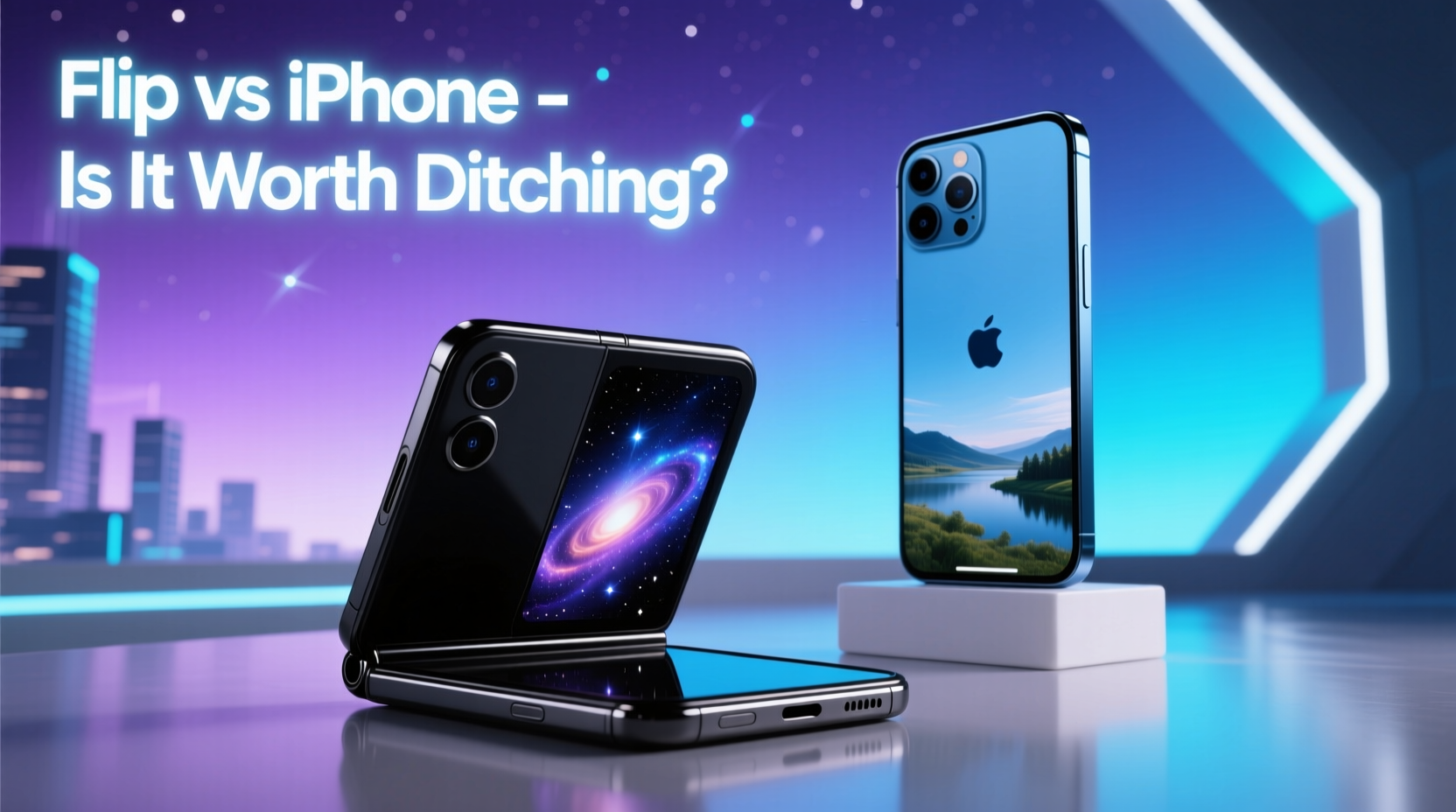
The most obvious difference between the Galaxy Z Flip and the iPhone 13 lies in their physical design. The iPhone 13 sticks to Apple’s familiar slab-style smartphone format — a 6.1-inch flat display with rounded edges and aerospace-grade aluminum frame. It fits comfortably in pockets and offers excellent build quality, but it doesn’t innovate beyond incremental improvements.
In contrast, the Galaxy Z Flip folds vertically like a clamshell. When closed, it shrinks to roughly half its size — making it ideal for purses, small pockets, or minimalist carry. Its hinge mechanism allows for hands-free use at multiple angles, enabling features like self-framing video calls or stabilized photo capture without a tripod.
Tip: If pocket space is limited or you frequently carry a bag, the Z Flip’s compact folded size can be a game-changer.However, folding comes with trade-offs. The crease down the center of the Z Flip’s inner screen is visible under certain lighting, and the device feels less rigid than the iPhone 13 when open. While both phones use durable glass (Gorilla Glass Victus on the Z Flip, Ceramic Shield on the iPhone), the Z Flip’s flexible polymer screen requires more careful handling.
Performance and Software Experience
Under the hood, the iPhone 13 runs on Apple’s A15 Bionic chip — one of the fastest mobile processors ever made. Apps launch instantly, multitasking is seamless, and iOS 17 delivers smooth animations and strong app optimization. The system is intuitive, secure, and tightly integrated with other Apple devices like AirPods, Macs, and Apple Watch.
The Galaxy Z Flip uses Qualcomm’s Snapdragon 888 (or 8 Gen 1 in later models), which is powerful but not quite on par with the A15 in single-core tasks. Android 13 offers greater customization and split-screen functionality that takes advantage of the foldable form, but app support for optimized layouts remains inconsistent. Some apps still don’t scale properly when unfolded or fail to remember window positions.
“Foldables aren’t just smaller phones — they’re a new category requiring new interaction patterns. Developers are catching up, but there’s still friction.” — Linus Lee, Mobile UX Researcher at FlexiInterface Labs
iOS benefits from uniformity across devices, while Samsung’s One UI adapts dynamically to the changing screen state. For example, answering a call works differently depending on whether the phone is folded or open. These nuances can feel innovative — or confusing — based on user preference.
Camera Comparison: Practicality vs. Innovation
The iPhone 13 set a high bar for smartphone photography with its dual-camera system (12MP wide and ultra-wide). It excels in natural color reproduction, low-light performance via Night mode, and cinematic video recording with depth control. Its consistency across lighting conditions makes it a favorite among casual and professional users alike.
The Galaxy Z Flip also has a 12MP main sensor and 10MP front camera, but lacks a dedicated ultra-wide lens. However, its unique hinge enables a feature called “Flex Mode,” which splits the viewfinder when partially opened — letting you preview selfies on the lower half while capturing on the upper. No tripod needed.
| Feature | iPhone 13 | Galaxy Z Flip |
|---|---|---|
| Main Camera | 12MP, f/1.6 | 12MP, f/1.8 |
| Ultra-Wide Lens | Yes | No |
| Front Camera | 12MP, f/2.2 | 10MP, f/2.4 |
| Video Recording | 4K @ 60fps, Cinematic Mode | 4K @ 60fps, no cinematic blur |
| Unique Feature | Photographic Styles | Hands-free Flex Mode shooting |
If you prioritize image quality and versatility, the iPhone 13 wins. But if you love taking selfies, vlogging, or want creative flexibility without extra gear, the Z Flip offers compelling advantages.
Battery Life and Durability Concerns
The iPhone 13 delivers all-day battery life under moderate use — typically lasting 12–14 hours from full charge. It supports fast charging (up to 50% in 30 minutes with 20W adapter) and MagSafe wireless charging. Apple doesn’t officially rate dust or water resistance beyond IP68, but real-world performance is strong.
The Z Flip packs a smaller 3,300mAh battery — significantly less than standard flagships. In practice, heavy users may need to recharge by late afternoon. Power-saving modes help, and adaptive refresh rate (1–120Hz) improves efficiency, but endurance lags behind the iPhone 13.
Durability is another concern. The Z Flip’s hinge is rated for over 200,000 folds — theoretically five years of twice-daily use — but sand or debris can damage the mechanism. Samsung includes a thin protective layer over the screen, but warns against peeling it off. Unlike the iPhone 13, the Z Flip cannot survive drops onto hard surfaces as easily due to its moving parts.
Tip: Always close the Z Flip before placing it in a bag or pocket to prevent screen scratches from keys or coins.Real-World Use Case: Sarah’s Switch from iPhone to Z Flip
Sarah, a freelance graphic designer in Austin, used iPhones exclusively for a decade. She upgraded to the iPhone 13 in 2021 and loved the camera and ecosystem integration. But after borrowing a friend’s Galaxy Z Flip, she was drawn to its compactness and aesthetic appeal.
She made the switch six months ago. “I work in coffee shops and co-working spaces,” she says. “Putting my phone face-up on the table used to feel awkward. Now, I fold it halfway during Zoom calls — it looks professional and charges at the same time.”
But the transition wasn’t seamless. “Some of my favorite productivity apps didn’t support split-screen well. And I missed iCloud Photos syncing automatically.” Still, she values the personalization options and tactile satisfaction of flipping the phone shut after finishing a task. “It feels like closing a notebook — a small ritual that helps me disconnect.”
Should You Make the Switch? A Decision Checklist
Moving away from iPhone means reevaluating your digital habits. Use this checklist to assess whether the Galaxy Z Flip aligns with your needs:
- ✅ Do you value portability and compact design over raw power?
- ✅ Are you comfortable learning new gestures and adapting to Android?
- ✅ Do you often take selfies or record videos without accessories?
- ✅ Can you accept shorter battery life in exchange for novelty and style?
- ✅ Are you willing to replace your phone sooner if the hinge wears out?
- ❌ Do you rely heavily on Apple ecosystem features (AirDrop, iMessage, FaceTime)?
- ❌ Is camera versatility (ultra-wide, zoom) essential to your daily use?
If most checks are positive, the Z Flip could enhance your experience. If negatives dominate, sticking with the iPhone 13 — or waiting for future foldables — might be wiser.
Frequently Asked Questions
Can the Galaxy Z Flip replace an iPhone 13 for everyday use?
Yes, for many users — especially those who prioritize style, compactness, and interactive features. However, compromises in battery life, app optimization, and ecosystem integration mean it won’t suit everyone equally well.
Is the foldable screen durable enough for long-term use?
Samsung designs the Z Flip to last, with a reinforced hinge and scratch-resistant layer. With proper care — avoiding dust, pressure, and moisture — it can endure daily use for years. But it’s inherently more fragile than a traditional phone like the iPhone 13.
Will I lose data switching from iPhone to Galaxy?
Not permanently. Samsung’s Smart Switch tool transfers contacts, photos, messages, and some app data. However, iMessage threads remain trapped in Apple’s ecosystem unless exported beforehand, and some subscriptions (like Apple Music) require separate cancellation or migration.
Final Verdict: The Flip Has Its Place — But Not for Everyone
The Galaxy Z Flip isn’t trying to beat the iPhone 13 at its own game. Instead, it offers a different philosophy: technology as expression, convenience, and gesture. It rewards users who appreciate design innovation and enjoy interacting with their devices in new ways.
But if you depend on reliability, long battery life, and seamless integration with Apple products, the iPhone 13 remains the safer, more practical choice. The Z Flip demands adaptation — and patience.
Ultimately, the flip isn’t worth ditching the iPhone for sheer novelty. But if your lifestyle values minimalism, creativity, and forward-thinking tech, the Galaxy Z Flip might just be the breath of fresh air you didn’t know you needed.
💬 Have you switched from iPhone to a foldable? What surprised you most? Share your story in the comments — your experience could help others make the leap.