The smartphone market has reached a fascinating crossroads. On one side, flagship devices like the Samsung Galaxy S21 Ultra deliver near-perfect refinement—powerful hardware, exceptional cameras, and polished software in a traditional slab form. On the other, foldables like the Galaxy Z Fold 4 represent the future: innovative, multitasking-focused, and redefining how we interact with mobile technology. But is that innovation worth the premium price? For many buyers weighing the Galaxy Z Fold 4 against the still-excellent S21 Ultra, the real question isn’t just about specs—it’s about lifestyle fit and long-term value.
The S21 Ultra remains a benchmark for Android flagships, even years after release. Meanwhile, the Z Fold 4 refines Samsung’s foldable vision with better durability, improved multitasking, and more natural daily usability. Yet it comes at a significantly higher cost. So who actually benefits from paying extra for the fold? The answer depends on how you use your phone—and what kind of experience you’re willing to trade for cutting-edge design.
Design and Build: Form Factor as a Lifestyle Choice
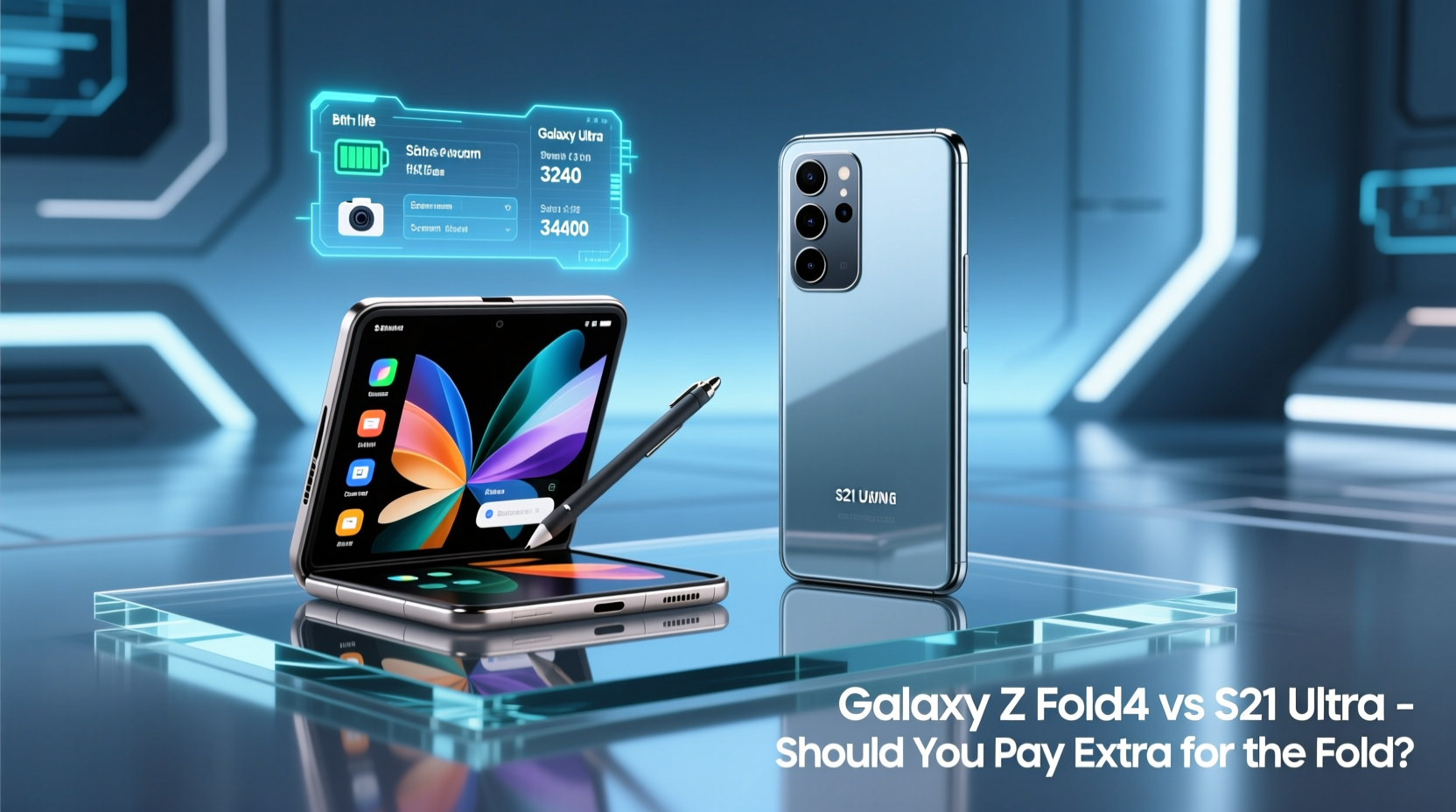
The most obvious difference between these two phones is their physical design. The S21 Ultra is a high-end traditional smartphone: sleek, dense, and built for single-handed use. It features a 6.8-inch flat Dynamic AMOLED display with a 120Hz refresh rate, Gorilla Glass Victus, and an IP68 rating for dust and water resistance. It’s heavy at 227g, but its weight distribution makes it manageable for extended use.
In contrast, the Galaxy Z Fold 4 folds open like a book. Closed, it’s compact (6.3 inches), but opens into a 7.6-inch tablet-like interior screen. This dual-screen approach changes everything—from pocketability to how you consume media or reply to messages. However, it sacrifices some ruggedness. While improved over previous models, the Z Fold 4 has no official IP rating and requires more careful handling due to its hinge and inner display vulnerability.
Tip: If you frequently drop your phone or use it outdoors, the S21 Ultra’s durability gives it a clear edge.The Fold’s design isn’t just novel—it enables new behaviors. You can watch a video on the main screen while replying to messages on the cover display. Or browse Twitter on one side of the inner screen while reading an article on the other. These aren’t party tricks; they reflect a shift toward true multitasking. But they only matter if your workflow demands it.
Performance and Software: Flagship Power, Different Priorities
Both phones are powered by top-tier hardware. The S21 Ultra runs on either the Exynos 2100 or Snapdragon 888 (depending on region), while the Z Fold 4 uses the newer Snapdragon 8+ Gen 1. Despite the generational leap, real-world performance differences are minimal. Both handle gaming, multitasking, and app switching with ease. RAM is 12GB on both, though storage options differ slightly.
Where they diverge is software optimization. The S21 Ultra runs One UI smoothly, with no compromises. The Z Fold 4, however, benefits from Samsung’s ongoing efforts to tailor Android for foldables. Features like App Pair, Split Screen Snap, and Flex Mode (which lets the phone stand partially open for hands-free viewing) make the most of the larger canvas. Apps like YouTube, Microsoft Office, and Samsung Notes adapt well across both screens.
Yet not all apps are optimized. Some still don’t resize properly or ignore the crease down the middle of the inner display. This inconsistency means the Fold’s potential isn’t fully realized—yet. For users who rely on niche or older apps, this can be frustrating.
“Foldables are no longer prototypes, but they’re still in evolution. The hardware leads the software.” — David Lee, Mobile UX Analyst at TechInsight Group
Camera Comparison: S21 Ultra Still Holds the Crown
If photography is a priority, the S21 Ultra is the undisputed winner. Its quad-camera system includes a 108MP main sensor, dual telephoto lenses (3x and 10x optical zoom), and advanced AI processing. The result is class-leading detail, dynamic range, and zoom capability—especially useful for moon shots, wildlife, or distant landscapes.
The Z Fold 4, while competent, takes a backseat. It features a 50MP main camera, 12MP ultrawide, and 10MP telephoto (3x zoom). Image quality is good in daylight but falls behind in low light and lacks the versatility of the S21 Ultra’s periscope lens. What’s more, the outer screen doubles as a viewfinder when using rear cameras, which is clever—but not enough to close the gap.
| Feature | Galaxy Z Fold 4 | S21 Ultra |
|---|---|---|
| Main Camera | 50MP | 108MP |
| Telephoto Zoom | 3x optical | 3x & 10x optical |
| Ultrawide Aperture | f/2.2 | f/2.2 |
| Low-Light Performance | Good | Excellent |
| Video Recording | 4K @ 60fps | 8K @ 24fps, 4K @ 60fps |
For social media creators or casual photographers, the Fold’s camera may suffice. But professionals or enthusiasts will miss the S21 Ultra’s precision and flexibility.
Real-World Use Case: Who Actually Benefits From the Fold?
Consider Maria, a digital marketing manager who travels weekly. She used an S21 Ultra for years but switched to the Z Fold 4 for her frequent flights. Her routine changed dramatically: she now edits Google Docs on one side of the inner screen while reviewing analytics dashboards on the other. During layovers, she watches tutorials full-screen while taking notes in Samsung Notes. The ability to prop the phone in Flex Mode during video calls has reduced neck strain.
But there were trade-offs. She quickly learned to avoid sand or dust near the hinge. She invested in a protective case and screen protector. Battery life, while acceptable, requires midday charging—unlike the S21 Ultra, which often lasted a full day and a half. And when her niece borrowed the phone, she accidentally scratched the inner screen trying to pry it open.
Maria’s experience highlights a truth: the Z Fold 4 excels for power users who need productivity gains. But it demands care, adaptation, and acceptance of certain limitations. For someone who mostly streams, texts, and takes photos, the S21 Ultra delivers a more seamless, worry-free experience.
Value Proposition: Is the Fold Worth the Premium?
Pricing tells part of the story. The S21 Ultra launched at $1,199 and can now be found refurbished or discounted for under $700. The Z Fold 4 started at $1,799 and remains above $1,200 even with promotions. That’s a $500–$600 difference—equivalent to buying a second mid-range phone.
So what do you get for that extra cost?
- A device that transforms from phone to mini-tablet
- Superior multitasking capabilities
- More immersive media consumption
- Future-forward design and status appeal
But you also accept:
- Shorter battery life
- No waterproofing
- Higher risk of damage
- Limited app optimization
- Faster depreciation
Checklist: Should You Choose the Z Fold 4?
- Do you regularly juggle multiple apps or tasks on your phone?
- Do you work remotely or travel frequently for business?
- Are you comfortable protecting and maintaining a delicate device?
- Do you value screen real estate over camera quality?
- Can you justify a $1,300+ investment in a secondary-device role?
If you answered “yes” to most, the Fold makes sense. If not, the S21 Ultra offers flagship performance at a fraction of the cost.
Frequently Asked Questions
Can the Z Fold 4 replace my tablet and phone?
For many users, yes—especially with DeX mode and app pairing. But it’s not ideal for long reading sessions or heavy gaming due to weight and heat buildup.
Is the crease on the Z Fold 4 distracting?
Initially, yes. Most users report getting used to it within a few days. It’s less noticeable during video playback or web browsing.
Does the S21 Ultra feel outdated next to the Fold?
Not in performance or daily use. It feels more solid and responsive. The Fold feels futuristic; the S21 Ultra feels complete.
Final Verdict: Pay Extra Only If You’ll Use the Fold
The Galaxy Z Fold 4 is no longer a novelty. It’s a capable, thoughtfully designed device that pushes mobile computing forward. But it’s not for everyone. The S21 Ultra remains one of the best traditional smartphones ever made—powerful, durable, and excellent in every core function.
Paying extra for the fold only makes sense if you actively use the multitasking features, value portability with large-screen functionality, and accept the trade-offs in durability and battery. For everyone else, the S21 Ultra delivers more practical value and fewer compromises.
Technology should serve your life—not the other way around. Before upgrading, ask yourself: will this device change how I work, create, or communicate? If yes, the Fold might be worth it. If not, save the money and enjoy a near-perfect phone experience without the fragility.
🚀 Ready to decide? Try both devices in-store, simulate your daily tasks, and choose based on actual use—not just the wow factor.