As holiday decor evolves beyond traditional tinsel and lights, two standout technologies have captured the imagination of modern decorators: fiber optic tree toppers and rotating crystal projectors. Both promise to transform a room’s atmosphere with dynamic, shimmering light displays that dance across ceilings and walls. But when it comes to creating truly mesmerizing patterns, which option delivers the deeper visual impact? The answer depends on your aesthetic goals, space layout, and tolerance for setup complexity.
Fiber optic toppers rely on bundles of thin glass or plastic strands that transmit light from a central source, often embedded in a star or angel design placed atop a Christmas tree. In contrast, rotating crystal projectors use motorized glass prisms and focused LED arrays to scatter intricate patterns through refraction and motion. While both create magical effects, their mechanisms, coverage, and emotional resonance differ significantly.
How Light Is Created: Core Technology Compared
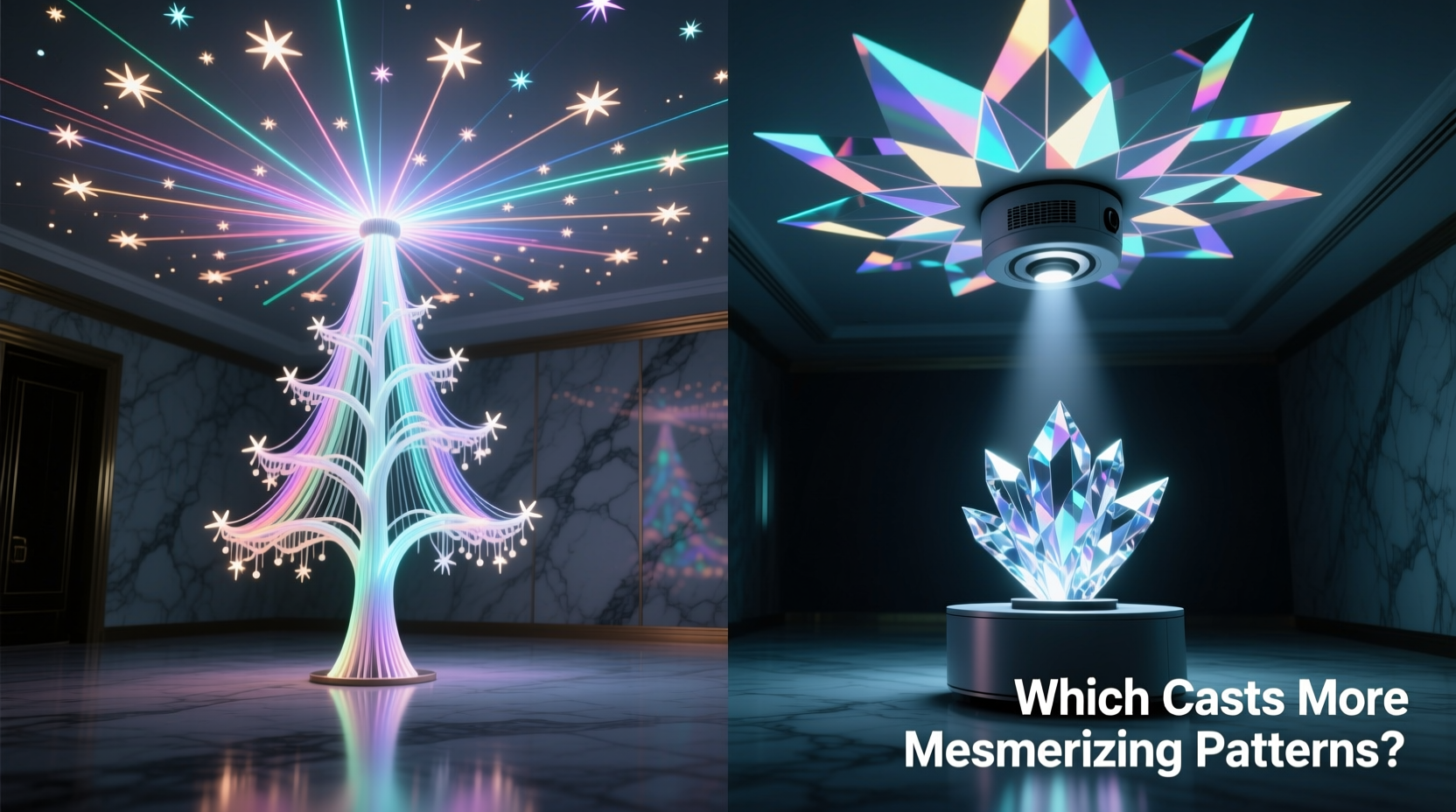
The fundamental difference between these two lighting systems lies in how they generate and distribute light.
Fiber optic tree toppers operate on the principle of total internal reflection. A bright LED or halogen bulb sits at the base of the topper, channeling light up thousands of fine fibers. Each fiber acts as a waveguide, emitting a pinpoint of light at its tip. When clustered densely—especially in a star-shaped housing—the collective effect resembles a miniature galaxy frozen in place. The patterns are static unless the entire topper is manually rotated, and the glow tends to be soft, diffuse, and uniform.
Rotating crystal projectors, by contrast, use kinetic optics. A high-lumen LED shines through a precisely cut glass or acrylic prism that spins slowly on a motorized axis. As the crystal turns, it refracts and splits the light into moving beams that sweep across surfaces in ever-changing configurations. Some models include interchangeable lenses or color wheels, enabling transitions between blue winter skies, warm amber glows, or festive red-and-green cycles.
Tip: For maximum pattern clarity, position crystal projectors 6–8 feet from the nearest wall or ceiling surface, and avoid overly textured paint finishes that scatter light unevenly.Visual Impact: Pattern Complexity and Movement
When evaluating \"mesmerizing\" quality, movement and variation are key. Human eyes are naturally drawn to motion, especially unpredictable or flowing patterns. This gives rotating crystal projectors a distinct advantage in sustained engagement.
Fiber optic toppers emit a consistent halo of tiny dots around the tree’s apex. The effect is elegant and celestial, but largely unchanging. Once you’ve seen it, the visual novelty diminishes unless viewed from multiple angles or paired with colored filters that shift slowly. Their strength lies in subtlety—a quiet sparkle rather than a dramatic show.
Rotating projectors, however, produce evolving lightscapes. As the crystal spins, each facet catches the light at a slightly different angle, creating shifting constellations, rippling waves, or cascading sparkles. The best models simulate aurora-like flows, with beams appearing to bloom outward before fading into new formations. Because the motion is continuous and non-repeating over short intervals, the brain remains engaged longer, enhancing the perception of magic.
“Dynamic light patterns activate the same cognitive curiosity as watching flames or water. They’re inherently hypnotic.” — Dr. Lena Torres, Environmental Psychologist, Institute of Sensory Design
Installation and Practical Considerations
Practicality plays a major role in choosing between these options, especially for renters, apartment dwellers, or those with limited storage.
Fiber optic toppers integrate directly into existing décor. If you already have a tree, attaching a topper is as simple as securing it to the top branch. Most models plug into standard outlets and require no calibration. However, their lighting effect is confined to the immediate vicinity of the tree—typically casting a 6- to 10-foot diameter of starlight on the ceiling. Larger rooms may feel underlit.
Crystal projectors demand more planning. They must be positioned on a stable surface—floor, shelf, or tripod—with a clear line of sight to the ceiling. Some units are sensitive to vibration, so placing them near foot traffic or subwoofers can disrupt the smooth rotation. Setup time ranges from 5 to 15 minutes, including focus adjustment and directional aiming. On the plus side, a single projector can cover an entire living room (up to 300 sq ft), making them ideal for open-concept spaces.
| Feature | Fiber Optic Tree Topper | Rotating Crystal Projector |
|---|---|---|
| Coverage Area | 6–10 ft diameter | Up to 300 sq ft |
| Setup Time | 2–3 minutes | 5–15 minutes |
| Motion Effect | Static (unless manually turned) | Continuous, automated rotation |
| Portability | High (part of tree) | Medium (separate unit) |
| Noise Level | Silent | Low hum (motorized) |
| Energy Use | 3–7 watts | 8–12 watts |
Real-World Example: A Cozy Apartment Transformation
Consider Sarah, a graphic designer living in a one-bedroom loft with 10-foot ceilings. Her previous holidays featured a modest artificial tree with string lights, but she wanted to elevate the ambiance without overcrowding her minimalist space.
In 2022, she tried a fiber optic star topper. While beautiful up close, the ceiling effect barely reached beyond the tree stand. Guests admired it but didn’t linger under the light.
The following year, she invested in a premium rotating crystal projector with a faceted glass orb and adjustable focus. She placed it on a side table across from the tree, aimed diagonally upward. Instantly, the entire ceiling came alive with slow-moving streaks of light that resembled falling snow and distant stars. Friends reported feeling “calm” and “transported,” and Sarah found herself turning it on not just during parties, but on quiet evenings to unwind.
The projector didn’t replace the tree—it enhanced the entire room. Unlike the topper, which was part of a single object, the projector transformed architecture itself into a canvas.
Step-by-Step: Optimizing Your Light Display
Whether you choose a fiber optic topper or a crystal projector, proper setup maximizes visual impact. Follow this sequence for best results:
- Assess your space: Measure ceiling height and room dimensions. Rooms over 200 sq ft typically benefit more from projectors.
- Choose placement: For toppers, ensure the tree is centered and unobstructed. For projectors, pick a location with direct upward visibility to the ceiling.
- Test ambient light: Turn off overhead lights and close blinds. Evaluate how much natural or artificial light competes with your display.
- Aim and focus: Adjust the projector’s tilt and zoom (if available) until patterns are sharp and evenly distributed. Avoid focusing on fans or hanging fixtures.
- Time the cycle: Set timers or smart plugs to activate the display during evening hours. Many find the effect most powerful in full darkness.
- Layer with other lights: Combine with dimmed string lights or candles to create depth without overpowering the main effect.
Which Is More Mesmerizing? A Balanced Verdict
\"Mesmerizing\" is subjective, but certain criteria can guide the decision:
- For romantic, intimate sparkle: Fiber optic toppers win. Their delicate, starfield-like glow suits small rooms, nurseries, or traditional holiday themes.
- For immersive, cinematic wonder: Rotating crystal projectors dominate. Their ability to animate an entire ceiling with fluid, evolving patterns makes them unmatched for sensory engagement.
- For ease and integration: Toppers are simpler. They require no extra cords across floors and blend seamlessly with tree décor.
- For versatility: Projectors can be used year-round—some owners repurpose them for meditation corners, home theaters, or even romantic dinners with warm-toned lenses.
If your goal is to create a moment of awe—where guests look up and pause—the crystal projector is more likely to deliver. It doesn’t just illuminate; it transforms. However, if you value tradition, simplicity, and a gentle glow that complements rather than commands attention, a fiber optic topper remains a timeless choice.
Checklist: Choosing the Right Option for You
Answer these questions to determine the best fit:
- ✅ Is your room larger than 200 sq ft?
- ✅ Do you want light patterns that move and evolve?
- ✅ Can you dedicate a floor or shelf space for a separate device?
- ✅ Are you comfortable with minor setup adjustments?
- ✅ Do you prefer a bold visual centerpiece over subtle elegance?
If you answered “yes” to three or more, a rotating crystal projector is likely the better investment. Otherwise, a fiber optic topper aligns with a low-maintenance, integrated aesthetic.
FAQ
Can I use both a fiber optic topper and a crystal projector together?
Yes, and many decorators do. The topper adds focal charm to the tree, while the projector expands the ambiance throughout the room. Just ensure colors and tones complement each other—avoid clashing cool and warm whites.
Do crystal projectors work on vaulted or angled ceilings?
They can, but effectiveness varies. Angled ceilings may distort or stretch patterns. For best results, aim the projector toward the highest point of the ceiling and test at night before final placement.
Are fiber optic toppers safe around pets and children?
Generally, yes. The fibers are non-conductive and emit minimal heat. However, the base unit contains electronics and should remain out of reach. Supervise curious hands or paws near any electrical decor.
Final Thoughts: Elevating Holiday Ambiance Through Light
The choice between fiber optic tree toppers and rotating crystal projectors isn't about superiority—it's about intention. One celebrates the beauty of stillness, the other the allure of motion. One honors tradition, the other embraces innovation.
Yet, when it comes to casting mesmerizing ceiling patterns—those fleeting moments of wonder that make people stop, look up, and smile—the rotating crystal projector holds a distinct edge. Its ability to turn architecture into art, to make static spaces feel alive, aligns closely with what \"mesmerizing\" truly means: capturing attention through graceful, unpredictable movement.
That said, the most magical spaces often combine both. A softly glowing tree crowned with fiber optics, paired with a projector’s celestial swirl above, creates layers of enchantment—one grounded in warmth, the other reaching for the stars.
💬 Have you tried either of these lighting styles? Share your experience, setup tips, or favorite brands in the comments—help others discover the perfect way to light up their holidays.