When it comes to vehicle safety and legal protection after an accident, dash cams have become essential tools for drivers. But not all dash cams offer the same level of security. The core decision many drivers face is whether to invest in a front-only dash cam or a dual-channel system that records both the front and interior (or rear) of the vehicle. While both options serve a purpose, understanding their differences in accident protection can significantly impact your ability to prove innocence, file accurate insurance claims, and deter fraudulent activity.
A single-lens front dash cam captures what happens on the road ahead—ideal for documenting collisions, near-misses, and traffic violations. However, it leaves blind spots when incidents occur behind or inside the car. Dual-channel systems, by recording from two angles simultaneously, provide a more complete picture. This article breaks down the key distinctions between these two types of dash cams, evaluates their effectiveness in real accident scenarios, and helps you determine which setup delivers superior protection.
Coverage and Field of View: What You See Matters
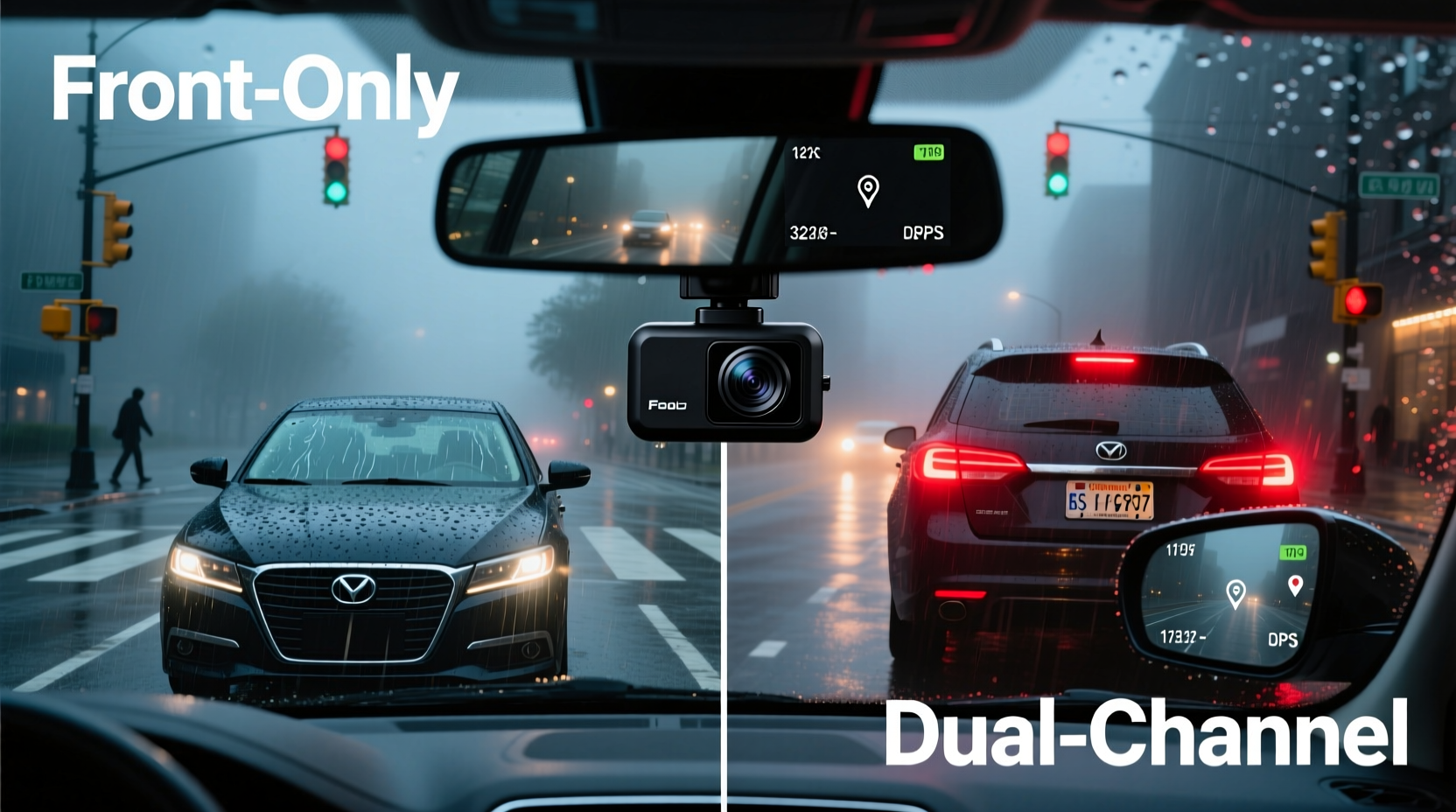
The most fundamental difference between front-only and dual-channel dash cams lies in the scope of visual coverage. A front-only camera typically mounts on the windshield and records everything directly in front of your vehicle. It’s excellent for capturing red-light runners, sudden stops, lane changes, and head-on collisions. However, its limited perspective becomes a liability in multi-angle accidents or disputes involving passengers or rear-end impacts.
Dual-channel systems add a second lens—usually mounted toward the cabin interior or facing the rear window. This allows simultaneous recording of both the road ahead and the vehicle’s interior or the traffic behind. In practical terms, this means:
- If a passenger behaves aggressively during a ride-share incident, the interior camera captures it.
- If your parked car is hit from behind, the rear camera records the fleeing driver.
- In a chain-reaction highway collision, footage from both ends helps reconstruct the sequence of events.
Insurance adjusters and law enforcement often require corroborating evidence from multiple angles. Relying solely on front footage may leave critical questions unanswered—especially when liability is disputed.
Tip: Always test your dash cam’s field of view before relying on it. Ensure the front lens captures at least three lanes of traffic and the interior lens clearly shows driver/passenger actions.Evidence Quality in Accident Claims
When filing an insurance claim or defending against false accusations, video evidence can make or break your case. Front-only dash cams deliver high-resolution footage of forward-facing events, but they fall short when the full context isn’t visible.
Consider a scenario where another vehicle rear-ends you, then claims you reversed into them. Without rear or cabin footage, proving your position and intent becomes difficult. A dual-channel system with rear recording can show the other vehicle approaching at speed, while interior audio might capture your startled reaction—both powerful pieces of evidence.
Moreover, some dual-channel models include time-stamped synchronized recordings, allowing side-by-side playback. This synchronization strengthens credibility in court or arbitration by showing consistent timelines across both cameras.
“Over 60% of contested auto claims involve conflicting accounts of who initiated contact. Multi-angle dash cam footage reduces ambiguity and speeds up resolution.” — Daniel Reeves, Auto Insurance Litigation Analyst
Front-only systems are still valuable, especially for commercial fleets focused on driver behavior and forward collision warning integration. But for personal vehicles exposed to diverse risks—including ride-sharing, parking lot incidents, and passenger disputes—dual-channel setups offer richer, more defensible data.
Real-World Scenarios: Where Each System Shines
To understand which system provides better accident protection, consider actual driving situations.
Case Study: The Hit-and-Run Parking Lot Incident
Sarah parks her SUV at a grocery store and returns to find damage on the rear bumper. No one left a note. Her front-only dash cam was off because the vehicle was parked. With no rear coverage or parking mode, she has no evidence. Repair costs exceed $1,200, and her insurance deductible makes filing a claim impractical.
Had Sarah used a dual-channel dash cam with parking mode enabled and a rear camera, the system could have detected motion or impact and started recording. The footage might have captured the license plate of the fleeing vehicle, enabling recovery of damages without involving insurance.
Case Study: Passenger Dispute During Ride-Sharing
James drives for a ride-hailing service. One evening, a passenger becomes verbally abusive and threatens him. James files a report, but without proof, the platform issues only a warning. The next week, the same passenger files a false complaint against James.
Luckily, James uses a dual-channel dash cam with interior recording. The footage clearly shows the initial incident—the passenger shouting, leaning forward, and making threats. Audio confirms the language used. James submits the clip to the platform, which bans the passenger and clears his record.
A front-only system would have recorded nothing relevant. The interior camera made the difference.
Feature Comparison: Front-Only vs Dual-Channel Dash Cams
| Feature | Front-Only Dash Cam | Dual-Channel Dash Cam |
|---|---|---|
| Number of Lenses | 1 | 2 (front + interior or rear) |
| Rear Impact Coverage | No | Yes (with rear camera) |
| Interior Monitoring | No | Yes (passenger behavior, driver alertness) |
| Parking Mode Effectiveness | Limited (only front view) | High (covers rear and sides if wired properly) |
| Storage Usage | Lower (one stream) | Higher (two simultaneous streams) |
| Installation Complexity | Simple | Moderate (requires routing second wire) |
| Best For | Basic accident documentation, budget users | Comprehensive protection, ride-sharers, parents, fleet managers |
Choosing the Right System: A Step-by-Step Decision Guide
Selecting between a front-only and dual-channel dash cam should be based on your driving habits, risk exposure, and intended use. Follow this timeline to make an informed choice:
- Assess Your Driving Profile (Week 1): Are you a daily commuter, occasional driver, ride-share operator, or parent teaching a teen? High-exposure drivers benefit more from dual-channel systems.
- Identify Key Risks (Week 1): List common concerns—e.g., parking lot dings, aggressive passengers, multi-vehicle pileups. If rear or interior events are possible, dual-channel is advisable.
- Budget Evaluation (Week 2): Front-only models start around $50. Dual-channel systems range from $100–$250. Determine how much protection is worth to you.
- Check Vehicle Compatibility (Week 2): Some cars have integrated rear cameras or complex wiring. Consult installation guides or professionals if adding a rear camera seems challenging.
- Test Sample Footage (Week 3): Watch demo videos from both types. Notice how much context is lost without a second angle. Pay attention to night vision, audio clarity, and field width.
- Make a Decision (End of Week 3): If comprehensive protection is a priority, choose dual-channel. If you only want basic front collision evidence and park in secure areas, front-only may suffice.
Frequently Asked Questions
Can a front-only dash cam protect me in a rear-end collision?
Partially. It may capture the moment of impact if the vehicle jerks forward, but it won’t show the other car approaching or their license plate. Without rear footage, proving fault relies more on witness statements or external cameras, which may not exist.
Are there privacy concerns with dual-channel dash cams?
Yes, particularly with interior recording. Always inform passengers if you’re recording audio or video inside the vehicle. In some states (e.g., California, Massachusetts), two-party consent laws require all parties to agree to audio recording. Disable audio or use mute features when necessary.
Do dual-channel dash cams drain the car battery?
Not if installed correctly. Most modern dual-channel systems use low-voltage cutoffs that disable recording when the battery drops below a safe level (usually 11.8V). Hardwiring through a fuse box with a dedicated parking mode circuit prevents excessive drain.
Action Checklist Before Buying
- ✅ Determine whether you need interior, rear, or both secondary views
- ✅ Confirm compatibility with your vehicle’s electrical system
- ✅ Choose a model with loop recording and G-sensor for automatic accident saving
- ✅ Opt for 1080p or higher resolution on both channels
- ✅ Enable parking mode only if hardwired to avoid battery drain
- ✅ Review local laws on audio and video recording in vehicles
- ✅ Test both cameras after installation to ensure full coverage
Conclusion: Dual-Channel Offers Superior Accident Protection
While front-only dash cams provide a baseline level of protection, dual-channel systems deliver a far more robust defense in real-world accident scenarios. They capture not just what happens in front of your car, but also behind it and within it—critical perspectives that often determine fault, support insurance claims, and protect against fraud.
The added cost and slightly more complex setup are outweighed by the comprehensive coverage dual-channel dash cams provide. Whether you're a daily commuter, a rideshare driver, or a parent lending the car to a teenager, having eyes in the back and inside the cabin adds a layer of security that front-only systems simply can’t match.
💬 Ready to upgrade your vehicle’s protection? Evaluate your driving risks today and consider switching to a dual-channel dash cam. Your future self might thank you after the next unexpected incident.