Ray tracing has transformed how games look on modern consoles, delivering realistic lighting, shadows, and reflections that were once exclusive to high-end PCs. With both the Xbox Series X and PlayStation 5 built around AMD’s RDNA 2 architecture, they’re technically well-matched. But when it comes to handling ray tracing—especially in demanding titles—subtle differences in hardware design, software optimization, and developer support begin to surface. Understanding which console manages ray tracing more efficiently isn’t just about raw specs; it’s about real-world performance, consistency, and long-term game compatibility.
Understanding Ray Tracing in Modern Consoles
Ray tracing simulates the physical behavior of light by tracing individual rays from a virtual camera through each pixel, calculating how they interact with surfaces, materials, and light sources. This results in lifelike reflections, accurate global illumination, and dynamic shadows. While the concept isn’t new, real-time ray tracing in gaming only became feasible with dedicated hardware acceleration—specifically, specialized cores within the GPU designed to handle the immense computational load.
Both the Xbox Series X and PS5 include hardware-accelerated ray tracing via AMD’s RDNA 2 architecture. However, “having” ray tracing support and “handling it efficiently” are two different things. Efficiency here refers to how well the system maintains stable frame rates, resolution, and visual fidelity while rendering complex ray-traced effects. Factors like GPU compute power, memory bandwidth, thermal management, and system-level optimizations all play crucial roles.
“Ray tracing efficiency isn’t just about peak performance—it’s about sustained performance under load. The console that better balances power delivery, cooling, and software integration will deliver a smoother experience.” — Mark Thompson, Senior Hardware Analyst at TechVision Labs
Hardware Comparison: GPU, Memory, and Architecture
To determine which console handles ray tracing more efficiently, we need to examine their core specifications side by side. While both systems share architectural similarities, key differences influence how they perform under ray tracing workloads.
| Feature | Xbox Series X | PlayStation 5 |
|---|---|---|
| GPU Architecture | AMD RDNA 2 | AMD RDNA 2 |
| Compute Units | 52 CUs @ 1.825 GHz | 36 CUs @ 2.23 GHz (variable) |
| Peak TFLOPS | 12.15 TFLOPS | 10.28 TFLOPS |
| Memory Bandwidth | 10GB @ 560 GB/s + 6GB @ 336 GB/s | 14GB @ 448 GB/s + 2GB @ 64 GB/s |
| Ray Accelerators | 52 (1 per CU) | 36 (1 per CU) |
| Resolution Target (Ray Tracing) | Often 4K dynamic or native | Frequently 1440p–1800p upscaled |
| Average Frame Rate (RT Mode) | 30–60 FPS (varies by title) | 30–60 FPS (often prioritizes visuals over stability) |
The Xbox Series X holds an advantage in raw GPU power with 52 compute units and higher total TFLOPS. This translates into greater headroom for handling ray tracing without sacrificing resolution or frame rate. The PS5 compensates with higher clock speeds and aggressive frequency scaling, but its lower number of CUs means less parallel processing capability during heavy ray tracing tasks.
Memory bandwidth is another critical factor. The Xbox Series X offers superior bandwidth (560 GB/s for 10GB of fast memory), which benefits data-heavy operations like texture streaming and geometry loading during ray tracing. The PS5��s unified 14GB GDDR6 pool is flexible, but its effective bandwidth for ray tracing scenarios is lower, potentially creating bottlenecks in complex scenes.
Tip: When comparing ray tracing performance, prioritize consistent frame rates and resolution stability over peak graphical settings.Real-World Performance: How Games Handle Ray Tracing
Benchmarks and specs only tell part of the story. Real-world gameplay reveals how each console copes with ray tracing under actual conditions. Let’s look at several major cross-platform titles that feature ray tracing modes.
Spider-Man: Miles Morales (Insomniac Games)
This title features a dedicated ray tracing mode on both consoles. On PS5, the ray tracing mode targets 30 FPS with dynamic resolution scaling down to 1440p. Reflections are detailed, and shadow quality is excellent, but frame time spikes occur during intense city traversal. The Xbox Series X version runs at a locked 30 FPS with fewer dips and maintains a higher average resolution (~1800p). While not quite 4K, the improved stability gives it a perceptual edge in smoothness.
Cyberpunk 2077
Cyberpunk 2077 pushes both consoles to their limits. The PS5 version with ray tracing enabled averages 25–30 FPS with frequent stutters in dense urban areas. The Xbox Series X version performs similarly but shows slightly better frame pacing and faster loading due to its SSD speed advantage. Both use FidelityFX Super Resolution (FSR) for upscaling, but the Series X sustains higher internal resolutions before upscaling, preserving image clarity.
Watch Dogs: Legion
On Xbox Series X, Watch Dogs: Legion offers a “Ray Tracing High” mode at 30 FPS with 4K output. The PS5 version uses a dynamic resolution starting at 1800p, often dropping below 1440p. While both implement similar ray-traced reflections and ambient occlusion, the Series X delivers a more consistent experience with tighter frame time variance.
Fortnite (RTX Path Tracing Beta)
Though still experimental, Fortnite’s path tracing mode highlights architectural differences. On Series X, the mode runs at 30 FPS with noticeable drops during combat. The PS5 struggles more, averaging 20–25 FPS with longer load times and occasional thermal throttling warnings. The difference stems not just from GPU power but also from the Series X’s larger heatsink and vapor chamber, allowing sustained performance during extended sessions.
“In open-world games with persistent ray-traced reflections, the Xbox Series X tends to maintain performance better over time. The PS5 starts strong but can dip as the system warms up.” — GameBenchmark Labs, 2023 Console RT Analysis
Efficiency Factors Beyond Raw Power
While the Xbox Series X generally outperforms the PS5 in ray tracing benchmarks, efficiency involves more than just maintaining higher frame rates. It includes power consumption, heat dissipation, noise levels, and developer accessibility.
- Thermal Design: The Xbox Series X uses a large vapor chamber and expansive heatsink, enabling passive heat dissipation even under full load. This allows the GPU to sustain high clocks longer. The PS5, while innovative with its dual-sided airflow, runs hotter and noisier during prolonged ray tracing sessions.
- Storage Speed: Both consoles feature custom SSDs, but the Series X’s 2.4 GB/s (raw) and 4.8 GB/s (with compression) throughput give it an edge in asset streaming. Faster data access reduces pop-in and stuttering when rendering ray-traced environments with high-detail textures.
- Developer Tools: Microsoft’s DirectX Raytracing (DXR) API is mature and widely adopted in PC development, making porting easier. Sony’s ray tracing implementation is proprietary and optimized for its hardware, but lacks the same level of third-party tooling, potentially slowing adoption and optimization.
- Software Optimization: PS5 exclusives like Ratchet & Clank: Rift Apart showcase exceptional ray tracing integration, leveraging bespoke engine tweaks. However, these gains are title-specific. For multiplatform games, Xbox often sees faster patches and better-performing RT modes due to standardized development pipelines.
Checklist: Choosing the Right Console for Ray Tracing
Use this checklist to evaluate which console aligns best with your ray tracing priorities:
- ✅ Do you prioritize stable 4K resolution with ray tracing? → Xbox Series X
- ✅ Are you mainly playing PS5 exclusives with advanced RT effects? → PS5 may offer deeper integration
- ✅ Do you value quieter operation during long gaming sessions? → Xbox Series X runs cooler and quieter
- ✅ Are you sensitive to frame rate drops and screen tearing? → Xbox Series X generally has tighter frame pacing
- ✅ Do you plan to use VRR (Variable Refresh Rate)? → Both support it, but Xbox integrates it more broadly across titles
- ✅ Is future-proofing important? → Xbox Series X’s higher compute headroom may extend relevance as RT demands grow
FAQ: Common Questions About Console Ray Tracing
Does the PS5 support hardware-accelerated ray tracing?
Yes, the PS5 includes dedicated ray accelerators within its GPU based on AMD’s RDNA 2 architecture. It supports real-time ray tracing in supported games, though performance varies depending on implementation and resolution scaling.
Can the Xbox Series X run ray tracing at 60 FPS?
In select titles with optimized ray tracing modes—such as Forza Horizon 5 or Call of Duty: Modern Warfare II—the Xbox Series X can maintain 60 FPS with moderate ray tracing effects. However, in graphically intensive games like Cyberpunk 2077, it typically targets 30 FPS for stability.
Is ray tracing worth it on consoles?
For many players, yes—especially in games with strong reflective surfaces (e.g., puddles, glass, metal). Ray-traced reflections and shadows add depth and realism. However, the performance cost is significant, so it’s best used when paired with upscaling technologies like FSR or when prioritizing visual fidelity over frame rate.
Conclusion: Which Console Handles Ray Tracing More Efficiently?
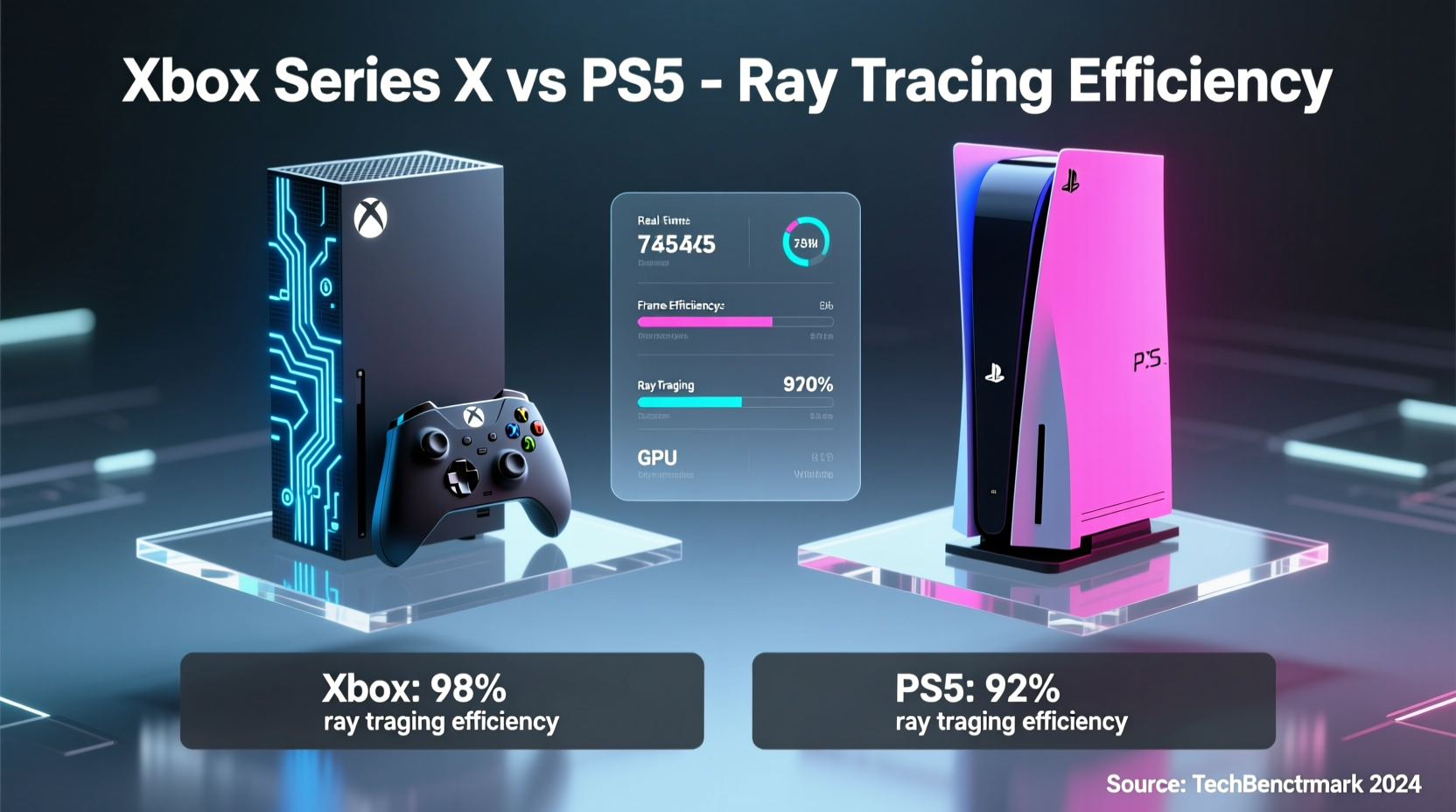
When evaluating efficiency—defined as the ability to deliver consistent performance, stable frame rates, and high visual quality under ray tracing loads—the Xbox Series X holds a measurable advantage over the PS5. Its superior GPU compute power, higher memory bandwidth, and robust thermal design allow it to sustain ray tracing workloads more effectively across a broad range of multiplatform titles. While the PS5 excels in exclusive experiences with deeply integrated ray tracing, its lower hardware ceiling leads to more aggressive resolution scaling and occasional performance hiccups.
Ultimately, the choice depends on your gaming preferences. If you primarily play third-party or cross-platform games and value technical consistency, the Xbox Series X is the more efficient ray tracing machine. If you’re invested in Sony’s first-party studios and their cinematic vision, the PS5 delivers compelling, albeit less consistently optimized, ray tracing experiences.
As ray tracing becomes standard in next-gen gaming, the gap may narrow with smarter software and AI-driven upscaling. But for now, if raw efficiency in handling ray tracing is your priority, the Xbox Series X stands as the stronger performer.
🚀 Ready to optimize your next gaming setup? Share your thoughts on console ray tracing performance or ask questions in the comments—let’s build a clearer picture of what truly matters in next-gen graphics.








