The shift to remote and hybrid work models has redefined how professionals engage with their jobs. While many celebrate the elimination of daily commutes as a win for personal time, the reality of work-life separation is more nuanced. Saving 30 to 90 minutes each day in transit sounds like a clear path to better balance—but does it actually translate into clearer boundaries between professional and personal life? For some, yes. For others, the lack of physical transition has blurred lines more than ever.
This article examines the relationship between commute time, hybrid work structures, and psychological work-life separation. Drawing on behavioral research, employee case studies, and organizational trends, we explore whether eliminating the commute enhances well-being—or if new challenges have emerged in its place.
The Myth of Time Saved: What Commute Elimination Really Offers
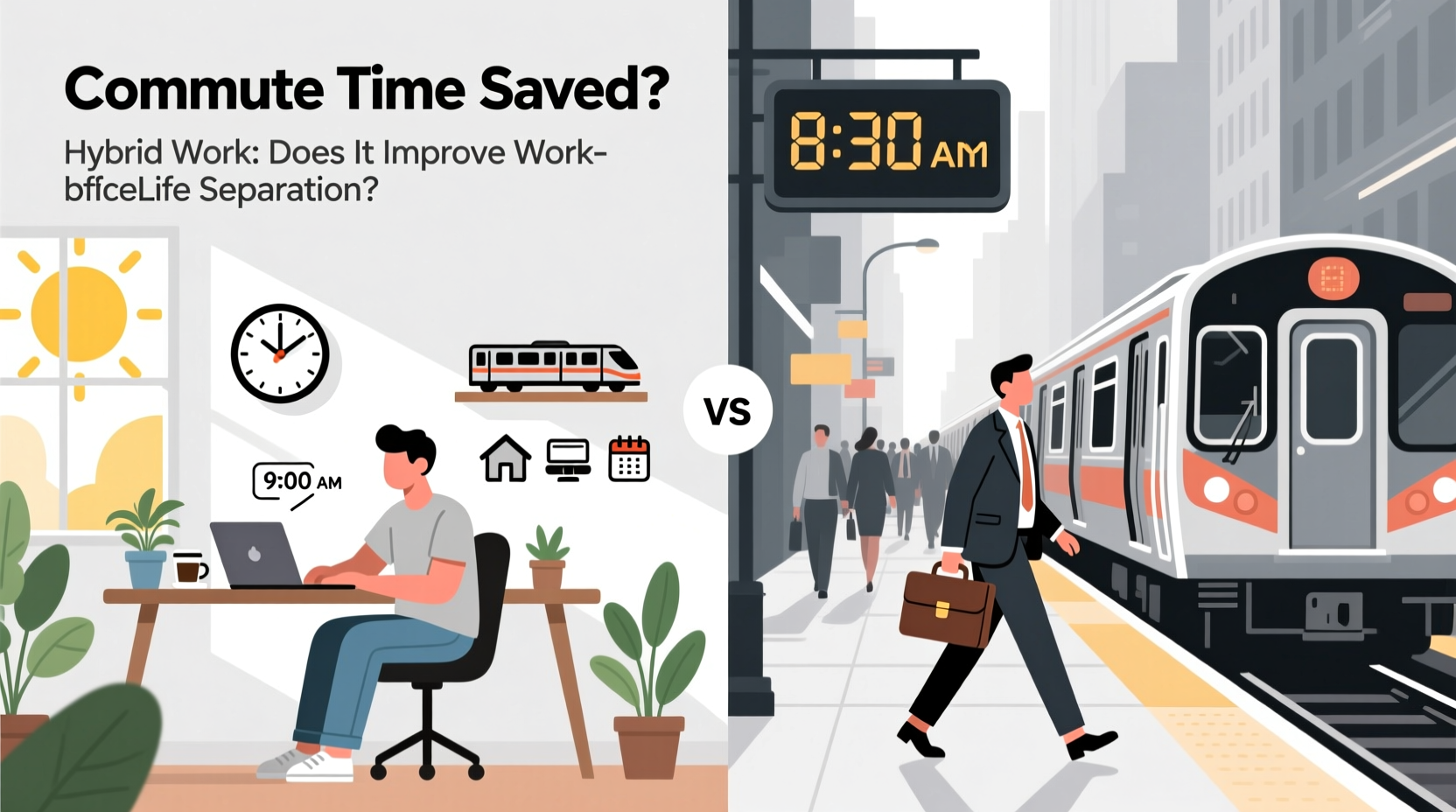
On paper, removing a two-hour daily commute equates to reclaiming five hours per week—over 200 hours annually. That’s nearly nine full days returned to employees. Yet time saved doesn’t always mean time gained for rest or family. Instead, many report that those hours are absorbed by extended workdays, overlapping household responsibilities, or digital fatigue from back-to-back virtual meetings.
A 2023 study by the National Bureau of Economic Research found that while remote workers reported higher job satisfaction, their average workday length increased by 48 minutes compared to pre-pandemic office routines. Without the natural bookends of commuting, people struggle to define when work begins and ends.
“Commuting used to be a psychological buffer—a transitional space where people mentally shifted into ‘work mode’ and then disengaged at the end of the day. Remove that, and the boundary dissolves.” — Dr. Lena Torres, Organizational Psychologist, Stanford University
For decades, the commute served an invisible but vital function: it was a ritual of separation. Whether walking through city streets, listening to a podcast on the train, or driving in silence, these moments allowed cognitive detachment from work stress. Now, logging off a laptop at 7 p.m. while sitting in the same chair used all day doesn’t signal closure—it feels like pausing.
Hybrid Work: A Balanced Solution or Just Another Compromise?
Hybrid models—where employees split time between home and office—are often promoted as the best of both worlds. But their effectiveness depends heavily on structure and intentionality. A poorly designed hybrid schedule can amplify fragmentation without delivering true separation.
Consider two common hybrid patterns:
- Fixed-day model: Employees work remotely on set days (e.g., Tues-Thurs) and come into the office on others. This creates predictability, allowing teams to align collaboration days and individuals to plan personal time.
- Flexible model: Employees choose office days weekly. While offering autonomy, this often leads to inconsistent rhythms and difficulty establishing routines.
The fixed-day approach tends to support stronger work-life boundaries because it introduces regularity. When someone knows they’ll be in the office every Monday and Friday, they can mentally prepare and create rituals around those transitions—much like the old full-time office routine.
Tip: If your company uses a flexible hybrid policy, designate your own consistent office days to build psychological rhythm.Commute Time vs. Mental Transition: What Truly Matters?
It's not just the duration of the commute that mattered—it was the act of movement itself. Physical displacement helps the brain compartmentalize roles. Walking out of an office signals “I’m leaving work.” Logging off Zoom from the kitchen table does not.
Researchers at the University of Michigan identified that employees who replaced their commute with a short walk, stretching session, or even a change of clothes after logging off reported significantly higher levels of psychological detachment from work. These micro-transitions compensated for the lost ritual of travel.
In contrast, those who moved directly from work tasks to family duties—without any pause—were twice as likely to report burnout symptoms within six months of going fully remote.
| Transition Practice | Psychological Detachment Rate | Burnout Risk Reduction |
|---|---|---|
| No transition (immediate task switch) | 38% | Baseline |
| Short walk (10–15 min) | 67% | 42% |
| Mindfulness or journaling | 73% | 51% |
| Change of clothing | 61% | 36% |
| Commuting (30+ min) | 78% | 58% |
Data shows that intentional post-work rituals can nearly match the psychological benefits of a traditional commute. The key is designing deliberate transitions—even if no distance is traveled.
Real-World Example: How One Team Rebuilt Boundaries
Sarah Kim, a project manager at a mid-sized tech firm in Austin, struggled with constant overwork during her first year of remote work. Her home doubled as her office, and she found herself checking Slack messages late into the evening, even on weekends.
After attending a workshop on digital well-being, Sarah implemented a structured shutdown ritual. Every day at 5:30 p.m., she follows a four-step process:
- Closes all work-related browser tabs and applications.
- Writes down unfinished tasks in a dedicated notebook to “park” them mentally.
- Changes out of her work clothes into casual loungewear.
- Takes a 15-minute walk around her neighborhood, rain or shine.
Within three weeks, Sarah noticed a significant reduction in anxiety and improved sleep quality. “That walk isn’t about exercise,” she says. “It’s my new commute. It tells my brain the day is over.”
Her team later adopted a group practice: ending Friday meetings with a shared intention to disconnect. They now say a collective phrase—“We’re done for the week”—before logging off, reinforcing closure.
Action Plan: Building Effective Work-Life Separation Without a Commute
If you're working remotely or in a hybrid setup, you can recreate the psychological benefits of a commute through intentional design. Here’s a step-by-step guide to building sustainable separation:
Step 1: Define Your Work Zone
Even in small homes, designate a specific area for work. Avoid using beds or dining tables regularly. A visual cue like closing a laptop cover or covering your workspace with a cloth signals completion.
Step 2: Create a Pre-Work and Post-Work Ritual
Morning: Start with 10 minutes of mindfulness, coffee in silence, or reviewing your daily priorities. Evening: Use a consistent sequence—log off, stretch, change clothes, take a walk—to mark the end of the workday.
Step 3: Schedule Digital Boundaries
Turn off non-essential work notifications after hours. Use tools like “Do Not Disturb” modes or separate devices for work and personal use when possible.
Step 4: Communicate Availability Clearly
Set calendar blocks for “focus time” and “unavailable” periods. Share these with colleagues and family to manage expectations.
Step 5: Audit Weekly for Balance
Every Sunday, reflect: Did I feel present during personal time? Was I able to detach? Adjust your rituals accordingly.
Tip: Pair your post-work ritual with a sensory cue—like lighting a scented candle or playing a specific playlist—to strengthen the mental association with downtime.Checklist: Are You Maintaining Healthy Work-Life Separation?
- ✅ I have a dedicated workspace I can leave at the end of the day.
- ✅ I follow a consistent morning routine before starting work.
- ✅ I have a defined end-of-day ritual (walk, shutdown checklist, etc.).
- ✅ I avoid checking work messages during meals or after bedtime.
- ✅ My coworkers know my availability and respect my boundaries.
- ✅ I take real breaks during the day, away from screens.
- ✅ I feel mentally refreshed when starting a new day or week.
If fewer than five apply, consider refining your daily structure using the steps above.
When Hybrid Fails: Common Pitfalls to Avoid
Not all hybrid arrangements succeed in improving work-life balance. Common issues include:
- Proximity bias: Managers favoring employees who come into the office more often, pressuring remote staff to attend unnecessarily.
- Meeting sprawl: Scheduling in-office days around meetings, reducing focused work time and increasing stress.
- Lack of equity: Remote employees missing informal networking or spontaneous decisions made in-office.
- Home guilt: Feeling obligated to handle household chores during remote work hours, fragmenting attention.
To mitigate these, organizations must standardize hybrid policies, rotate office days fairly, and train leaders to manage distributed teams equitably. Transparency and consistency are critical.
Frequently Asked Questions
Does eliminating the commute always harm work-life balance?
No—not inherently. For many, especially those with long or stressful commutes, remote work improves quality of life. The issue arises when no alternative transition rituals are established. With intentional design, remote work can support excellent separation.
Can a short commute be better than no commute?
Yes. Even a 15-minute walk or bike ride to a co-working space can serve as a mental reset. The physical movement and change of environment provide cognitive closure that sitting in one place cannot replicate.
How can companies support better work-life separation in hybrid models?
Employers should encourage structured schedules, discourage after-hours communication, offer stipends for home office setups, and train managers to recognize signs of burnout. Leading by example—such as executives logging off on time—also sets cultural tone.
Conclusion: Rethinking Time, Space, and Psychological Closure
The assumption that eliminating commute time automatically improves work-life separation is outdated. While saving time is valuable, true balance depends on psychological detachment, not just physical location. The commute wasn’t just wasted time—it was functional infrastructure for mental health.
In the era of hybrid work, individuals and organizations must proactively rebuild those boundaries. This means replacing passive travel with active rituals, designing equitable policies, and recognizing that flexibility without structure can lead to overload.
The future of work isn’t about choosing between home and office—it’s about designing transitions that honor both productivity and well-being. Whether you walk to a desk across the house or drive to a downtown building, what matters most is how intentionally you begin and end your workday.
🚀 Start today: Pick one transition ritual—like a post-work walk or shutdown checklist—and commit to it for seven days. Notice the difference in your energy and focus. Share your experience with your team and inspire healthier habits for all.








