The invention of the automobile stands as one of the most transformative milestones in human history. More than just a new mode of transport, the car reshaped cities, economies, and social structures. But what drove its creation? Behind the mechanical breakthroughs were powerful societal, economic, and technological forces. Understanding why the automobile was invented requires exploring the convergence of industrial ambition, urbanization, and the timeless human desire for mobility and independence.
Industrial Revolution and the Need for Efficient Transport
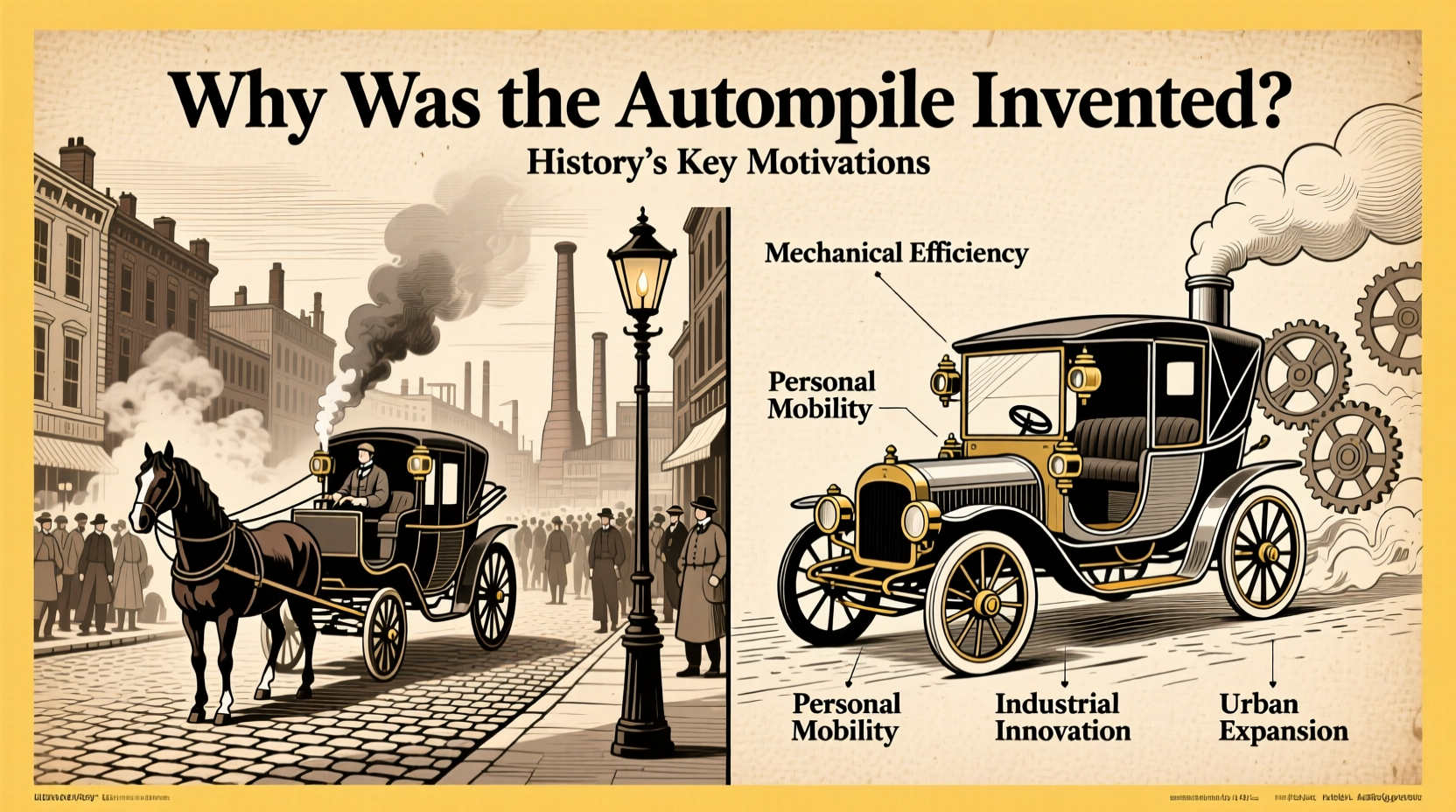
The roots of the automobile trace back to the Industrial Revolution, a period of rapid technological advancement in the 18th and 19th centuries. As factories replaced cottage industries, goods needed faster ways to move between production sites and markets. Horses and carts, while reliable, were limited by speed, range, and maintenance costs. Steam-powered locomotives solved long-distance freight but lacked flexibility for local or individual use.
Inventors began experimenting with self-propelled vehicles as early as the late 1700s. Nicolas-Joseph Cugnot built a steam-driven artillery tractor in 1769—clumsy and slow, but a proof of concept. By the mid-1800s, engineers across Europe and America were refining steam carriages, though their complexity and safety issues hindered widespread adoption.
The real breakthrough came with the internal combustion engine. In 1885, Karl Benz patented the Benz Patent-Motorwagen in Germany—a three-wheeled vehicle powered by a gasoline engine. This marked the birth of the modern automobile. Unlike steam models, it was lighter, more efficient, and easier to operate.
Tip: The shift from steam to gasoline wasn’t just about power—it was about practicality, scalability, and energy density.Urbanization and the Rise of Personal Mobility
As cities expanded during the 19th century, so did congestion and inefficiency in transportation. Public transit like trams and omnibuses existed, but they followed fixed routes and schedules, limiting personal freedom. For the growing middle class, owning a private vehicle symbolized autonomy and status.
The automobile offered unprecedented flexibility. No longer bound by timetables or rail lines, people could travel when and where they pleased. This shift was especially impactful in the United States, where vast distances between towns made horse-drawn travel impractical over time.
Henry Ford recognized this demand. His introduction of the Model T in 1908, combined with assembly line production, drastically reduced costs. What was once a luxury for the elite became accessible to average Americans. By 1916, over half of all U.S. households owned a car.
“The Model T didn’t just sell cars—it sold freedom.” — Dr. Laura Simmons, Transportation Historian
Technological Convergence: Engines, Roads, and Fuel
The automobile didn’t emerge in isolation. It was the product of converging innovations:
- Internal Combustion Engine: Developed throughout the 1800s, perfected by engineers like Nikolaus Otto and Gottlieb Daimler.
- Petroleum Industry: The rise of oil drilling and refining made gasoline widely available and affordable.
- Road Infrastructure: Governments began investing in paved roads to accommodate motor vehicles, further encouraging adoption.
- Energies Storage: Early electric cars appeared in the 1890s, showing that alternative propulsion was possible—even if batteries at the time lacked range and durability.
This ecosystem of support technologies made automobiles not just feasible, but inevitable. Without reliable fuel, durable engines, or decent roads, the car would have remained a curiosity.
Key Technological Milestones Leading to the Automobile
| Year | Invention/Event | Significance |
|---|---|---|
| 1769 | Cugnot’s Steam Tractor | First self-propelled road vehicle |
| 1807 | François Isaac de Rivaz Engine | First internal combustion engine (hydrogen-powered) |
| 1885 | Benz Patent-Motorwagen | First practical gasoline-powered automobile |
| 1908 | Ford Model T Launch | Mass production makes cars affordable |
| 1913 | Ford Assembly Line | Revolutionizes manufacturing efficiency |
Social and Economic Motivations
Beyond technology, deeper social currents fueled the automobile's rise. The late 19th and early 20th centuries saw a growing emphasis on individualism, convenience, and consumer choice. Cars aligned perfectly with these values.
For rural populations, automobiles meant access to schools, hospitals, and markets without relying on unreliable public services. For city dwellers, they represented escape—from crowded streets, rigid commutes, and urban constraints. Suburbs began to grow as people realized they could live farther from work and still commute efficiently.
Economically, the auto industry became a powerhouse. It created millions of jobs in manufacturing, sales, repair, and road construction. Ancillary industries—like oil, rubber, and steel—expanded rapidly to meet demand. By the 1920s, the automobile was central to national economies, particularly in the U.S.
Tip: The car didn’t just respond to demand—it created new markets, lifestyles, and entire industries.Timeline: From Concept to Global Dominance
A clear progression marks the automobile’s journey from experimental machine to cultural icon:
- 1769–1850: Early experiments with steam-powered vehicles; limited success due to weight and safety.
- 1860–1890: Development of internal combustion engines; first electric car prototypes appear.
- 1885–1900: Benz and Daimler build the first practical gasoline cars; European elites adopt them as novelties.
- 1900–1915: Ford introduces mass production; prices drop, ownership rises in the U.S.
- 1920s: Cars become mainstream; infrastructure expands; driving culture emerges.
- Post-WWII: Global expansion; cars symbolize prosperity and freedom in Western societies.
FAQ
Who really invented the automobile?
While many contributed, Karl Benz is widely credited with inventing the first true automobile—the 1885 Benz Patent-Motorwagen—because it was the first to combine an internal combustion engine with a purpose-built chassis.
Why didn’t steam cars dominate instead of gasoline ones?
Steam vehicles were heavy, slow to start, and required frequent water refills. Gasoline engines offered higher power-to-weight ratios, faster refueling, and better scalability for mass production.
Were there environmental concerns at the time of invention?
Not initially. In the 19th century, the main concern was pollution from horses—manure, flies, and disease. Cars were seen as cleaner alternatives. Environmental impacts of fossil fuels only became a major issue decades later.
Conclusion: The Legacy of a Revolutionary Machine
The automobile was invented not because of a single eureka moment, but because multiple forces—industrial, social, and technological—aligned to make it necessary and possible. It answered real problems: inefficient transport, urban crowding, and limited personal mobility. At the same time, it unleashed unintended consequences—traffic, pollution, and urban sprawl—that society still grapples with today.
Yet, its core motivation remains relevant: the human desire to move freely. Whether powered by gasoline, electricity, or future innovations, the automobile continues to evolve because the need it fulfills is fundamental.
💬 What does the future of personal transportation look like to you? Share your thoughts on how innovation can balance freedom, efficiency, and sustainability.








