In an age dominated by digital streaming and high-resolution audio files, it’s easy to assume that older formats like vinyl would have vanished entirely. Yet, over the past two decades, vinyl records have not only survived—they’ve thrived. Global sales have surged year after year, with 2023 marking the 17th consecutive year of growth in the United States alone. Independent record stores report booming foot traffic, major labels press new releases on vinyl, and younger generations are embracing turntables as both functional devices and lifestyle symbols. But what’s driving this resurgence? And more importantly, is the audio quality of vinyl truly superior to modern digital formats?
The answer isn’t simple. While some listeners swear by the warmth and depth of analog sound, others argue that digital formats offer greater clarity, consistency, and convenience. To understand the vinyl revival, we need to examine not just technical specifications, but also emotional resonance, cultural trends, and the human desire for tangible experiences in an increasingly intangible world.
The Emotional and Cultural Appeal of Vinyl
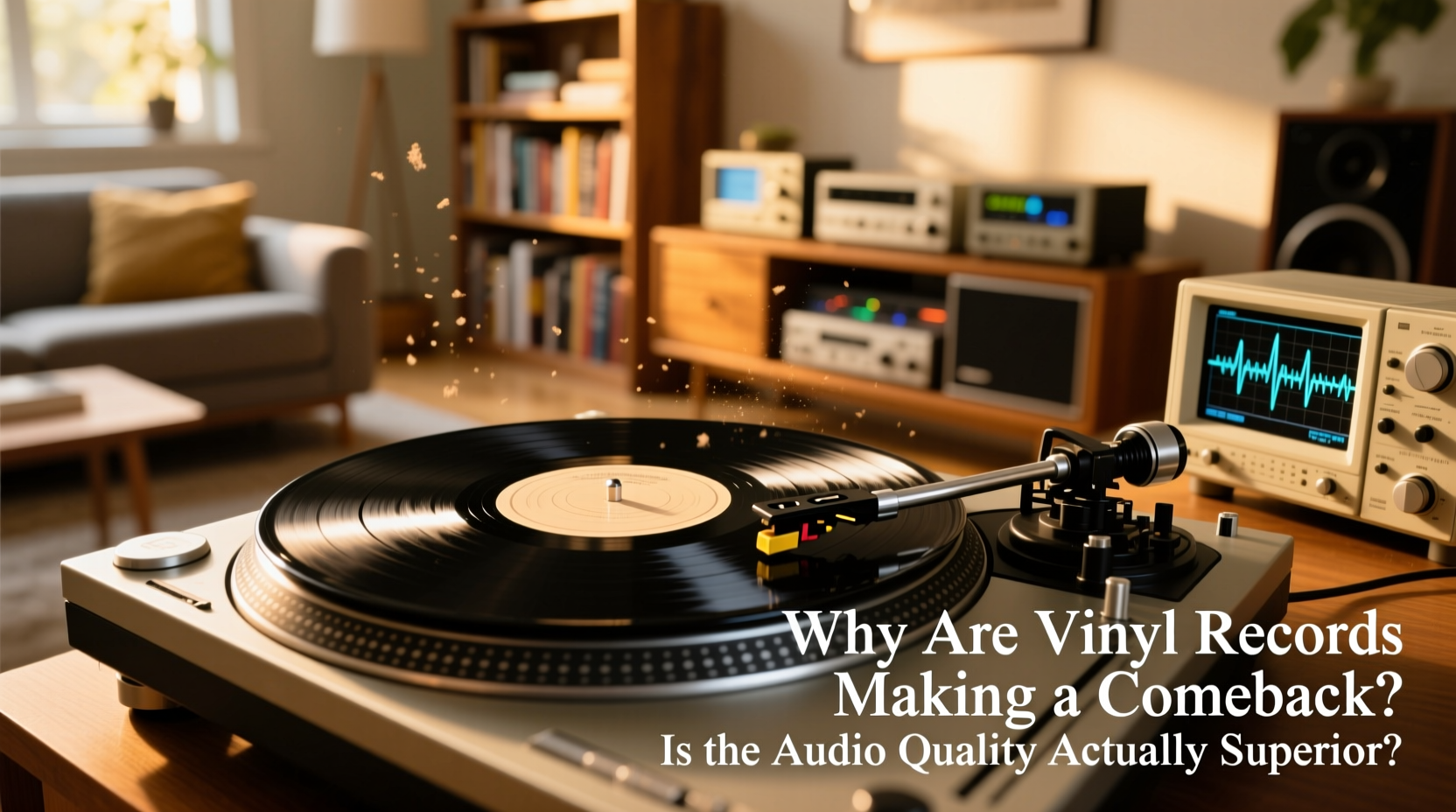
Vinyl records offer more than just music—they provide an experience. From the ritual of handling the sleeve, placing the needle, and flipping sides, to the large artwork and liner notes, listening to vinyl engages multiple senses. This tactile interaction fosters a deeper connection between listener and music, something that scrolling through a playlist on a smartphone rarely replicates.
For many, vinyl represents authenticity. In a world saturated with algorithm-driven playlists and fleeting digital content, owning a physical artifact—especially one with care instructions, credits, and perhaps even hand-written inserts—feels meaningful. The format has become a symbol of intentionality: you don’t just listen to a vinyl record; you *commit* to it.
“People aren’t buying vinyl because it’s technically perfect. They’re buying it because it feels real.” — David Byrne, musician and co-founder of Talking Heads
This sentiment resonates across demographics. Millennials and Gen Z, often labeled “digital natives,” are among the most enthusiastic adopters of vinyl. For them, collecting records is part of a broader cultural shift toward analog hobbies—film photography, typewriters, and board games—as antidotes to screen fatigue and digital overload.
Tip: Create a dedicated listening space with minimal distractions to fully appreciate the immersive experience of vinyl.Audio Quality: Analog Warmth vs. Digital Precision
One of the most debated aspects of the vinyl revival is whether its sound quality is objectively better than digital. The short answer: it depends on how you define “better.”
Vinyl records store audio in an analog format, meaning the grooves on the disc physically mirror the original sound waves. This continuous representation can produce a rich, full-bodied sound often described as “warm” or “organic.” Many listeners find this pleasing, especially for genres like jazz, classical, and classic rock where dynamic range and tonal nuance matter.
Digital audio, on the other hand, samples sound at discrete intervals (e.g., 44.1 kHz for CDs) and converts it into binary data. High-resolution digital formats (like 24-bit/96kHz) can capture more detail than standard CD quality and surpass vinyl in frequency response and dynamic range. Digital files also lack surface noise, clicks, and pops—common artifacts of vinyl playback.
However, digital perfection can sometimes feel sterile. Some audiophiles argue that analog imperfections—such as subtle harmonic distortion or slight compression—add character that makes music feel more alive. This phenomenon, known as the “vinyl glow,” isn’t about accuracy; it’s about emotional impact.
Technical Comparison: Vinyl vs. Digital Formats
| Feature | Vinyl | CD | High-Res Digital | Streaming (Lossy) |
|---|---|---|---|---|
| Dynamic Range | 60–70 dB | 96 dB | Up to 144 dB | Varies (often reduced) |
| Frequency Response | 20 Hz – 15 kHz (typical) | 20 Hz – 20 kHz | Up to 48 kHz or higher | Limited (e.g., 16 kHz max) |
| Noise Floor | Surface noise, pops, hiss | Near silent | Near silent | Compression artifacts |
| Portability & Convenience | Low | Medium | High | Very High |
| Sound Character | Warm, rounded, slightly compressed | Neutral, accurate | Precise, detailed | Thin, compressed (lossy) |
As shown, vinyl doesn’t win on technical benchmarks. But for many, the sonic “flaws” are features in disguise. The mild roll-off in high frequencies can soften harshness in recordings. The inherent compression can make music feel more cohesive. And the lack of absolute precision allows room for imagination—what some call “musicality.”
The Role of Mastering and Pressing Quality
Not all vinyl sounds the same. The final listening experience depends heavily on two critical factors: mastering and pressing quality.
Mastering refers to the process of preparing and transferring recorded audio to a data storage device (the master). When done well for vinyl, it includes adjustments for groove spacing, bass management, and dynamic range optimization. Unfortunately, many modern vinyl releases use masters originally created for digital formats—sometimes even compressed “loudness war” versions—which are poorly suited for analog reproduction. These records may sound harsh, fatiguing, or lack depth.
In contrast, “audiophile-grade” reissues often feature remastering from original analog tapes using flat transfers that preserve dynamics. Labels like Mobile Fidelity Sound Lab and Analogue Productions are renowned for such meticulous work. These pressings can reveal nuances lost in digital compression and are often cited as examples of vinyl’s superiority.
Pressing quality also varies widely. A well-pressed record on 180-gram virgin vinyl from a reputable plant (e.g., GZ Media, RTI) will play smoothly with minimal surface noise. Cheap pressings on recycled vinyl, however, may contain defects like warping, off-center spins, or excessive crackle—detracting significantly from sound quality.
Tip: Look for vinyl pressings labeled “AAA” (Analog recording, Analog mastering, Analog cut) for the purest analog experience.Real Example: The Case of Fleetwood Mac’s \"Rumours\"
A telling example of how mastering affects perception is Fleetwood Mac’s iconic album *Rumours*. The 2006 digital remaster released on CD was criticized for being overly bright and compressed. In contrast, the 2013 180-gram vinyl reissue, mastered from the original analog tapes, received widespread acclaim for its balanced tone and spacious soundstage.
Many listeners claimed the vinyl version sounded “clearer” and “more natural”—not because vinyl is inherently superior, but because the source material and mastering process were optimized for the medium. This highlights a crucial point: when comparing formats, context matters. A poorly mastered digital file may sound worse than a well-made vinyl, and vice versa.
Step-by-Step Guide to Getting the Most from Your Vinyl Setup
If you're exploring vinyl, optimizing your setup can dramatically improve sound quality. Follow these steps:
- Choose a reliable turntable: Entry-level models like the Audio-Technica AT-LP60X or Rega Planar 1 offer solid performance. Avoid cheap, beltless models with built-in speakers.
- Ensure proper alignment: Use a protractor to align the cartridge correctly. Misalignment causes distortion and uneven wear.
- Set the correct tracking force: Refer to your cartridge’s specifications and use a stylus gauge to adjust the tonearm weight.
- Clean your records: Use a carbon fiber brush before each play and a deep-cleaning solution periodically. Dust increases surface noise.
- Upgrade components gradually: Invest in a better phono preamp, cartridge, or speaker system over time to unlock higher fidelity.
- Store records vertically: Keep them in a cool, dry place away from sunlight to prevent warping and mold.
Frequently Asked Questions
Is vinyl really higher quality than Spotify or Apple Music?
Generally, no. Most streaming services use lossy compression (e.g., AAC, Ogg Vorbis), which removes audio data to reduce file size. Even high-quality streams (like Spotify Premium at 320 kbps) don’t match CD or high-res digital quality. However, if the vinyl was poorly mastered or pressed, it could sound worse than a well-encoded digital file. For the best experience, compare high-res digital (e.g., Qobuz, Tidal Masters) with well-mastered vinyl.
Why do some people say vinyl sounds warmer?
The “warmth” often attributed to vinyl comes from subtle harmonic distortion and high-frequency roll-off introduced during playback. These characteristics can make music feel fuller and less fatiguing, especially on bright or over-compressed recordings. It’s a subjective preference rather than an objective improvement.
Can I hear the difference between vinyl and digital?
Yes, but it depends on your equipment, environment, and listening skills. On a high-end system in a quiet room, differences in texture and spatial imaging may be apparent. On budget gear or with background noise, they may be negligible. Critical listening takes practice—train your ears by comparing the same album across formats.
Checklist: How to Evaluate a Vinyl Release Before Buying
- ✅ Check the mastering credits—look for names like Bernie Grundman, Kevin Gray, or Stan Ricker.
- ✅ Confirm if it’s pressed on 180g vinyl from a known manufacturer.
- ✅ Research reviews for comments on surface noise or centering issues.
- ✅ Prefer releases labeled “direct-to-analog” or “AAA” for purist sound.
- ✅ Avoid “budget reissues” unless they have strong user feedback.
Conclusion: Why Vinyl Endures—and What It Means for the Future of Music
The vinyl comeback isn’t about technological supremacy. It’s about value—emotional, aesthetic, and experiential. While digital formats excel in convenience and fidelity, vinyl offers something they cannot: presence. Holding an album, reading the lyrics, and hearing the faint rustle before the first note—it all contributes to a sense of ceremony that deepens engagement with music.
And while vinyl may never surpass digital in technical precision, its enduring popularity proves that sound quality isn’t solely measured in decibels or frequency ranges. Sometimes, the “best” audio experience is the one that makes you pause, focus, and truly listen.
💬 Do you prefer vinyl, digital, or both? Share your thoughts and favorite albums on wax—we’d love to hear what moves you beyond the numbers.








