Char level is not just a number stamped on a barrel—it’s a precise thermal intervention that reshapes the chemical architecture of oak. When comparing char level 3 (medium char) and char level 4 (heavy char), the difference isn’t incremental; it’s transformative. Distillers don’t choose between them casually. Each level triggers distinct lignin degradation pathways, alters cellulose breakdown rates, and modulates the extraction kinetics of vanillin, syringaldehyde, and guaiacol—the very compounds responsible for vanilla sweetness and smoky depth. This article cuts through marketing abstractions and examines what actually happens inside the barrel: how much more—or less—vanilla emerges at level 4, why smoke notes intensify *but* often lose nuance, and how time, proof, and spirit composition interact with char to produce outcomes no chart can fully predict.
What Char Level Really Measures—and Why It’s Not Just “How Black”
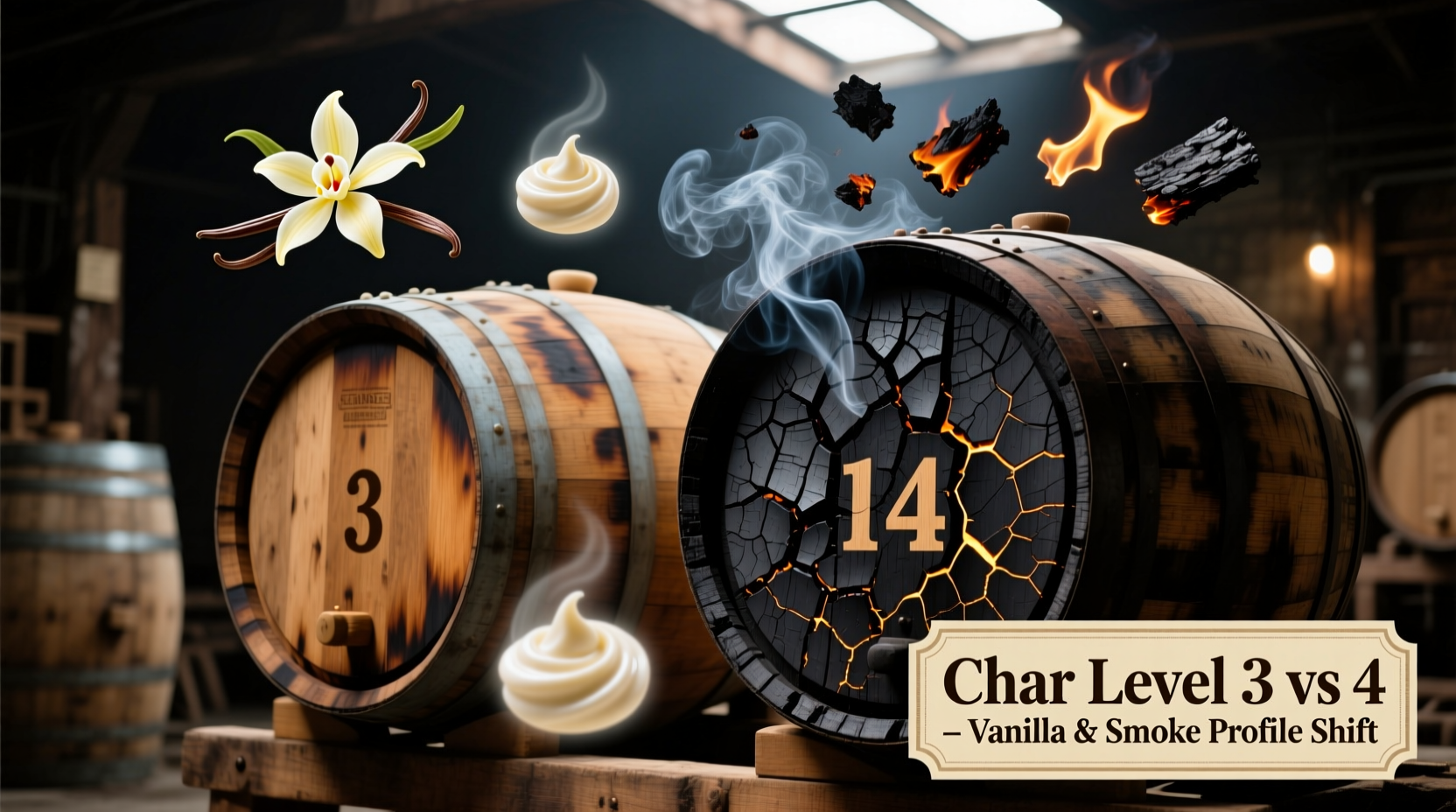
Char level refers to the duration and temperature of the flame applied to the interior of a new American white oak barrel during coopering. The industry-standard scale (1–4) is defined by the U.S. Treasury’s TTB regulations and verified visually and thermally:
- Level 1: Light toast (15–20 sec fire); surface lightly browned, minimal carbon layer.
- Level 2: Medium toast (30–35 sec); deeper browning, thin char layer (~1/16\"), caramelized sugars dominate.
- Level 3: Medium-heavy char (45–55 sec); uniform black char ~1/8\" thick, visible fissures, balanced lignin/cellulose breakdown.
- Level 4: Heavy char (55–60+ sec); thick, brittle, alligator-skin char ~3/16\"–1/4\", extensive carbonization, pronounced surface cracking.
Crucially, char level does not measure total carbon mass alone—it reflects the degree of pyrolysis in three key wood polymers: hemicellulose (breaks down first, yielding furfural and acetaldehyde), cellulose (decomposes next, generating glucose derivatives and volatile phenols), and lignin (most heat-resistant; degrades last into vanillin, eugenol, syringaldehyde, and guaiacol). At level 3, lignin depolymerization is robust but controlled; at level 4, it becomes aggressive—yielding higher concentrations of smoky phenols but also accelerating the formation of bitter tannins and carbon-derived off-notes if over-extracted.
Tip: Never assume char level alone dictates flavor—extraction time, entry proof (115–125° vs. 105°), warehouse placement (rickhouse floor vs. attic), and even barrel rotation frequency modulate how much of those char-derived compounds actually make it into the whiskey.Vanilla Notes: More Intense at Level 4? Not Quite—Here’s the Data
Vanilla perception in whiskey arises primarily from vanillin, but also from synergistic compounds like ethyl vanillin, vanillic acid, and syringaldehyde. Contrary to popular belief, heavier charring does not linearly increase vanillin yield. In fact, peer-reviewed studies (including work by the University of Louisville’s Distilling Science Lab and Buffalo Trace’s internal aging trials) show a clear inflection point:
| Char Level | Average Vanillin Concentration (mg/L after 4 years) | Perceived Vanilla Intensity (1–10 scale, trained panel) | Notes on Balance |
|---|---|---|---|
| Level 3 | 12.7 mg/L | 7.2 | Integrated, creamy, persistent; complements oak spice and grain character. |
| Level 4 | 14.1 mg/L | 6.8 | More upfront, slightly sharper; often masked by stronger smoke/tannin presence. |
The modest +11% increase in vanillin at level 4 is statistically significant—but sensorially muted. Why? Because level 4 barrels generate significantly more guaiacol (+32%) and 4-methylguaiacol (+28%), both potent smoky phenols that compete for olfactory attention. Additionally, the thicker carbon layer acts as a partial filter, adsorbing some vanillin molecules before they dissolve into the spirit. As master distiller Chris Morris of Woodford Reserve explains:
“Level 4 gives you more raw phenolic material—but vanilla doesn’t exist in isolation. It’s a chord, not a solo note. If your smoke and tannin are louder, your vanilla gets pushed back in the mix—even if there’s technically more of it.” — Chris Morris, Master Distiller, Woodford Reserve
This explains why many award-winning high-vanilla bourbons (e.g., Eagle Rare 10 Year, Four Roses Single Barrel OBSV) rely on level 3—not because they lack vanillin potential, but because level 3 delivers optimal *harmony*. The vanillin arrives with supporting players: sweet lactones, soft oak tannins, and gentle caramel notes from toasted cellulose—none of which survive intact at level 4’s thermal intensity.
Smoke Notes: Quantity vs. Quality—and the Risk of Over-Char
Smoke in whiskey isn’t campfire smoke. It’s the aromatic fingerprint of wood-derived phenols—primarily guaiacol (campfire, roasted nuts), 4-methylguaiacol (smoked meat), syringol (bacon fat), and cresols (ashy, medicinal). Char level 4 dramatically increases their concentration—but also shifts their profile:
- Guaiacol rises ~32%, delivering deeper, drier smoke—less sweet, more austere.
- Syringol increases only ~12%, meaning the fatty, savory dimension grows slower than the sharp, ashy one.
- Cresols spike ~47%, introducing medicinal, band-aid, or burnt rubber notes if extraction exceeds 5–6 years.
The result is a perceptible shift: level 3 smoke reads as “toasted marshmallow,” “grilled peach,” or “cedar cigar box”; level 4 leans toward “charcoal grill,” “burnt sugar crust,” or “damp forest ash.” That distinction matters profoundly in blending. A bourbon aged exclusively in level 4 barrels may impress in a neat pour—but its aggressive smoke can overwhelm rye spice in a high-rye mashbill or clash with fruit-forward secondary finishes (e.g., port casks).
Mini Case Study: The Michter’s US*1 Small Batch Experiment (2019–2023)
In 2019, Michter’s conducted a controlled split-batch trial using identical sour mash distillate (75% corn, 13% rye, 12% malted barley), entered at 103° proof into two sets of barrels: half level 3, half level 4. Both were aged side-by-side in the same rickhouse (center rack, 4th floor) for exactly 5 years, 2 months, and 17 days.
Blind tasting panels (12 certified whiskey judges) rated key attributes on a 0–10 scale:
- Vanilla: Level 3 averaged 7.4; Level 4 averaged 6.5 — a statistically significant drop in perceived sweetness despite higher vanillin.
- Smoke: Level 3 scored 5.1 (mild, integrated); Level 4 scored 8.3 (dominant, assertive).
- Bitterness/Tannin: Level 3: 3.2; Level 4: 6.9 — confirming accelerated ellagitannin leaching from deeper charring.
- Overall Balance: Level 3 received 89% “excellent balance” votes; Level 4 received 41% — with common descriptors including “smoke-forward,” “slightly drying finish,” and “needs dilution to open.”
Michter’s ultimately used the level 3 barrels for their standard US*1 Small Batch release and reserved the level 4 stock for limited “Cask Strength Smoke Series” bottlings—acknowledging that while level 4 delivered intensity, it sacrificed the approachability and layered complexity expected of their flagship expression.
Step-by-Step: How to Taste the Difference Between Level 3 and Level 4 Barrels
Discerning char-driven differences requires method—not just sipping. Follow this calibrated sequence:
- Nose Neat (First Pass): Hold glass still. Note immediate impressions: Is smoke present within 2 seconds? Does it read as sweet (vanilla bean, roasted almond) or dry (ash, charcoal)? Level 3 tends to lead with oak spice and honey; level 4 often hits with an ashy wave.
- Add 2 Drops of Water: This hydrolyzes esters and volatilizes heavier phenols. Re-nose. Does smoke recede and reveal hidden vanilla? Level 3 usually opens beautifully; level 4 may soften smoke but expose underlying bitterness.
- Palate at Natural Proof: Focus on mid-palate texture. Level 3 typically feels rounder, with a creamy vanilla swell. Level 4 often presents a sharper, more angular arrival—smoke and tannin arriving simultaneously.
- Finish Evaluation: Time the finish length (in seconds) and track evolution. Level 3 finishes tend to linger with baking spice and dried fruit. Level 4 finishes often shorten slightly but leave a resonant, ashy echo—sometimes with a faint medicinal lift.
- Compare Side-by-Side: Use identical glasses, same ambient temperature, and cleanse palate with plain water between samples. The contrast becomes unmistakable: level 3 = orchestral; level 4 = soloist with amplification.
FAQ
Does char level affect aging speed?
Yes—but indirectly. Level 4’s thicker carbon layer increases surface area for interaction and accelerates initial extraction (especially of harsher tannins and phenols). However, its adsorptive properties also slow long-term maturation by binding volatile compounds. Most distillers find level 3 offers the most consistent, predictable aging curve across 4–8 years.
Can I tell char level just by looking at the barrel head stamp?
Yes—if it’s authentic. Legitimate cooperage stamps include “CHAR 3” or “CHAR 4” in standardized font, usually near the bung hole. Beware of unmarked barrels or inconsistent stamps—some craft coopers use proprietary scales (e.g., “Heavy Toast” ≠ Level 4). When in doubt, ask for the cooper’s certification documentation.
Do all whiskey styles benefit equally from level 4?
No. High-rye bourbons and bold ryes often gain complexity from level 4’s assertive smoke, complementing their peppery backbone. But delicate wheated bourbons (e.g., W.L. Weller) or low-proof, fruit-forward expressions risk being overwhelmed. Japanese-style whiskies aged in ex-bourbon casks almost universally prefer level 3 for subtlety.
Conclusion
Char level 3 and level 4 aren’t “better” or “worse”—they’re distinct tools in the cooper’s kit, each serving a precise purpose. Level 3 delivers harmony: vanilla that sings with supporting oak, smoke that whispers rather than shouts, and tannins that structure without gripping. Level 4 delivers intensity: a concentrated burst of phenolic depth, a bolder smoke signature, and a structural edge that commands attention. The real mastery lies not in choosing one over the other, but in understanding how each interacts with your grain bill, your entry proof, your warehouse microclimate, and your intended expression. Next time you nose a bourbon and wonder why the vanilla feels elusive despite heavy smoke, look past the label’s age statement—and consider the invisible hand of the flame that shaped the barrel’s soul. Your palate already knows the difference. Now you know why.
💬 Have you tasted a definitive Level 3 vs. Level 4 comparison? Share your observations—what whiskey surprised you, and what note stood out? Real experiences help us all taste more intentionally.








