For families with two children, the choice between an SUV and a minivan isn’t just about transportation—it’s a lifestyle decision. On one side, you have the sleek, rugged appeal of SUVs that dominate driveways and parking lots with their commanding presence. On the other, minivans offer unmatched interior flexibility, sliding doors, and cavernous storage—yet often come saddled with outdated stereotypes. The real question isn’t just about cargo room or fuel economy; it’s whether the “cool factor” of driving an SUV justifies sacrificing the practicality that minivans deliver so effortlessly.
This isn’t a debate settled by marketing brochures or social media trends. It comes down to daily realities: carpool logistics, grocery runs, road trips, and how much space your family actually needs. For a family of four, especially with young kids, every inch counts. So let’s cut through the noise and assess what truly matters when choosing between these two family-hauling titans.
Practicality: Space, Storage, and Real-World Usability
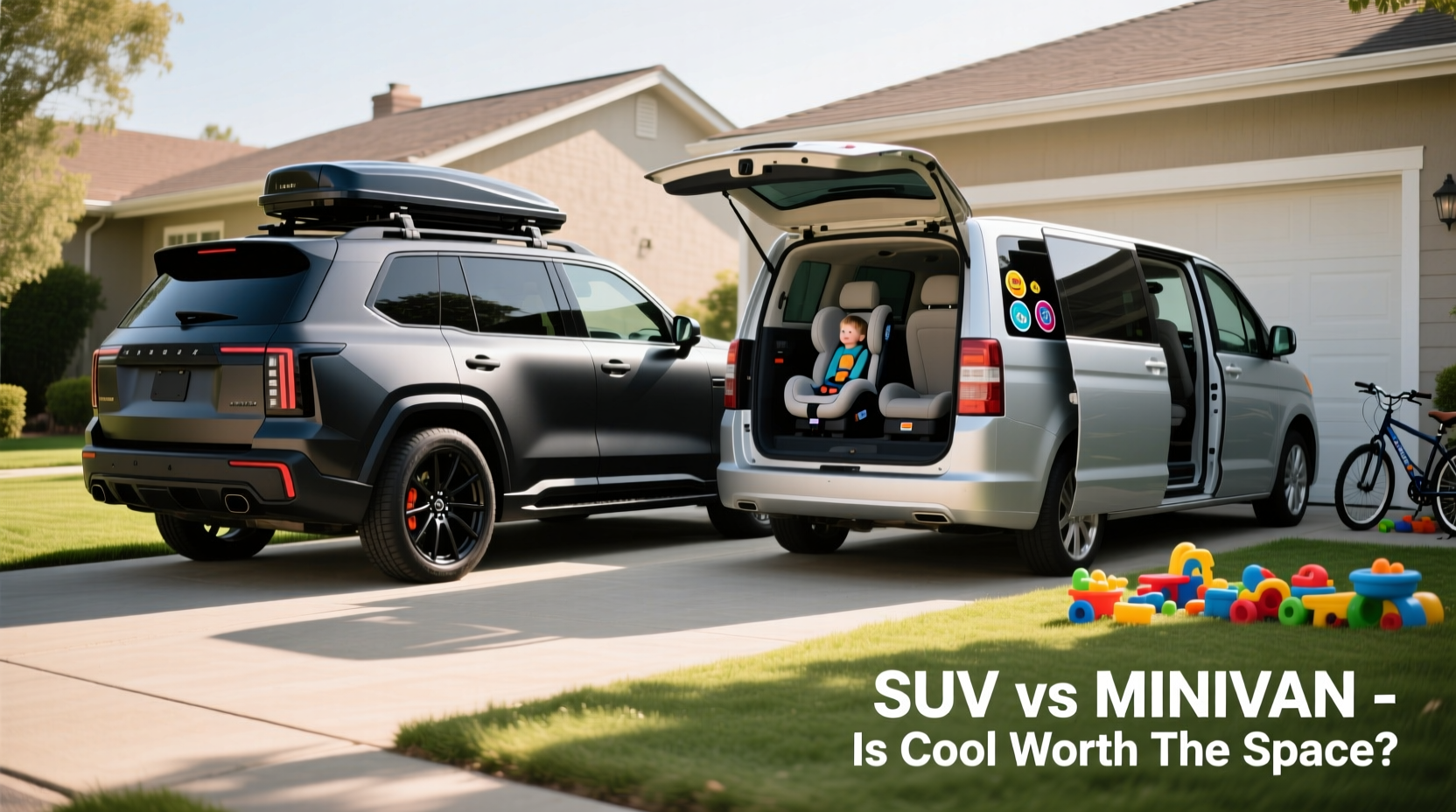
When it comes to sheer volume, minivans consistently outperform SUVs in both passenger and cargo dimensions. While many modern SUVs tout three rows of seating, the reality is that third-row access and comfort are often compromised—especially in midsize models. Minivans, designed from the ground up for family transport, prioritize cabin usability over image.
Consider this: most full-size SUVs offer around 90 cubic feet of total passenger volume. Compare that to the Honda Odyssey or Toyota Sienna, which exceed 140 cubic feet. That extra space translates into legroom for kids in the back, easier access to child seats, and room for strollers, diaper bags, sports gear, and more—all without folding seats or playing Tetris with luggage.
| Model | Passenger Volume (cu ft) | Cargo Behind 3rd Row (cu ft) | Seating Capacity |
|---|---|---|---|
| Honda Pilot | 157 | 18.5 | 8 |
| Toyota Highlander | 159 | 16 | 7–8 |
| Honda Odyssey | 161 | 38.6 | 8 |
| Chrysler Pacifica | 163 | 32.3 | 7–8 |
The numbers don’t lie. Even when comparing vehicles with similar footprints, minivans maximize interior efficiency. Sliding doors eliminate the need for wide berth in tight parking spots—a game-changer at school drop-off. And features like built-in vacuum cleaners (in the Pacifica) or Magic Slide second-row seats (Odyssey) reflect thoughtful design aimed at actual parenting challenges.
Tip: If you frequently carry bulky items like strollers, sports equipment, or pet crates, prioritize cargo space behind the third row—not just max volume.Safety and Family-Centric Features
Safety is non-negotiable for parents, and both SUVs and minivans score well in crash tests. However, the way safety is implemented differs. SUVs benefit from higher ground clearance and heavier mass, which can be advantageous in collisions with smaller vehicles. But minivans counterbalance this with advanced driver-assist systems and superior visibility due to taller windows and lower hoods.
Modern minivans come equipped with full suites of active safety tech: adaptive cruise control, lane-keeping assist, blind-spot monitoring, rear cross-traffic alert, and even surround-view cameras. The latest Sienna, for example, includes Toyota Safety Sense 2.5+ across all trims, ensuring consistent protection regardless of price point.
“Minivans have quietly become some of the safest family vehicles on the market—not because they’re large, but because they’re engineered with predictability, visibility, and redundancy in mind.” — Dr. Linda Chen, Automotive Safety Researcher at NHTSA
Another advantage: ease of installing and accessing child seats. Minivans typically feature wide door openings and flat floor designs, allowing caregivers to secure car seats without contorting themselves. Many models also include reminders to check the back seat—an increasingly critical feature as distracted parenting becomes a documented risk.
The Cool Factor: Image, Perception, and Social Pressure
Let’s address the elephant in the garage: the stigma around minivans. Despite their functional superiority, many families avoid them due to perceived lack of style. The term “soccer mom van” still carries cultural baggage, even though today’s minivans are far removed from the boxy, beige models of the '90s.
SUVs, by contrast, project versatility and adventure. Their aggressive grilles, raised profiles, and off-road-inspired aesthetics align with aspirational lifestyles—even if the vehicle never leaves paved roads. This image-driven preference has real consequences: according to Edmunds, minivan sales accounted for just 2% of new vehicle purchases in 2023, while SUVs made up over 45%.
But does looking cool matter more than functionality? For some, yes. A survey by Consumer Reports found that 38% of parents who chose SUVs over minivans cited “style” or “how the vehicle makes them feel” as a top factor. Yet nearly half of those same respondents admitted regretting the decision after six months due to cramped third rows or insufficient storage.
The irony is that minivans have evolved. The Chrysler Pacifica boasts a sleek, aerodynamic profile. The Toyota Sienna offers hybrid powertrains and modern interiors rivaling luxury crossovers. These aren��t your dad’s vans—they’re smartly designed people-movers with dignity.
Tip: Test-drive both types with your kids and gear. How easy is it to load groceries? Can your child reach their backpack from the middle seat? Prioritize function over facade.Real-Life Trade-Offs: A Mini Case Study
Meet the Reyes family: Sarah and David, both professionals, with twin 6-year-olds and an active weekend schedule. They initially leaned toward the 2023 Toyota Highlander Hybrid, drawn to its clean lines and reputation for reliability. After purchasing, they quickly encountered limitations.
On a weekend trip to visit grandparents, packing two suitcases, a collapsible stroller (for occasional use), soccer gear, and snacks left no room behind the third row. One child had to sit in the middle of the back seat, complaining of discomfort on drives longer than 30 minutes. Accessing the third row required folding the second row entirely, making quick stops inconvenient.
After 10 months, they traded in the Highlander for a Honda Odyssey. The difference was immediate. The twins had personal cup holders, USB ports, and enough legroom to stretch. The stroller fit upright behind the third row. Sliding doors allowed safe unloading near traffic. Sarah noted, “I didn’t realize how much stress the SUV added until we switched. The Odyssey feels like it was built for our lives.”
Their experience reflects a broader truth: convenience compounds over time. Small frustrations—struggling with doors, rearranging seats daily, forgetting items because there’s no designated spot—wear down even the most patient parents.
Cost, Fuel Efficiency, and Long-Term Value
Price parity between SUVs and minivans has narrowed significantly. Entry-level models like the Kia Carnival start under $35,000, comparable to base trims of the Ford Explorer or Hyundai Palisade. Higher-end minivans may reach $50,000 with premium packages, but so do fully loaded SUVs.
Where minivans pull ahead is long-term value. According to Kelley Blue Book, minivans retain resale value better than most midsize SUVs, thanks to durability and low depreciation. The Toyota Sienna, especially in hybrid form, leads the pack with average three-year retention rates above 60%.
Fuel economy is another area where minivans shine. The Sienna Hybrid achieves 36 mpg combined—outperforming nearly every three-row SUV, most of which hover between 20–25 mpg. Over five years and 15,000 miles annually, that’s a savings of over $3,000 in fuel costs alone, assuming $3.50 per gallon.
“The hybrid powertrain in the Sienna proves you don’t need to sacrifice efficiency for space. It’s a benchmark for family vehicles.” — Mike Aldred, Senior Editor at Car and Driver
Checklist: Choosing Between SUV and Minivan
- ✅ Measure your typical cargo load (stroller, sports bags, pet carriers)
- ✅ Evaluate third-row comfort with your children seated
- ✅ Test sliding vs. hinged rear doors in a crowded parking lot
- ✅ Compare fuel economy and projected 5-year ownership costs
- ✅ Assess available safety tech across trim levels
- ✅ Consider ease of child seat installation and access
- ✅ Drive both types during a busy weekday routine
FAQ: Common Questions Answered
Are minivans safer than SUVs?
Both vehicle types earn top safety ratings, but minivans often provide better visibility and more predictable handling due to lower centers of gravity. SUVs have higher rollover risks, though modern stability control systems mitigate this. Overall, the difference in real-world safety is minimal—design and driver behavior matter more.
Can a three-row SUV comfortably fit a family of four long-term?
It depends on the model and your expectations. In larger SUVs like the Chevrolet Traverse or Volkswagen Atlas, second and third rows offer ample space. However, in compact or midsize options like the Mazda CX-9 or Subaru Ascent, rear passengers may find legroom tight on extended trips. Always test with your family before committing.
Do minivans feel outdated compared to SUVs?
Subjectively, some drivers feel minivans lack the prestige of SUVs. However, modern minivans feature contemporary interiors, touchscreen infotainment, premium materials, and advanced tech. The perception gap is narrowing, especially as automakers rebrand minivans as “lifestyle vehicles” rather than utilitarian boxes.
Conclusion: Prioritizing Your Family’s Needs Over Trends
The allure of the SUV is understandable. It represents freedom, strength, and a certain aesthetic ideal. But for a family of four, practicality often outweighs image. Minivans aren’t just functional—they’re intelligent solutions designed around real-life demands. From effortless loading to superior fuel economy and long-term cost savings, they offer tangible benefits that accumulate with every mile.
The “cool factor” fades. A spilled juice box in a cramped third row does not. Choosing a vehicle should be less about how it looks in the driveway and more about how it serves your family day after day. If space, comfort, and ease matter—and for most families, they do—the minivan deserves serious consideration, stigma or not.
🚀 Ready to rethink your family vehicle? Take both an SUV and a minivan for a real-world test drive—with your kids, gear, and schedule. See which one truly fits your life, not just your Instagram feed.








