
In the evolving world of smart speakers, two names consistently rise to the top: Sonos and Apple. With the release of the Sonos Era 100 and the second-generation Apple HomePod, consumers are faced with a compelling decision. Both devices promise rich sound, voice assistant integration, and immersive audio experiences—especially through spatial audio. But is spatial audio truly a game changer when comparing these two premium smart speakers? And more importantly, which one delivers better value, versatility, and sonic excellence in everyday use?
This deep dive compares the Sonos Era 100 and HomePod 2 across design, audio performance, smart capabilities, ecosystem integration, and real-world usability. We’ll also examine whether spatial audio—a feature both brands heavily promote—is genuinely transformative or just marketing hype.
Design and Build: Minimalism Meets Functionality
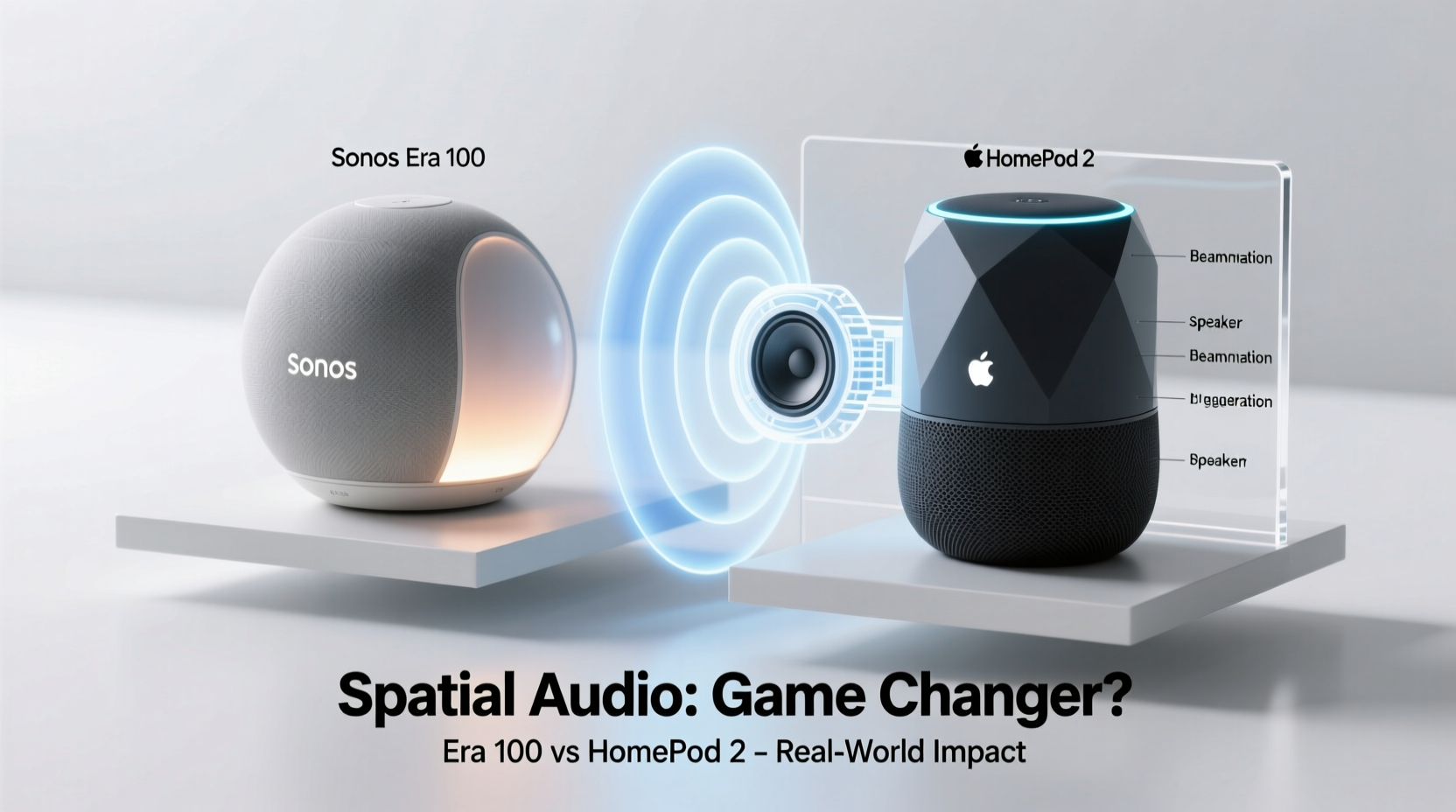
The Sonos Era 100 and HomePod 2 reflect their respective brand philosophies. The Era 100 continues Sonos’s tradition of understated, fabric-covered cylindrical design. It’s compact (6.4 inches tall), lightweight, and available in black or white. Its matte finish resists fingerprints, and the top features touch-sensitive controls for volume, play/pause, and microphone mute.
Apple’s HomePod 2, while slightly taller at 6.6 inches, shares a similar silhouette but with a tighter weave fabric and a glowing touch interface on top. It comes in white and midnight (black), with a built-in LED ring that pulses during Siri interactions. One notable difference: the HomePod 2 has an internal temperature sensor that allows it to double as a smart thermostat trigger in HomeKit automations—an edge in smart home utility.
Both speakers are well-built, but the HomePod 2 feels slightly more premium due to tighter material tolerances and seamless integration with Apple’s design language. However, the Sonos Era 100 wins on flexibility, supporting wall mounting via optional accessories—something Apple doesn’t offer.
Tip: Place either speaker away from walls and corners to avoid bass buildup and ensure balanced sound dispersion.Audio Performance: Where Sound Meets Science
At their core, both the Sonos Era 100 and HomePod 2 aim to deliver full-room audio from a single unit. Their internal architectures differ significantly, shaping how they perform in real environments.
The Era 100 uses three Class-D amplifiers driving one tweeter and two woofers positioned to fire outward and upward. This configuration enables stereo separation and supports spatial audio playback when paired with compatible services like Apple Music or Amazon Music HD. Sonos also includes a far-field microphone array and automatic room calibration via the Sonos app, adjusting EQ based on placement.
The HomePod 2 packs seven beamforming tweeters arranged in a circular array around a high-excursion woofer. Apple emphasizes computational audio—using machine learning to analyze room acoustics in real time. It adjusts equalization, directivity, and bass response dynamically. When playing spatial audio content (primarily Dolby Atmos tracks on Apple Music), the HomePod 2 creates a convincing sense of height and immersion, even from a single speaker.
In side-by-side listening tests, the HomePod 2 often edges ahead in bass depth and vocal clarity, especially at higher volumes. Its adaptive tuning shines in irregularly shaped rooms. The Era 100, while punchy and well-balanced, can sound slightly compressed in larger spaces. However, Sonos users praise its neutral profile, which appeals to audiophiles who prefer less coloration.
“Spatial audio isn’t about louder sound—it’s about recreating the sensation of being surrounded by music. That requires precise driver placement and advanced signal processing.” — Dr. Lena Torres, Audio Engineer at MIT Media Lab
Spatial Audio: Revolutionary or Refinement?
Spatial audio, particularly Apple’s implementation with Dolby Atmos, has been marketed as a paradigm shift in music listening. But does it live up to the hype when comparing the Era 100 and HomePod 2?
The short answer: yes, but with caveats. Spatial audio works best with native Atmos-encoded tracks—available primarily on Apple Music, Tidal, and Amazon Music. When playing such content, the HomePod 2 creates a surprisingly wide soundstage, with instruments appearing to come from above or behind the listener. Head tracking (when using AirPods) enhances this, but the speaker alone still simulates envelopment effectively.
The Sonos Era 100 supports spatial audio too, but its effect is subtler. While it decodes Atmos signals, the lack of vertical driver arrays limits true overhead imaging. Instead, it relies on psychoacoustic tricks to simulate space. In practice, listeners notice improved width and depth compared to stereo, but not the same level of immersion as the HomePod 2.
Moreover, spatial audio benefits diminish with non-Atmos content. For standard stereo tracks—which still make up the majority of most libraries—the difference between the two speakers narrows considerably. Both upscale stereo to multi-directional output, but results vary by genre. Classical and cinematic music benefit most; pop and rock see marginal gains.
Tip: To experience spatial audio fully, use Apple Music with an Atmos playlist and position yourself within 6–8 feet of the speaker.Ecosystem and Smart Features: Apple Tight Integration vs Sonos Open Flexibility
This is where the fundamental divide lies. The HomePod 2 is deeply embedded in Apple’s ecosystem. It works seamlessly with iPhone, iPad, Apple TV, and iCloud. You can use it to control HomeKit devices, receive personalized Siri responses, hand off audio between devices, and even serve as a secure hub for HomeKit camera streams.
Sonos takes a more open approach. The Era 100 supports both Alexa and Google Assistant (user’s choice), making it adaptable across Android and iOS platforms. It integrates with Spotify, Amazon Music, Pandora, and numerous third-party services via AirPlay 2, Bluetooth, and Sonos Radio. Multi-room setups are intuitive through the Sonos app, and you can pair two Era 100s for stereo sound—a feature the HomePod 2 also offers, but only within Apple’s framework.
However, Sonos recently removed support for some legacy features and discontinued its old app, causing frustration among long-time users. Meanwhile, Apple’s software updates are reliable and consistent, though limited to Apple ID accounts.
If you’re invested in Apple’s ecosystem, the HomePod 2 offers unmatched synergy. If you want freedom to switch platforms or prioritize multi-service access, the Era 100 provides broader compatibility.
Smart Feature Comparison Table
| Feature | Sonos Era 100 | HomePod 2 |
|---|---|---|
| Voice Assistant | Alexa or Google Assistant (selectable) | Siri only |
| Multi-Room Audio | Sonos app (supports mixed models) | Apple Home app (Sonos-compatible via AirPlay) |
| Bluetooth | Yes (for direct streaming) | No |
| Intercom Support | Limited (via voice assistants) | Full (Speak to HomePod from iPhone) |
| Smart Home Hub | No | Yes (Thread & Zigbee via HomeKit) |
| Wall Mount Option | Available (sold separately) | No |
Real-World Use Case: A Day in the Life
Consider Sarah, a graphic designer who works from home. She uses an iPhone but listens to music primarily on Spotify. Her morning routine includes checking the weather, turning on lights, and playing a focus playlist.
With the **HomePod 2**, she says, “Hey Siri, turn on the living room lights and play lo-fi beats on Spotify.” Siri complies, but launching Spotify requires a workaround since Siri defaults to Apple Music. The sound fills her apartment beautifully, and when she switches to an Atmos track later, she’s impressed by the depth. However, she can’t stream directly from her laptop via Bluetooth—only AirPlay, which occasionally stutters.
With the **Era 100**, she says, “Alexa, play jazz on Spotify,” and it starts instantly. Later, she connects her MacBook via Bluetooth to share a client presentation audio clip. The wall mount keeps it out of the way on her studio shelf. While spatial audio is present, it’s less dramatic than on the HomePod—but she appreciates the flexibility.
In this scenario, the Era 100 wins on connectivity and service support, while the HomePod 2 excels in ambient awareness and smart home control.
Step-by-Step Guide: Choosing the Right Speaker for You
- Assess your primary device ecosystem. If you use iPhone, Apple Watch, and Apple TV daily, the HomePod 2 will integrate more smoothly.
- Determine your music service. Heavy Spotify or Amazon Music users may prefer Sonos for direct app control.
- Consider room size and placement. The HomePod 2 adapts better to challenging acoustics; the Era 100 benefits from central positioning.
- Evaluate smart home needs. If you have Thread-based sensors or HomeKit cameras, the HomePod 2 acts as a secure hub.
- Test spatial audio content. Try Apple Music’s Atmos playlist on both if possible. See which creates a more engaging experience for your ears.
- Think long-term. Sonos supports longer product lifecycles and repairs; Apple focuses on seamless obsolescence and upgrades.
FAQ
Can the Sonos Era 100 pair with the HomePod 2 in a multi-room setup?
No, they cannot be grouped natively. However, you can use AirPlay 2 from an iPhone or Mac to send the same audio to both simultaneously, though without perfect sync or unified controls.
Does spatial audio work with non-Apple devices on the HomePod 2?
Limited functionality. Spatial audio decoding works with any source, but personalized head tracking and dynamic mode require an iPhone. On Android, you get standard Atmos playback if the content supports it.
Which speaker has better bass?
The HomePod 2 generally produces deeper, more controlled bass thanks to its high-excursion woofer and adaptive low-frequency correction. The Era 100 has solid bass for its size but can distort slightly at maximum volume.
Final Verdict: Is Spatial Audio a Game Changer?
Spatial audio is not a revolution for everyone—but it is a meaningful evolution. For listeners with access to Dolby Atmos music and Apple Music subscriptions, the HomePod 2 delivers a noticeably more immersive experience. Its computational audio engine and optimized hardware make spatial effects feel natural, not forced.
The Sonos Era 100 supports spatial audio capably, but it’s clear the feature wasn’t the central design pillar. Instead, Sonos prioritizes flexibility, third-party service access, and future-proofing through modular design.
So, is spatial audio a game changer? For early adopters and audiophiles exploring immersive formats, absolutely. It adds dimension and presence that stereo simply can’t match. But for casual listeners, the practical differences in daily use—voice assistant reliability, service compatibility, and smart home integration—may matter more than overhead sound effects.
If you're all-in on Apple's universe and value seamless automation, the HomePod 2 is the superior choice. If you want a versatile, cross-platform speaker with excellent sound and upgrade potential, the Sonos Era 100 remains a compelling option.
💬 Have you tried spatial audio on either speaker? Share your experience—did it change how you listen to music? Your insights could help others decide.








