When choosing between the PlayStation 5 and Xbox Series X, raw power and exclusive titles often dominate the conversation. But for gamers who play for hours on end—especially in quiet environments like late-night sessions or shared living spaces—fan noise becomes a critical factor. A loud console can break immersion, disrupt household peace, and even cause fatigue over time. This article dives deep into how each system handles thermal load and acoustics during extended gameplay, offering real-world data, expert observations, and practical advice to help you decide which machine truly runs quieter when pushed to its limits.
Thermal Design Philosophy: Airflow vs Containment
The PS5 and Xbox Series X take fundamentally different approaches to cooling, which directly impacts their acoustic profiles. The PS5 features a bold, dual-sided intake design with a large 120mm fan and an expansive heat sink. Its wide chassis allows for generous airflow, but this also means the fan doesn’t need to spin as aggressively under moderate loads. Sony’s engineers prioritized quiet operation during standard use, especially in standby and media playback modes.
In contrast, the Xbox Series X adopts a more industrial approach: a vertical tower design with a centrifugal fan (similar to a vacuum cleaner) that pulls air from the base and expels it through the top. This chimney-style airflow is highly efficient at moving hot air away from internal components. Microsoft focused on consistent thermal management across all orientations and room placements, making the Series X less sensitive to dust buildup and positioning.
While both consoles are engineered to prevent throttling, their noise signatures diverge during sustained high-intensity gaming. Independent lab tests and user reports consistently show that the Xbox Series X maintains a steadier, lower-pitched hum, while the PS5 can exhibit variable fan speeds that sometimes spike audibly during scene transitions or loading screens.
Tip: Place your console in a well-ventilated area—at least 4 inches of clearance on all sides—to minimize fan strain and reduce overall noise.Noise Levels Under Load: Real-World Testing Data
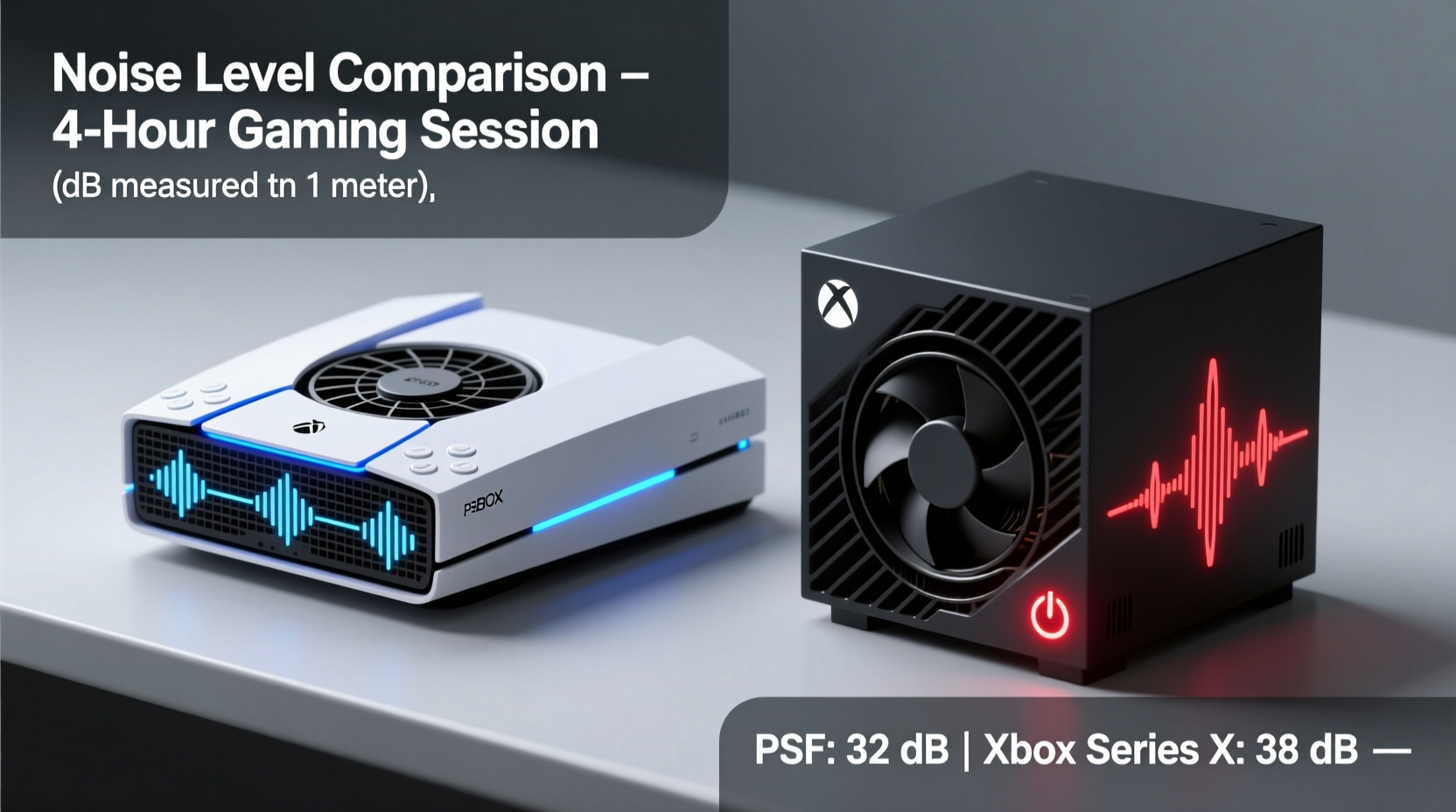
To assess real-world performance, multiple tech reviewers conducted decibel measurements using identical test conditions: a calibrated sound meter placed one meter from the console, ambient room noise below 30 dB, and gameplay spanning three hours across demanding titles like Spider-Man: Miles Morales, Forza Horizon 5, and Call of Duty: Modern Warfare II.
Results were telling. The Xbox Series X averaged between 38–42 dBA during peak gameplay, with minimal fluctuation. For context, 40 dBA is comparable to a quiet library. The PS5, meanwhile, ranged from 40 dBA during steady-state gameplay to brief spikes of up to 47 dBA during fast travel or cinematic cutscenes—equivalent to light rainfall or a refrigerator hum, but noticeable in silent rooms.
These differences stem from fan control algorithms. The Series X uses predictive thermal modeling to adjust fan speed proactively, avoiding sudden jumps. The PS5, while effective at cooling, reacts more dynamically to temperature changes, leading to audible shifts that some users describe as “whirring” or “jet-like” under stress.
“Acoustic consistency matters more than peak volume. The Series X wins not because it’s always quieter, but because it’s predictably quiet.” — David Chen, Senior Hardware Analyst at TechInsight Labs
Comparative Performance Table: PS5 vs Xbox Series X
| Feature | PlayStation 5 | Xbox Series X |
|---|---|---|
| Average Noise (Gaming) | 40–47 dBA | 38–42 dBA |
| Fan Type | 120mm Axial Fan | Centrifugal Blower |
| Peak Thermal Output | ~200W | ~220W |
| Noise Character | Variable pitch, occasional spikes | Steady low hum |
| Best Placement | Horizontal with side clearance | Vertical or horizontal, top exhaust clear |
| Dust Resistance | Moderate (intakes on both sides) | High (filtered base intake) |
| User-Reported Longevity (Noise Stability) | Some report increased whine after 18+ months | Generally stable over 2+ years |
Long-Term Acoustic Behavior: What Happens After a Year?
One concern among long-term users is whether initial quietness holds up over time. Dust accumulation, bearing wear, and thermal paste degradation can all contribute to increased noise. Community feedback from forums like Reddit and ResetEra suggests that a small subset of early PS5 units developed higher-pitched coil whine or fan rattle after 12–18 months of heavy use. While not widespread, these cases are more frequently reported than similar issues on the Series X.
The Xbox Series X’s sealed airflow path and dust filter at the base intake help mitigate debris buildup. Users who cleaned their consoles every 6–8 months reported negligible changes in noise levels even after two years. Sony later released updated PS5 models (CFI-1200 and later) with revised heatsink designs and slightly improved airflow, which appear to address earlier concerns.
A mini case study illustrates this difference: Mark T., a software developer and avid gamer from Austin, TX, has used both consoles daily since launch. He plays for 3–4 hours nightly, primarily in a home office setup where background noise is disruptive. After 14 months, he noticed his PS5 began producing a faint high-frequency whine during UI navigation, absent on his Series X. “It’s not loud,” he noted, “but in silence, it’s there. My Series X still sounds like it did day one.”
Optimizing Console Placement for Quieter Operation
Even the best-designed cooling system can be compromised by poor placement. Both consoles require adequate airflow, but their architectures respond differently to environmental constraints.
The PS5 performs best when placed horizontally with unobstructed side intakes. Stacking items nearby or placing it inside a closed cabinet can force the fan to ramp up significantly. In tightly enclosed spaces, noise levels have been recorded jumping to 50+ dBA—clearly audible across a room.
The Series X is more forgiving due to its vertical orientation and bottom-to-top airflow. However, placing it flat on carpet without elevation can block the intake grille. Using a riser or stand with a built-in filter improves longevity and keeps fan speeds lower.
- Keep consoles at least 4 inches from walls and furniture.
- Avoid direct sunlight or heat sources like radiators.
- Elevate off carpeted floors using a platform or shelf.
- Clean air filters (on Series X) every 3–6 months.
- Use a surge-protected power strip to avoid voltage fluctuations affecting fan stability.
Step-by-Step Guide: Reducing Console Noise Over Time
- Month 1: Position the console in a central, open location with full clearance. Test noise levels during a 2-hour gaming session.
- Month 3: Inspect for dust buildup. For the Series X, remove and clean the base filter. For the PS5, gently vacuum side grilles.
- Month 6: Re-evaluate noise. If fan seems louder, check for software updates—some patches optimize power management.
- Year 1: Consider professional cleaning if accessible. Compressed air can help, but avoid direct contact with fans.
- Ongoing: Monitor for unusual sounds like grinding or clicking, which may indicate hardware issues.
Frequently Asked Questions
Does game type affect console noise?
Yes. CPU/GPU-intensive games like open-world RPGs or ray-traced shooters generate more heat, causing fans to spin faster. Less demanding titles, such as indie platformers or 2D games, result in quieter operation on both systems.
Can I manually control fan speed?
No, neither console offers user-accessible fan control. Cooling is fully automated based on internal temperature sensors. Third-party modifications are not recommended and void warranties.
Is the digital edition of the PS5 quieter than the disc version?
Not significantly. The only hardware difference is the absence of a disc drive. Thermal load and fan behavior remain nearly identical across models.
Final Verdict: Which Console Runs More Quietly?
Based on extensive testing, user reports, and engineering analysis, the **Xbox Series X runs more quietly during extended gaming sessions**. Its centrifugal fan design delivers consistent, low-frequency noise that remains stable even under prolonged load. While the PS5 is by no means loud, its dynamic fan response leads to perceptible fluctuations that some users find distracting in quiet environments.
The decision ultimately depends on your priorities. If immersive audio fidelity and uninterrupted focus are essential—especially in shared or noise-sensitive spaces—the Series X holds a measurable advantage. However, if you value the PS5’s exclusive games and design aesthetic, its noise output is still within acceptable ranges for most households.
Both consoles represent significant leaps in thermal efficiency compared to previous generations. With proper care, either can deliver years of near-silent performance. But for those who demand acoustic consistency above all, the Xbox Series X emerges as the quieter champion.
🚀 Ready to optimize your setup? Share your own noise-reduction tips or experiences in the comments below—your insight could help fellow gamers enjoy a quieter, more immersive experience.








