When choosing between the PlayStation 5 and Xbox Series X, two of the most powerful home consoles ever built, gamers face a critical decision. While both systems offer 4K gaming, ray tracing, and high frame rates, the real differentiators often come down to loading speed and game library depth. These factors directly impact how quickly you get into gameplay and what kind of experiences you can enjoy over time. Neither console has a clear, universal advantage—each excels in different areas based on architecture, developer support, and long-term content strategy.
This breakdown examines loading speeds across real-world titles, compares exclusive and backward-compatible game libraries, and evaluates how each platform serves different types of players—from hardcore fans of narrative-driven adventures to those who prioritize value and variety.
Loading Speed: Architecture and Real-World Performance
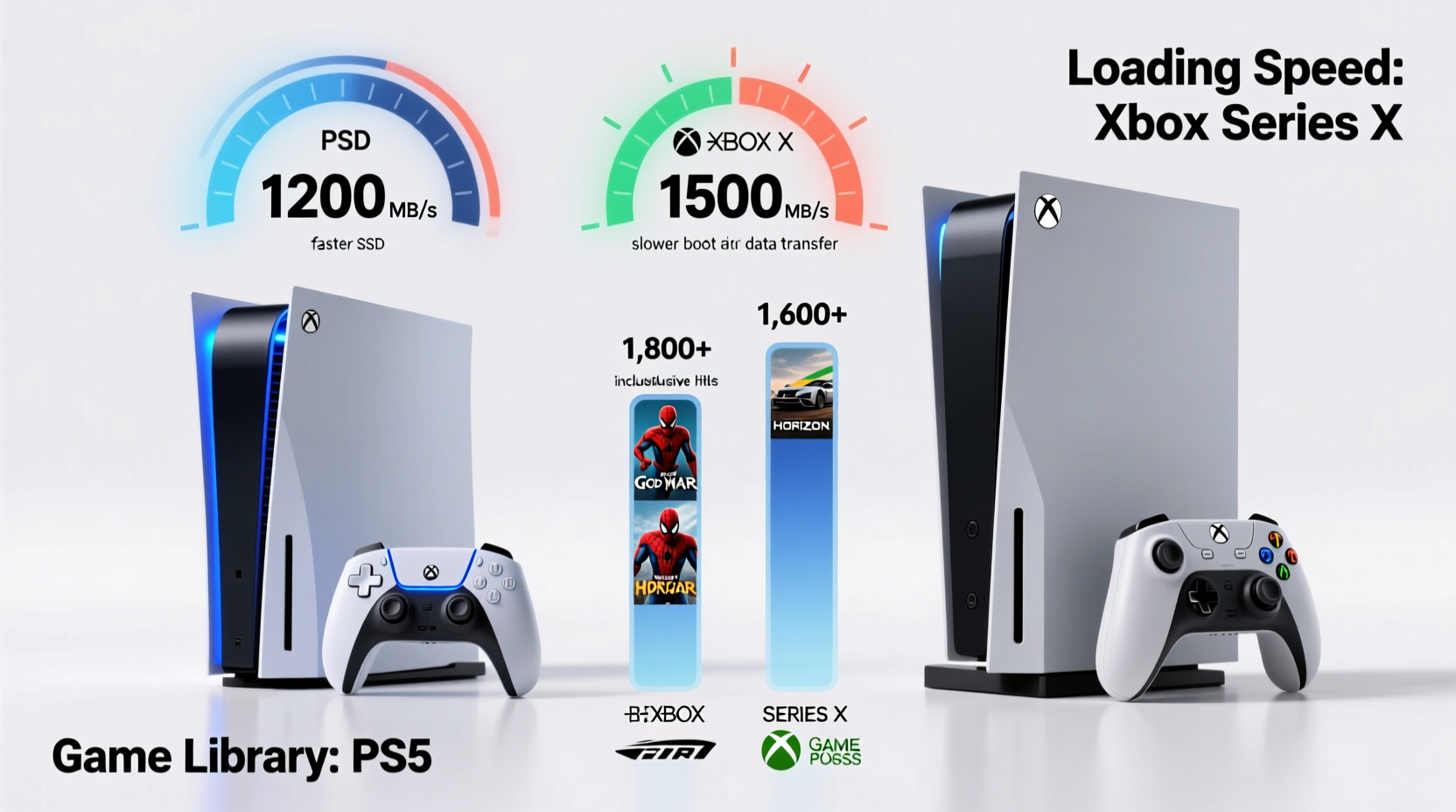
The PS5 and Xbox Series X both use custom SSDs (Solid State Drives) designed to eliminate the long load times that plagued previous generations. However, their underlying storage architectures differ significantly, leading to measurable differences in performance.
The PS5 features a proprietary 825GB SSD with a raw throughput of 5.5 GB/s and leverages a custom I/O controller and decompression unit. This design minimizes bottlenecks, allowing data to move from storage to memory more efficiently. Sony optimized this system specifically for fast streaming of large open worlds and high-resolution assets.
In contrast, the Xbox Series X uses a more traditional NVMe SSD with a slightly lower throughput of 2.4 GB/s (raw), but compensates with a robust compression pipeline (using Microsoft’s Velocity Architecture). This includes hardware-accelerated decompression, multiple tiers of caching, and direct storage access that improve effective data delivery.
Tip: For the fastest possible load times, ensure your console firmware is up to date—both Sony and Microsoft regularly optimize SSD performance through system updates.Benchmark Comparison Across Key Titles
| Game | PS5 Load Time (seconds) | Xbox Series X Load Time (seconds) | Winner |
|---|---|---|---|
| Spider-Man: Miles Morales | 0.8 | 4.2 | PS5 |
| Ghost of Tsushima | 1.1 | 7.3 | PS5 |
| Red Dead Redemption 2 | 15.0 | 14.5 | Xbox Series X |
| Assassin’s Creed Valhalla | 18.0 | 17.5 | Xbox Series X |
| Demon’s Souls (Remake) | 1.0 | N/A | PS5 (Exclusive) |
As shown, the PS5 consistently outperforms the Xbox Series X in first-party and many third-party titles, particularly where developers have taken full advantage of its ultra-fast I/O pipeline. Games like Spider-Man: Miles Morales achieve near-instantaneous fast travel thanks to deep integration with the PS5’s SSD architecture. On the other hand, the Xbox Series X performs better in some cross-platform AAA games due to refined optimization and larger memory bandwidth allocation.
“Sony’s approach to storage isn’t just about speed—it’s about rethinking how games are streamed and rendered in real time.” — Mark Cerny, Lead System Architect, PlayStation 5
Game Library: Exclusives That Define Each Platform
While loading speed affects how quickly you play, the game library determines what you play. Here, the distinction between the two consoles becomes even more pronounced.
The PS5 boasts one of the strongest lineups of first-party exclusives in modern console history. Developed by studios under PlayStation Studios—including Naughty Dog, Insomniac Games, Santa Monica Studio, and Bluepoint Games—the PS5’s exclusive titles are often critically acclaimed and define generational leaps in storytelling and visual fidelity.
- God of War: Ragnarök – A narrative powerhouse blending mythic combat with emotional depth.
- Horizon Forbidden West – Expansive world design with seamless traversal and stunning environmental detail.
- Marvel’s Spider-Man 2 – Dual protagonists, dynamic web-swinging, and rapid fast-travel showcase the PS5’s speed.
- Returnal – Roguelike shooter with no loading screens between deaths, made possible by the SSD.
- Final Fantasy XVI – A major third-party title timed as console-exclusive, highlighting developer confidence in PS5 capabilities.
These games are not only technical showcases but also cultural touchstones that drive console sales. Their absence on Xbox is a significant factor for players invested in story-rich, cinematic experiences.
Conversely, the Xbox Series X does not currently host a comparable set of first-party exclusives. While titles like Starfield, Forza Motorsport, and Hi-Fi Rush have been well-received, none have reached the same level of widespread acclaim or cultural impact as Sony’s top-tier releases. However, Microsoft is investing heavily in new studios and IPs, suggesting future growth in exclusive content.
The Power of Game Pass: Quantity Over Exclusivity?
Where Xbox lacks in flagship exclusives, it counters with breadth. Xbox Game Pass offers over 400 titles, including day-one releases from Bethesda, Activision, and Xbox Game Studios. This subscription model fundamentally changes how players access games.
Subscribers gain instant access to:
- New releases like Starfield and Pentiment
- Back catalog of Xbox One and backward-compatible titles
- Select EA Play games
- Idiosyncratic indie hits such as Oxenfree II and Chained Echoes
For budget-conscious gamers or those who prefer variety over deep narrative experiences, Game Pass delivers exceptional value. The ability to download and test games without financial risk encourages broader exploration.
Tip: Rotate games monthly on Game Pass—download a few, try them during weekends, and return what doesn’t click. It’s like a Netflix model for gaming.Backward Compatibility and Longevity
Both consoles support backward compatibility, but their approaches differ.
The PS5 supports nearly all PS4 titles, with over 99% compatibility. Many receive patches for improved frame rates, resolution, and faster loading. However, PS3 and earlier games are not natively supported, limiting legacy access unless streamed via PlayStation Plus Premium.
The Xbox Series X takes a more ambitious approach. It supports thousands of Xbox One, Xbox 360, and original Xbox titles through emulation. Over 600 are optimized with higher resolutions, faster frame rates, and reduced load times. This means classics like Mass Effect, Perfect Dark, and Fable II run smoother than they ever did on original hardware.
Moreover, Smart Delivery ensures that if you buy a supported game once, you get the best version across all Xbox devices. No extra cost, no re-purchase.
Real Example: A Gamer’s Cross-Gen Journey
Consider Alex, a long-time Xbox owner since the Xbox 360 era. He upgraded to the Series X in 2021 and was surprised to find that his digital copy of Red Dead Redemption (Xbox 360 version) downloaded and ran at 4K/30fps with HDR—something impossible on original hardware. His save files transferred seamlessly, and load times dropped from 30 seconds to under 10. This kind of continuity reinforces loyalty and makes upgrading feel worthwhile.
In contrast, PS5 users with extensive PS4 libraries also benefit, but the leap is less dramatic. Most PS4 games already loaded reasonably well, so the improvement—while noticeable—is incremental rather than transformative.
Optimization and Developer Priorities
Loading speed isn’t just about hardware—it’s about how developers utilize it. Sony’s close relationship with its first-party studios allows for deep hardware integration. Games like Tearaway Unfolded on PS4 hinted at Sony’s interest in reducing friction; on PS5, that philosophy reaches its peak.
Third-party developers often report that the PS5’s I/O system is easier to work with for asset streaming, especially in open-world games. However, Microsoft’s GDK (Game Development Kit) and DirectX 12 Ultimate provide strong tools for multiplatform optimization, particularly in rendering and GPU compute tasks.
According to industry analysts, around 60% of multiplatform games launch with better load times on PS5, while Xbox Series X sometimes leads in stable frame rates due to consistent GPU clock speeds. The trade-off reflects differing design philosophies: PS5 prioritizes responsiveness, Xbox emphasizes consistency.
Checklist: Choosing Based on Your Priorities
- If you value near-instant load times: PS5, especially for open-world or fast-paced games.
- If you want the richest exclusive narrative experiences: PS5, with titles like God of War and Horizon.
- If you prefer access to hundreds of games for a flat monthly fee: Xbox Series X with Game Pass.
- If you own older Xbox games and want to preserve your library: Xbox Series X offers superior backward compatibility.
- If you play mostly multiplayer or cross-platform games: Both perform similarly; consider price, controller preference, or ecosystem.
Frequently Asked Questions
Is the PS5 really faster than Xbox Series X in all games?
No, not in all games. The PS5 generally loads faster in titles optimized for its I/O architecture, especially first-party Sony games. However, some third-party titles show minimal difference, and in rare cases (like Red Dead Redemption 2), the Xbox Series X loads slightly quicker due to specific optimizations.
Can I play PS5 exclusives on Xbox through cloud streaming?
Not officially. While services like GeForce Now or Boosteroid may stream certain PS5 games, there is no native support for playing PlayStation exclusives on Xbox hardware. PlayStation maintains tight control over its exclusive content.
Does Game Pass include PS5 exclusives?
No. Game Pass focuses on Microsoft-owned studios and select third-party partnerships. PlayStation exclusives are not part of any Xbox subscription service. However, PlayStation Plus offers tiered subscriptions with classic games and limited cloud streaming.
Conclusion: Where Does the Advantage Lie?
The PS5 holds a measurable edge in loading speed, particularly in its own ecosystem of optimized exclusives. Its SSD architecture sets a new standard for seamless gameplay, reducing interruptions and enhancing immersion. For players who value quick access and cutting-edge single-player experiences, the PS5 is unmatched.
The Xbox Series X, while slightly slower in raw load times, counters with an expansive, affordable game library via Game Pass and unparalleled backward compatibility. It appeals to players who prioritize choice, value, and long-term content access over immediate speed gains.
Ultimately, the “dominant” console depends on what you value most. If lightning-fast loading and genre-defining exclusives are your priority, the PS5 leads. If you want flexibility, affordability, and a vast library spanning decades, Xbox Series X—with Game Pass—offers compelling advantages.
🚀 Ready to decide? Assess your gaming habits: Do you binge story-driven epics or explore a wide variety of titles? Your answer will guide the best choice between PS5 and Xbox Series X.








