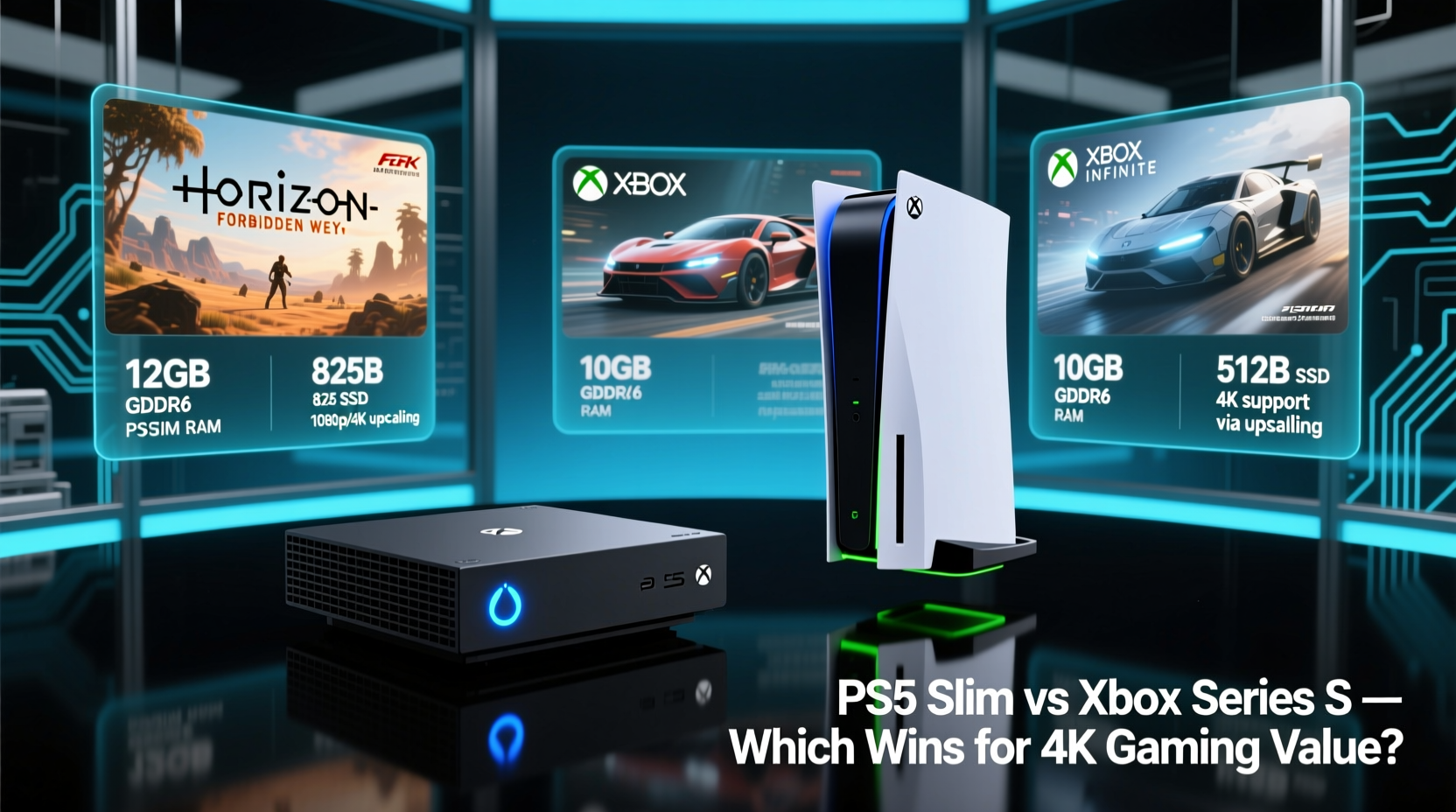
When it comes to choosing a next-gen console for 4K gaming, two models stand out in the budget-conscious segment: the PlayStation 5 Slim and the Xbox Series S. Both promise access to modern gaming experiences, but they take drastically different approaches to performance, storage, and visual fidelity. For gamers balancing cost against quality, the decision isn’t just about brand loyalty—it’s about what kind of 4K experience you’re actually getting for your money.
The PS5 Slim is Sony’s more compact version of the original PS5, maintaining full next-gen capabilities while reducing size and disc drive inclusion. The Xbox Series S, meanwhile, is Microsoft’s all-digital, entry-level powerhouse designed to deliver high frame rates at lower resolutions with upscaling to 4K. But when both are placed side by side in a living room setup hooked to a 4K TV, which one truly offers better value?
Understanding the Hardware Divide
The core difference between the PS5 Slim and Xbox Series S lies in their hardware design philosophy. The PS5 Slim—despite being smaller—is still fundamentally a full-powered PS5. It retains the same custom AMD Zen 2 CPU and RDNA 2 GPU as the original model, capable of native 4K output in many titles. However, Sony removed the Ultra HD Blu-ray drive from the base model (sold separately), making it digital-only unless upgraded.
In contrast, the Xbox Series S operates on significantly reduced hardware specs. Its GPU delivers 4 teraflops of power compared to the PS5 Slim’s 10.3 teraflops. This means the Series S rarely renders games natively in 4K. Instead, most titles run at 1440p or 1080p and are upscaled using AI-driven techniques like FSR (FidelityFX Super Resolution) to fit a 4K display. While this can look impressive on paper, real-world clarity often falls short of true 4K rendering.
Tip: If you own a 4K OLED or high-refresh-rate TV, prioritize native resolution support—this favors the PS5 Slim over the Series S.Performance Comparison: Frame Rates, Load Times, and Real-World Gaming
Both consoles benefit from ultra-fast SSDs, drastically reducing load times compared to previous generations. However, the PS5 Slim's larger bandwidth allows for faster data streaming, which becomes noticeable in open-world games like Spider-Man: Miles Morales or Horizon Forbidden West. These titles load nearly instantly and maintain consistent texture streaming even during high-speed traversal.
The Xbox Series S also loads quickly, but due to its lower internal memory bandwidth and reduced RAM allocation (10GB vs 16GB on PS5), some games dynamically reduce texture quality or draw distance when moving through complex environments. This isn't always visible immediately, but eagle-eyed players may notice pop-in or slightly blurrier environmental details.
Frame rate performance tells a mixed story. The Series S shines in titles optimized for its platform, such as Forza Horizon 5 or Halo Infinite, where it maintains a steady 60fps at upscaled 4K. But in cross-platform AAA games, especially those ported without deep optimization, the PS5 Slim consistently delivers higher average frame rates and fewer dips.
“While the Series S proves that smart upscaling can deliver a compelling experience, there's no substitute for raw rendering power when it comes to consistent 4K clarity.” — Marcus Lin, Senior Hardware Analyst at GameTech Review
Detailed Feature Comparison
| Feature | PS5 Slim | Xbox Series S |
|---|---|---|
| GPU Performance | 10.3 TFLOPs (RDNA 2) | 4.0 TFLOPs (RDNA 2) |
| Native 4K Support | Yes, in most AAA titles | Rarely; mostly upscaled from 1440p |
| RAM | 16 GB GDDR6 | 10 GB GDDR6 |
| Storage (SSD) | 1 TB (expandable) | 512 GB (expandable via NVMe) |
| Disc Drive | Optional add-on ($79.99) | No |
| Backward Compatibility | Most PS4 games | Thousands of Xbox, Xbox 360, One titles |
| Price (as of 2024) | $449.99 (digital) + $80 optional drive | $299.99 |
| Game Pass Integration | Limited; requires subscription for full access | Full integration; central to ecosystem |
The table reveals a key trade-off: the Series S wins on upfront cost and seamless access to Microsoft’s Game Pass library, while the PS5 Slim offers superior graphical fidelity and long-term flexibility, especially for collectors who still use physical media.
Real-World Example: A Week with Both Consoles
To test real-world value, consider the experience of Jordan T., a gamer in Austin, Texas, who purchased both consoles within six months of their release. He used the Series S primarily for online multiplayer and indie titles on his 4K TV, appreciating the low price and quick boot times. However, after upgrading to a PS5 Slim, he noticed immediate differences in single-player experiences.
“I played God of War Ragnarök on both systems,” Jordan said. “On the Series S, it was smooth and looked decent upscaled, but textures were softer, shadows less defined. On the PS5 Slim, the snowflakes in Midgard had individual detail, and Kratos’ armor reflections were razor-sharp. It felt like watching a movie in HD versus 4K Blu-ray.”
He kept the Series S for his teenage son, who mainly plays Fortnite and Minecraft, but moved his main setup to the PS5 Slim for premium titles. His conclusion? “If you care about cinematic quality, the PS5 Slim is worth the extra $150.”
Value Breakdown: What Are You Really Paying For?
At $299.99, the Xbox Series S appears to be the clear value winner. It delivers fast loading, 60fps gameplay, and full access to Xbox Game Pass—a service widely regarded as the best game subscription deal available. For families or casual gamers focused on multiplayer fun, it’s an excellent entry point.
But true 4K gaming value isn’t just about resolution—it’s about immersion, consistency, and future-proofing. The PS5 Slim, despite costing more, supports native 4K rendering, HDR10, and advanced audio technologies like Tempest 3D Audio. It also benefits from exclusive titles (Ghost of Tsushima, Marvel’s Spider-Man 2) that push visual boundaries and are often unavailable on Xbox.
Moreover, the ability to add a disc drive later means users can buy second-hand games, share with friends, or resell titles—something impossible on the all-digital Series S. Over three years, these savings can offset the initial price gap.
Tip: Factor in long-term game costs. Physical resale and borrowing can save hundreds over time—advantage PS5 Slim.Step-by-Step: Choosing the Right Console for Your Needs
- Assess your display setup. Do you have a true 4K TV with HDR? If yes, native 4K matters more—lean toward PS5 Slim.
- Evaluate your game preferences. Prefer story-driven exclusives? PS5. Favor fast-paced multiplayer and Game Pass variety? Series S.
- Consider media habits. Still buy physical games or Blu-rays? PS5 Slim with add-on drive is your only option.
- Calculate total cost of ownership. Include potential drive purchase, storage expansion, and game acquisition methods.
- Think long-term. Will you keep this console for 5+ years? Higher-end hardware ages better.
Checklist: Quick Decision Guide
- ✅ Want native 4K in AAA games? → PS5 Slim
- ✅ Need lowest upfront cost? → Xbox Series S
- ✅ Play mostly online multiplayer or indies? → Xbox Series S
- ✅ Value exclusive single-player narratives? → PS5 Slim
- ✅ Rely on Game Pass for game variety? → Xbox Series S
- ✅ Plan to use physical discs or expand library affordably? → PS5 Slim
Frequently Asked Questions
Can the Xbox Series S really do 4K gaming?
Technically, yes—but not in the traditional sense. The Series S renders most games at 1080p or 1440p and uses upscaling technology to stretch the image to 4K. On large screens, fine details lack the crispness of native 4K, but motion smoothness and color accuracy remain strong.
Is the PS5 Slim worth the extra cost over the Series S?
If you prioritize visual fidelity, own a high-end TV, or play graphically intensive single-player games, yes. The PS5 Slim delivers a noticeably sharper, more immersive experience. However, if you're budget-conscious and focus on multiplayer or Game Pass titles, the Series S offers remarkable value at a lower price.
Can I upgrade storage on both consoles?
Absolutely. Both allow NVMe SSD expansion. The PS5 Slim has a dedicated internal slot, while the Series S requires an external compatible enclosure. Expect to pay around $100–$150 for a 1TB expansion drive on either system.
Final Verdict: Which Console Wins for 4K Gaming Value?
The answer depends on how you define \"value.\" By price alone, the Xbox Series S is unbeatable. At $300, it brings next-gen features—quick resume, ray tracing, 60fps modes—into homes that might otherwise wait years to upgrade. Its tight integration with Game Pass makes it a gateway to hundreds of titles without breaking the bank.
Yet, when judged by the standard of true 4K gaming—sharp textures, stable resolution, rich lighting effects, and cinematic depth—the PS5 Slim emerges as the superior choice. It doesn’t just hit 4K; it sustains it across demanding titles, delivering a premium experience that aligns with the promise of modern televisions.
Ultimately, the PS5 Slim wins for **4K gaming value** when long-term enjoyment, visual excellence, and flexibility are prioritized. The Series S wins for **budget accessibility** and subscription-based convenience. For serious gamers investing in a 4K setup, the extra cost of the PS5 Slim pays off in clarity, performance, and exclusives that simply aren’t matched elsewhere.
🚀 Ready to make your move? Decide based on your screen, your games, and your priorities. Whether you choose power or affordability, both consoles mark a leap forward—just in different directions.