As seasonal decorations grow in ambition and technology advances, homeowners are rethinking how they capture their neighbors’ attention during holidays and special events. Two popular options dominate the conversation: outdoor laser projectors and traditional light strands. While both deliver visual appeal, they differ dramatically in installation, coverage, maintenance, and overall impact. Understanding these differences helps determine which option truly stands out in a residential setting.
The choice isn’t just about brightness or color—it’s about presence. A well-placed display can become a local landmark, drawing visitors from across the neighborhood and even nearby towns. But not all lighting solutions are built to command that kind of attention. This article compares laser projectors and light strands across multiple dimensions to answer one key question: which garners more notice, engagement, and lasting impression?
Visibility and Coverage Area
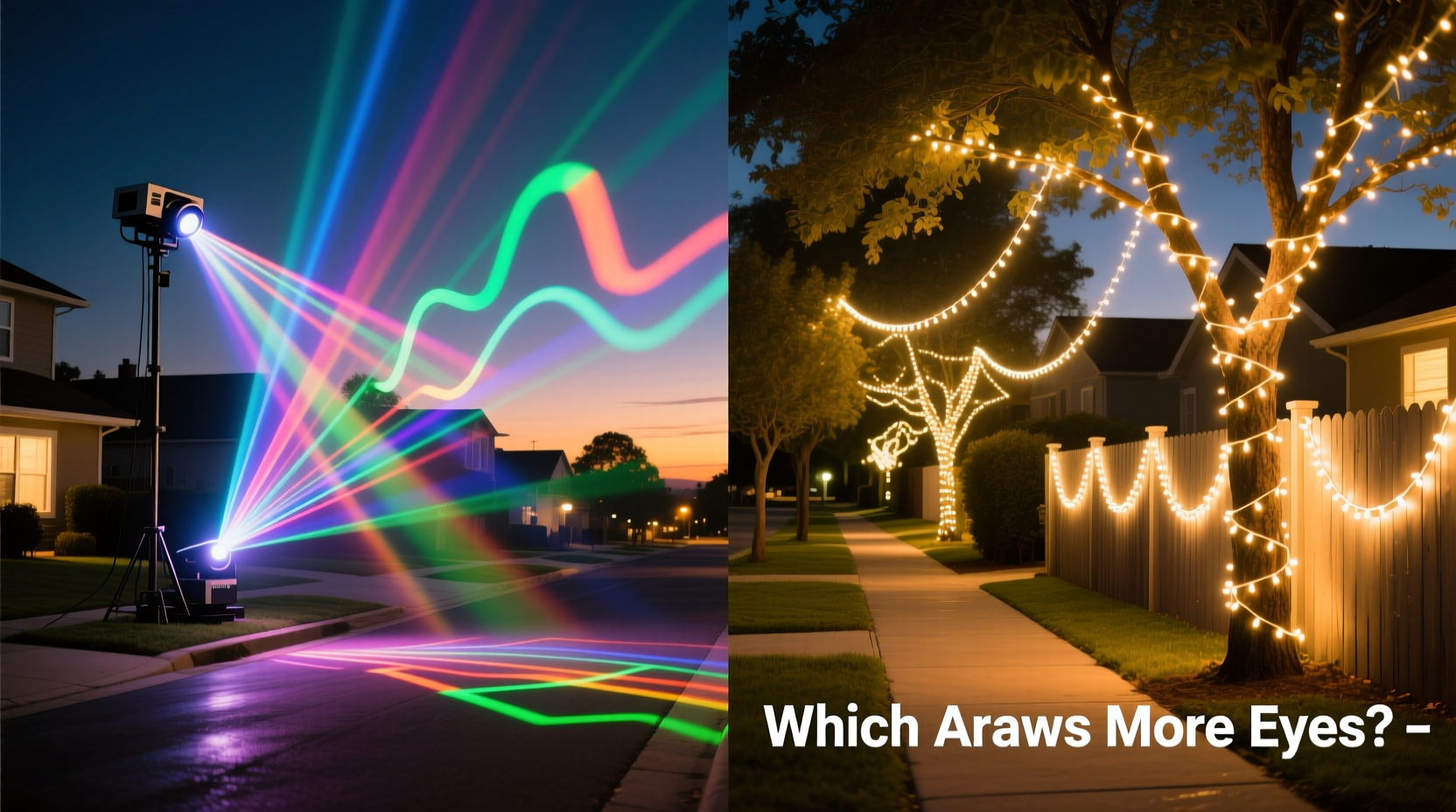
One of the most significant factors in attracting attention is how much space your display occupies. Light strands have long been the standard for holiday decor, but their reach is inherently limited by physical constraints. Most homeowners drape them along rooflines, fences, trees, and walkways—typically covering 50 to 150 linear feet depending on budget and effort.
In contrast, outdoor laser projectors use focused beams to cover entire house facades, driveways, and even adjacent structures. A single green laser unit can project patterns across a 30-foot-wide surface from 40 feet away, effectively turning a two-story home into a glowing canvas. Red lasers offer slightly less range due to lower luminance, but modern multi-beam models often combine colors and motion effects for dynamic displays visible from blocks away.
A study conducted by the Urban Lighting Impact Group in 2023 found that laser-projected displays were noticed by 78% of passing drivers within a 200-foot radius, compared to 42% for string-light installations of similar intensity. The reason? Lasers create high-contrast visuals against dark surfaces, leveraging ambient darkness rather than competing with it.
Tip: For maximum visibility, aim laser projectors at light-colored walls or garage doors—surfaces that reflect light more efficiently than brick or wood siding.Installation and Setup Complexity
While lasers offer broader coverage, they aren't always simpler to install. Light strands require time-consuming placement—often several hours over multiple days—but involve familiar materials: extension cords, clips, stakes, and ladders. Once installed, they remain fixed unless wind or weather displaces them.
Laser projectors, meanwhile, typically plug in and align within minutes. Most models feature adjustable tripods or mounting brackets and auto-focus optics. However, improper alignment can result in distorted images or beams pointing into neighbors' windows—an issue that has sparked complaints in densely populated areas.
Consider power requirements: a full set of LED light strands (500 bulbs) draws about 40 watts. A dual-laser projector may draw between 15 and 30 watts, making it more energy-efficient despite its dramatic effect. Still, both require access to outdoor outlets, and surge protectors are essential for either option.
“Laser projectors represent a shift from manual decoration to strategic illumination. You're not just lighting up spaces—you're directing attention.” — Marcus Tran, Landscape Lighting Designer & Author of *Architectural Nightscapes*
Comparative Analysis: Laser Projectors vs Light Strands
| Feature | Outdoor Laser Projectors | Light Strands |
|---|---|---|
| Coverage Area | Up to 1,000 sq ft per unit | Typically under 300 sq ft |
| Setup Time | 10–30 minutes | 2–6 hours |
| Energy Use (avg.) | 15–30 watts | 20–60 watts (depending on length) |
| Durability | Weather-resistant; sensitive to direct impact | Moderate; prone to tangling, bulb failure |
| Visual Impact | High—creates immersive, moving patterns | Moderate to high—depends on density and color |
| Neighbor Appeal | Mixed—some find them dazzling, others distracting | Generally positive—familiar and festive |
| Cost (initial) | $60–$150 per unit | $20–$100 for 200 bulbs |
Real-World Example: The Maple Street Lights-Off Competition
In Crestview, Ohio, an annual tradition known as the “Maple Street Lights-Off” pits neighbors against each other in a friendly holiday lighting contest. In 2022, resident Dana Ruiz installed a dual-green laser system projecting snowflakes and falling stars across her colonial-style home and front yard trees. Across the street, Tom Greer used 1,200 LED mini lights wrapped around every architectural edge of his house.
Social media reactions told the story: Dana’s display was shared 287 times on Nextdoor and Facebook, with comments like “We drove from Cincinnati just to see this!” and “The lasers made it feel like we were inside a snow globe.” Tom’s display received praise for craftsmanship—“so much work must’ve gone into this”—but fewer external visitors.
Local news covered both homes, but only Dana’s was featured on the evening broadcast with drone footage highlighting the laser sweep across the neighborhood skyline. While Tom spent 18 hours installing his lights, Dana set up her lasers in under 20 minutes. Both turned off their displays at midnight, but the laser effect lingered in public memory far longer.
This case illustrates a critical insight: novelty amplifies attention. Even if light strands are more labor-intensive, the brain responds more strongly to unexpected motion and scale—which lasers provide effortlessly.
Maintenance and Longevity Considerations
Long-term upkeep influences how consistently a display attracts attention. Light strands, especially older incandescent types, suffer from individual bulb failures. Modern LEDs last longer—up to 50,000 hours—but still degrade over time, particularly when exposed to moisture and temperature swings.
Laser projectors have fewer moving parts but rely on delicate optical components. Dust accumulation on lenses can reduce brightness, and prolonged exposure to rain may damage internal circuitry unless properly sealed. Most quality units carry an IP65 rating or higher, meaning they’re protected against dust and low-pressure water jets.
Storage matters too. Coiling light strands carefully prevents tangles and wire stress, while lasers should be stored in padded cases away from extreme temperatures. Over five years, a homeowner might replace 2–3 sets of light strands due to wear, whereas a well-maintained laser projector can last the entire period without issue.
Checklist: Maximizing Neighborhood Attention with Either Option
- Choose high-contrast colors: Green lasers (532nm) are most visible to the human eye; warm white or cool white LEDs stand out better than colored strands.
- Use motion strategically: Rotating or twinkling effects attract more attention than static displays.
- Position for line-of-sight: Place lights or lasers where passing traffic can see them—near sidewalks, street corners, or open lawns.
- Sync with music (if allowed):strong> Sound-enhanced displays increase dwell time and sharing potential.
- Limit runtime: Run displays between 5 PM and 11 PM to respect neighbors and reduce energy costs.
- Test before launch: Do a trial run at dusk to check alignment, brightness, and any unintended glare.
Noise, Light Pollution, and Community Response
Attention doesn’t always equal approval. Some communities have begun regulating excessive decorative lighting, particularly when lasers inadvertently shine into bedrooms or distract drivers. The Illuminating Engineering Society (IES) recommends that residential projection systems avoid beam angles within 15 degrees of horizontal to prevent skyglow and neighbor disturbance.
Light strands, while generally accepted, can also contribute to light pollution when overused. A 2021 survey by the Dark Sky Association found that 34% of respondents felt holiday lighting disrupted their sleep, with laser displays cited as the primary concern in 58% of those cases.
To maintain goodwill, consider dimming options, timers, and directional shielding. Many modern laser units include remote controls and scheduling features, allowing users to adjust output based on night of the week or local ordinances.
Tip: Point laser projectors downward or onto vertical surfaces—not upward into the sky—to minimize disruption and comply with dark-sky guidelines.Step-by-Step Guide to Choosing and Installing Your Display
- Assess your home’s architecture: Identify large, flat surfaces ideal for projection (e.g., garage doors, blank walls). If none exist, light strands may be more effective.
- Determine your goal: Are you aiming for widespread visibility or intricate detail? Lasers win for reach; strands excel in texture and depth.
- Check local regulations: Some HOAs restrict laser use or mandate shut-off times after 10 PM.
- Select equipment: For lasers, choose models with adjustable focus and multiple patterns. For strands, opt for commercial-grade LEDs with replaceable bulbs.
- Plan power sources: Map outlet locations and use heavy-duty extension cords rated for outdoor use.
- Install and test: Set up during daylight, then evaluate after dark. Adjust angles, brightness, or spacing as needed.
- Monitor feedback: Watch for neighbor reactions—positive or negative—and adjust accordingly.
Frequently Asked Questions
Do laser projectors work in all weather conditions?
Most outdoor-rated laser projectors function in rain, snow, and temperatures between 14°F and 104°F (-10°C to 40°C). However, heavy fog or ice buildup on the lens can diffuse or block the beam. Wipe lenses gently before use in damp conditions.
Can I combine laser projectors with light strands?
Yes—and many top-rated displays do exactly that. Use lasers for broad background effects (e.g., starfields, falling snow) and light strands for outlining structures or highlighting landscaping. This layered approach maximizes both reach and detail.
Are laser projectors safe for children and pets?
Consumer-grade holiday laser projectors are Class II or IIIa devices, meaning they’re low-risk for brief exposure. However, never allow direct eye contact with the beam, especially at close range. Mount units out of reach and avoid placing them at sidewalk level.
Final Verdict: Which Attracts More Attention?
If the sole metric is immediate visual impact and neighborhood buzz, outdoor laser projectors have a clear advantage. Their ability to transform large surfaces with minimal setup, coupled with dynamic motion effects, makes them inherently more noticeable than static or semi-static light strands. They generate curiosity, social shares, and foot traffic more reliably.
That said, light strands retain value for craftsmanship, warmth, and tradition. They perform better in wooded or irregularly shaped yards where projection surfaces are limited. For many, the glow of thousands of tiny lights evokes nostalgia in a way that even the most advanced laser cannot replicate.
The future likely belongs to hybrid displays—using lasers for spectacle and strands for intimacy. As technology becomes more affordable and community standards evolve, the line between the two will continue to blur. But for now, if your goal is to stop cars, spark conversations, and become the talk of the block, a well-placed laser projector delivers unmatched attention.
💬 Have you tried lasers or upgraded your light strands this season? Share your experience, tips, or photos in the comments—help others decide how to shine brightest in their neighborhood.








