In recent years, the gaming industry has been dominated by expansive open worlds. From sprawling fantasy realms to meticulously recreated modern cities, developers have poured resources into building massive environments. Yet a growing number of players are expressing fatigue—not with open world design itself, but with the sheer scale often prioritized over substance. What was once a hallmark of ambition now risks becoming a burden. As linear games continue to deliver focused, emotionally resonant experiences, a quiet rebellion is forming. Players aren’t rejecting exploration; they’re questioning whether bigger always means better.
The Rise and Saturation of Open World Design
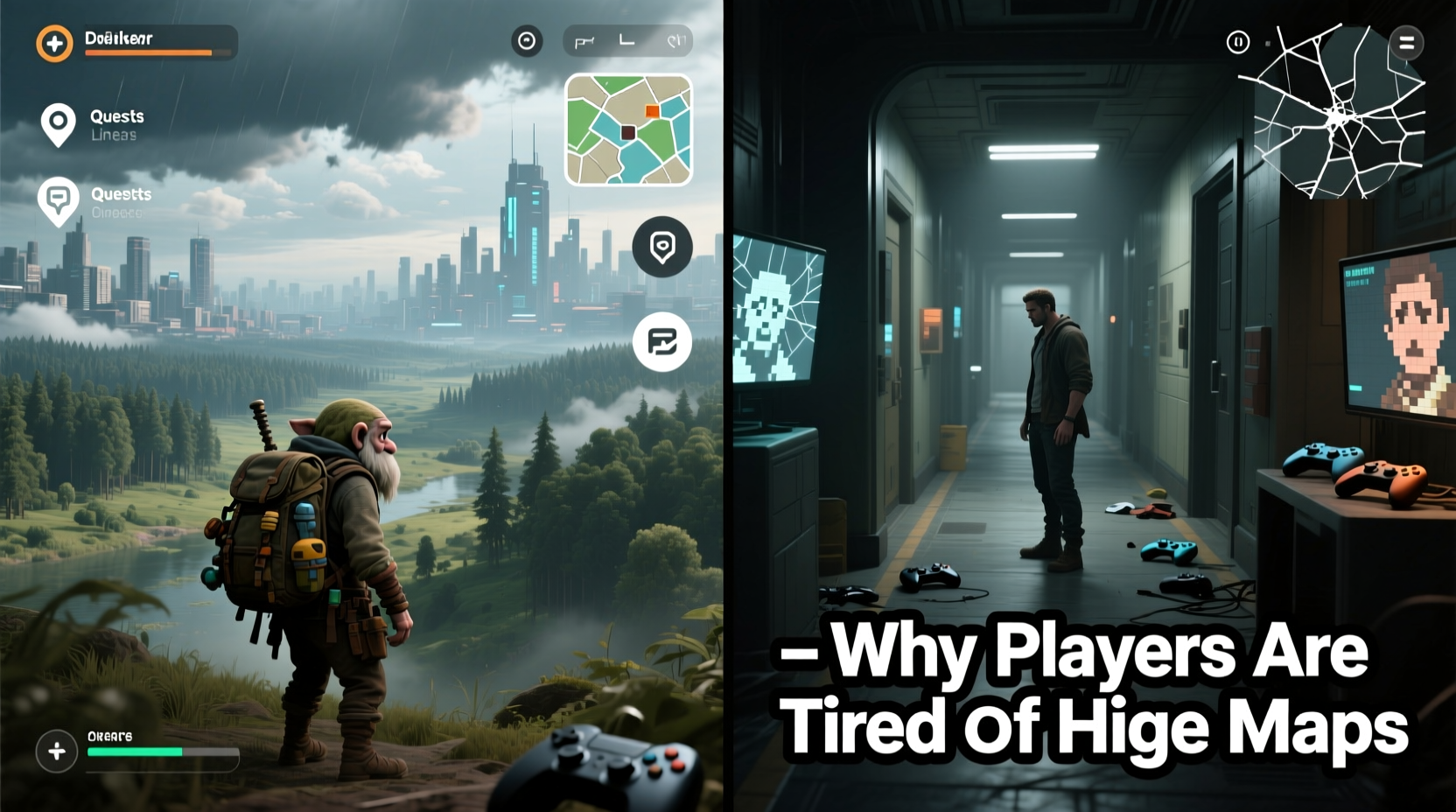
The appeal of open world games is undeniable. Titles like The Legend of Zelda: Breath of the Wild, Red Dead Redemption 2, and Horizon Zero Dawn demonstrated how freedom of movement and discovery could redefine immersion. These games offered players the chance to forge their own paths, stumble upon hidden stories, and interact with dynamic ecosystems—all within vast digital landscapes.
However, success bred imitation. The formula became standardized: unlock a map quadrant, clear out icons, repeat. What began as innovation evolved into a checklist-driven grind. Developers, eager to match blockbuster expectations, began equating quality with quantity—measuring success not by narrative depth or gameplay variety, but by square mileage.
As more studios adopted this model, players noticed a troubling pattern: larger maps didn’t necessarily mean richer experiences. Instead, many open worlds felt padded, filled with repetitive side quests, artificial barriers, and collectibles that added little emotional or mechanical value.
Tip: A great open world isn’t defined by size, but by density of meaningful interactions—every location should offer purpose, surprise, or story.Linear Games: The Underrated Power of Focus
In contrast, linear games have maintained a reputation for precision. By guiding players along a curated path, these titles can tightly control pacing, atmosphere, and narrative payoff. Consider Half-Life 2, where environmental storytelling and uninterrupted momentum create an immersive journey without ever opening a map. Or Portal, which turns spatial constraints into a core gameplay mechanic, delivering one of the most memorable endings in gaming history.
Modern examples like Alan Wake 2 and Resident Evil Village prove that linearity doesn’t mean rigidity. These games use constrained spaces to amplify tension, ensuring every encounter feels intentional. There’s no filler because there’s no room for it. Every corridor, puzzle, and enemy placement serves a purpose.
This focus allows developers to invest deeply in world-building, character development, and moment-to-moment gameplay. Without the pressure to fill hundreds of square kilometers, teams can prioritize polish over scale.
“We’ve mistaken bigness for depth. A well-crafted level can be more impactful than an entire overworld full of radio towers.” — Lena Park, Narrative Designer at Obsidian Entertainment
Why Players Are Tired of Huge Maps
The fatigue isn’t about hating exploration—it’s about diminishing returns. When every new AAA title promises “the biggest world ever,” players begin to question what that actually delivers. Several key issues have emerged:
- Repetition and Bloat: Many open world games rely on procedural generation or copy-pasted mission structures. Climbing towers, liberating camps, scanning wildlife—these tasks become rote rather than rewarding.
- Lack of Meaningful Choice: Despite the illusion of freedom, main storylines often remain rigidly linear. Players may roam freely, but critical narrative beats unfold on rails.
- Design Overload: Massive maps demand enormous resources. Often, this leads to underdeveloped side characters, shallow lore, or inconsistent tone—because attention is spread too thin.
- Fatigue from Completionism: Achievement culture pressures players to 100% games, turning leisure into labor. Clearing every icon becomes a chore, not a joy.
- Navigation Fatigue: Long traversal times across empty terrain disrupt pacing. Fast travel helps, but it breaks immersion and reduces the sense of place.
Players aren’t asking for smaller games—they’re asking for smarter ones. They want experiences where time spent matters, where exploration feels organic, and where every area contributes to a larger vision.
A Case Study: The Division 2 vs. Returnal
Consider two contrasting titles released within a year of each other: The Division 2 and Returnal.
The Division 2 offers a detailed recreation of Washington, D.C., packed with activities, factions, and gear progression. Yet many players reported burnout after a few weeks—despite enjoying the core mechanics. The map was large, but much of it felt functionally identical. Side missions reused objectives, and endgame content relied heavily on repetition.
In contrast, Returnal, a linear-but-structured roguelike, confined players to interconnected biomes that reconfigured with each death. Though technically smaller in scope, its world felt denser. Every run revealed new narrative fragments, environmental shifts, and combat challenges. Players stayed engaged not because of scale, but because of mystery and consequence.
This comparison illustrates a broader trend: engagement stems from meaning, not magnitude.
Striking the Right Balance: Hybrid Models That Work
The future may lie not in choosing between open world and linear, but in blending their strengths. Some of the most acclaimed recent games have adopted hybrid designs—offering exploration within tightly authored frameworks.
Elden Ring, for example, presents a vast open world, yet its zones are carefully designed like levels in a traditional game. Each region has distinct rules, enemies, and architectural logic. Exploration is rewarded with lore, unique bosses, and gameplay innovations—not just view-point unlocks.
Similarly, God of War (2018) transitioned from linear platforming to a semi-open realm structure. While players could revisit areas and uncover secrets, the narrative remained focused. The world expanded only as Kratos and Atreus grew, making progression feel earned and thematically coherent.
| Design Approach | Strengths | Weaknesses |
|---|---|---|
| Traditional Open World | Freedom, discovery, player agency | Bloat, repetition, navigation fatigue |
| Strict Linearity | Pacing, narrative control, polish | Limited replayability, less exploration |
| Hybrid (Open Zones + Linear Progression) | Balanced freedom and focus, high engagement | Harder to design cohesively |
The most successful hybrids treat space as a narrative device. Environments evolve alongside the story. Unlocking a new area isn’t just about access—it’s about thematic advancement.
Checklist: Is Your Game’s World Serving the Experience?
Before expanding a map, developers—and discerning players—can ask the following:
- Does every major location have a unique identity or gameplay twist?
- Are side activities integrated into the world’s logic (e.g., helping townsfolk in a warzone)?
- Is traversal meaningful, or does it rely on fast travel to avoid boredom?
- Do exploration rewards feel impactful (story, power, insight), not just cosmetic?
- Could any section be removed without weakening the overall experience?
- Is the player’s sense of progression tied to growth, not just map completion?
If multiple answers are “no,” the design may be prioritizing size over significance.
What the Industry Can Learn
Player fatigue with oversized maps signals a maturing audience. Gamers are no longer impressed by scale alone. They value craftsmanship, emotional resonance, and mechanical innovation. This shift mirrors earlier transitions in film and literature, where maximalism gave way to tighter storytelling.
Indie games have led the charge in proving that small-scale design can be revolutionary. Titles like Outer Wilds and Disco Elysium offer vastness not in geography, but in ideas. Their worlds feel infinite because they reward curiosity, not checklist completion.
Meanwhile, even major studios are responding. Naughty Dog’s The Last of Us Part II used semi-open levels to blend cinematic direction with player agency. CD Projekt Red has acknowledged the bloat in Cyberpunk 2077’s side content, vowing more narrative integration in future projects.
The lesson is clear: players don’t need more space—they need more soul.
FAQ
Are open world games dying?
No, but they are evolving. Open world design isn’t disappearing, but the expectation of endless scale is being challenged. Future successes will likely emphasize quality of content over quantity of space.
Can a game be both open and meaningful?
Absolutely. Games like Shadow of the Colossus and Starfield (when well-executed) show that open environments can host profound experiences. The key is intentionality—every element should serve the theme, story, or gameplay.
Why do developers keep making huge maps if players are tired of them?
Marketing plays a big role. “Biggest world ever” is an easy selling point. Additionally, investor expectations and franchise precedents pressure studios to scale up. However, as player feedback grows louder, we’re seeing more investment in narrative depth and systemic richness instead of pure size.
Conclusion: Reimagining Scale in Game Design
The debate between open world and linear games isn’t about declaring a winner. It’s about recognizing that different stories demand different structures. A vast desert may be perfect for a tale of isolation, while a claustrophobic bunker suits a psychological thriller. The best games understand this—and design accordingly.
Players aren’t rejecting exploration. They’re rejecting emptiness. They want worlds that breathe, challenge, and surprise—not ones they merely traverse. As the industry moves forward, the most memorable titles won’t be remembered for how many hours they took to beat, but for how deeply they made players feel.
It’s time to stop measuring greatness by map size and start measuring it by impact.
🚀 What kind of game world do you find most engaging? Share your thoughts—whether you prefer the freedom of the wild or the intensity of a curated path, your perspective helps shape the future of gaming.








