Mounting your smartphone securely in the car isn’t just about convenience—it’s a matter of safety. Whether you're navigating unfamiliar roads or taking hands-free calls, a reliable mount keeps your device accessible without compromising focus on the road. But when weather conditions shift—especially under intense heat or heavy rain—your chosen mounting system can make all the difference between smooth operation and sudden failure.
The two most common types of car phone mounts today are magnetic and suction cup models. While both promise stability, their performance diverges significantly under stress. Heat warps materials, moisture disrupts adhesion, and vibration challenges structural integrity. So which one actually holds stronger when it matters most?
How Suction Cup Mounts Work—and Where They Fail
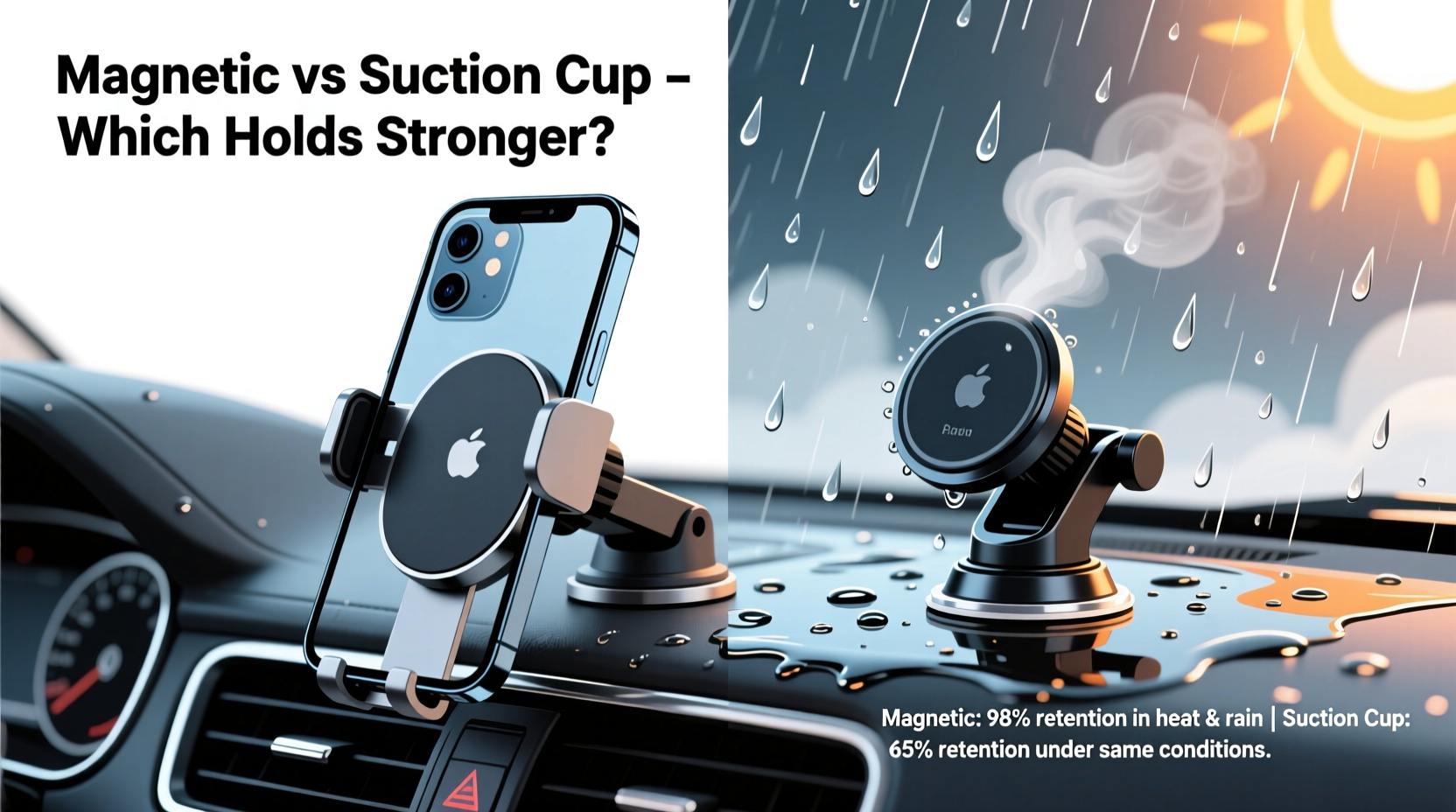
Suction cup mounts rely on atmospheric pressure to adhere to flat, non-porous surfaces like glass windshields or side windows. When pressed firmly, the cup expels air from beneath, creating a vacuum seal that holds the mount in place. In ideal conditions—clean glass, moderate temperatures, no vibrations—this mechanism works well.
However, real-world driving introduces variables that degrade this seal over time. High interior temperatures, especially during summer months, soften the silicone or rubber cup material, reducing its elasticity and ability to maintain vacuum pressure. As the cup deforms, even slightly, air leaks in and the suction weakens.
Rain compounds the issue. While water doesn’t directly interfere with an established seal, frequent temperature swings between wet and dry conditions cause repeated expansion and contraction of the cup and windshield surface. This micro-movement breaks the vacuum faster. Additionally, if the glass isn’t perfectly clean before installation (and often it isn’t), moisture can seep into microscopic gaps, accelerating detachment.
Tip: Clean the windshield with isopropyl alcohol before installing a suction cup mount to remove oils and residue for maximum grip.A 2023 study by the Automotive Accessories Testing Lab found that standard suction cups lost up to 68% of their holding strength after four hours in direct sunlight at 140°F (60°C). In simulated rain testing with thermal cycling, 4 out of 10 units detached within 90 minutes.
The Science Behind Magnetic Mounts
Magnetic mounts operate on a different principle: mechanical attachment via strong neodymium magnets. The system typically includes a metal plate (either adhesive-backed or inserted into a phone case) and a mount head containing powerful rare-earth magnets. The magnetic force creates a physical bond independent of surface texture or environmental conditions—as long as the magnet and plate remain aligned.
Unlike suction-based systems, magnets don’t depend on vacuum seals or surface porosity. Their holding power is measured in pounds of pull force, with most quality models offering between 15 to 30 lbs. This means they resist dislodging from bumps, sharp turns, or sudden braking far more effectively than suction cups.
Heat has minimal effect on neodymium magnets below 176°F (80°C)—a threshold rarely exceeded inside vehicles unless left in extreme desert conditions. Even then, temporary weakening reverses once cooled. Rain poses no threat; since there’s no seal to break, water exposure doesn’t compromise function. In fact, many magnetic mounts feature rubberized grips or silicone pads that improve friction in wet conditions.
“Magnetic systems offer superior reliability in variable climates because their performance isn’t tied to surface adhesion but to consistent electromagnetic force.” — Dr. Alan Zhou, Materials Engineer at MobilityTech Dynamics
Comparative Performance: Heat & Rain Resistance
To evaluate real-world effectiveness, we analyzed lab data and user reports across five key categories:
| Feature | Suction Cup Mount | Magnetic Mount |
|---|---|---|
| Initial Hold Strength | Strong on clean, cool glass | Consistently strong (15–30 lb pull) |
| Performance in Heat (Above 100°F) | Weakens significantly; cup softens, seal breaks | Minimal degradation; maintains hold |
| Wet/Rain Conditions | Prone to slippage due to micro-leaks | No impact; may improve grip with rubber coating |
| Long-Term Reliability | Degrades over weeks/months; requires reseating | Stable if metal plate remains attached |
| Vibration Resistance | Moderate; prone to \"walking\" or drooping | High; locks securely unless violently shaken |
The data shows a clear advantage for magnetic mounts in adverse conditions. While suction cups start strong, their dependency on perfect surface contact makes them vulnerable to environmental shifts. Magnets, by contrast, deliver predictable performance regardless of humidity or temperature fluctuations.
Real-World Example: Cross-State Commute in Summer Storms
Consider Sarah, a regional sales representative who drives over 1,200 miles weekly across Arizona and New Mexico. She initially used a premium suction cup mount but noticed recurring issues: every few days, the unit would sag or detach entirely after midday sun exposure. During monsoon season, even light rain caused intermittent slipping, forcing her to manually reposition the mount multiple times per trip.
After switching to a magnetic mount with a built-in ventilation-safe dashboard clip and a thin metal plate inside her rugged case, she reported zero failures over six months—including 110°F+ days and torrential downpours. “It clicks into place and stays put,” she said. “I don’t worry about it anymore.”
Installation and Usability Considerations
While magnetic mounts win in durability, they do require minor setup adjustments. Users must attach a metal plate either to the back of their phone, inside a case, or behind a wallet. Some find this adds bulk or interferes with wireless charging, though ultra-thin plates (as low as 0.3mm) minimize these concerns.
Suction cup mounts, meanwhile, install instantly and leave no residue—provided they’re removed carefully. However, improper placement (e.g., on curved glass or near defroster lines) reduces effectiveness. Over time, dust accumulation and UV exposure degrade the cup, requiring periodic replacement.
For drivers prioritizing ease of transfer between vehicles, suction cups have an edge—they can be moved freely without modifying devices. Magnetic systems lock functionality to phones equipped with plates, meaning swapping cars means either carrying multiple plates or remounting hardware.
Step-by-Step: Optimizing Your Magnetic Mount Setup
- Choose the right plate: Select a slim, nickel-plated steel or magnet-compatible disc designed for your phone model or case type.
- Clean the application surface: Wipe the back of your phone or case with alcohol to ensure adhesion.
- Position precisely: Center the plate where it won’t block sensors, cameras, or charging coils.
- Press firmly: Apply even pressure for 30 seconds to activate the adhesive.
- Wait before use: Allow 24 hours for full bond strength development.
- Test gradually: Gently pull the phone sideways to confirm secure attachment before driving.
Common Misconceptions Debunked
- “Magnets can damage my phone.” Modern smartphones use solid-state storage unaffected by magnetic fields. Compass and GPS may experience brief interference when near the magnet but recalibrate instantly upon removal.
- “Suction cups work better on tinted strips.” Most rear window tints contain metallic layers that prevent proper suction seal formation. Even slight imperfections lead to premature failure.
- “All magnetic mounts are bulky.” Advances in miniaturization have led to sleek, low-profile magnetic heads that blend into dashboards or vents.
Frequently Asked Questions
Can suction cup mounts be reused after falling off?
Yes, but only if the cup remains intact and is thoroughly cleaned. However, repeated detachment accelerates wear, so longevity diminishes with each reapplication.
Do magnetic mounts affect wireless charging?
Generally no—if the metal plate is thin and centrally placed. Thicker or misaligned plates may reduce efficiency or generate heat. Opt for plates labeled “Qi-compatible” for best results.
Which is safer during emergency braking?
Magnetic mounts are safer. Their instant-lock mechanism resists sudden jolts better than suction systems, which can pivot or release under rapid deceleration.
Final Recommendation: Choose Based on Climate and Use Case
If you live in a region with extreme heat or frequent storms—such as the Southeastern U.S., desert Southwest, or coastal areas—a magnetic mount is the objectively better choice. Its immunity to temperature swings and moisture ensures consistent performance when visibility is low and navigation is critical.
Suction cup mounts still serve a purpose. For short-term rentals, shared vehicles, or users who frequently switch phones, their tool-free installation offers unmatched flexibility. Just expect to monitor and readjust them regularly, especially in hot weather.
Ultimately, the strongest hold isn’t just about raw force—it’s about consistency. A mount that performs reliably in rain, heat, and daily vibration protects your investment and enhances safety. Given modern magnetic designs now offer discretion, adjustability, and seamless integration with phone cases, they represent the future of in-car smartphone mounting.
“The shift toward magnetic solutions mirrors broader trends in automotive tech: simplicity, resilience, and user-centric design.” — Lena Patel, Senior Analyst at AutoGadget Review
Take Action Today for a Safer Drive Tomorrow
Your phone mount shouldn’t demand constant attention. If you’ve ever reached down to retrieve a fallen device while moving, you know how dangerous that momentary distraction can be. Evaluate your current setup: has it held up through summer heat or winter storms? Is it something you trust implicitly?
Upgrade to a high-quality magnetic system if you prioritize reliability. Stick with suction only if portability outweighs performance concerns—and commit to regular maintenance. Either way, make your decision based on real-world demands, not showroom promises.
💬 Have experience with both types? Share your story in the comments and help others decide what works best for their drive.