For many home winemakers, the journey begins with a kit, a few pounds of grapes or juice, and enthusiastic curiosity. As batches multiply and palates sharpen, questions emerge—not just about flavor, but about chemistry. Among the most debated tools is the wine pH meter: sleek, precise, and priced anywhere from $120 to $400. Some swear by it as essential; others dismiss it as laboratory-grade overkill for a garage or basement operation. The truth lies in the nuance—not in whether pH matters (it undeniably does), but in whether *measuring it yourself, routinely*, delivers proportional returns for *your* winemaking practice.
pH governs microbial stability, color retention, sulfur dioxide (SO₂) effectiveness, and enzymatic activity. A wine at pH 3.2 behaves fundamentally differently than one at pH 3.8—even if both taste balanced. Yet many successful home winemakers rely solely on acid titration (total acidity or TA) and sensory evaluation. So where does practicality end and precision begin? This article cuts through the marketing noise and technical jargon to help you assess whether investing in a dedicated wine pH meter aligns with your goals, skill level, and production reality.
Why pH Matters More Than You Might Think
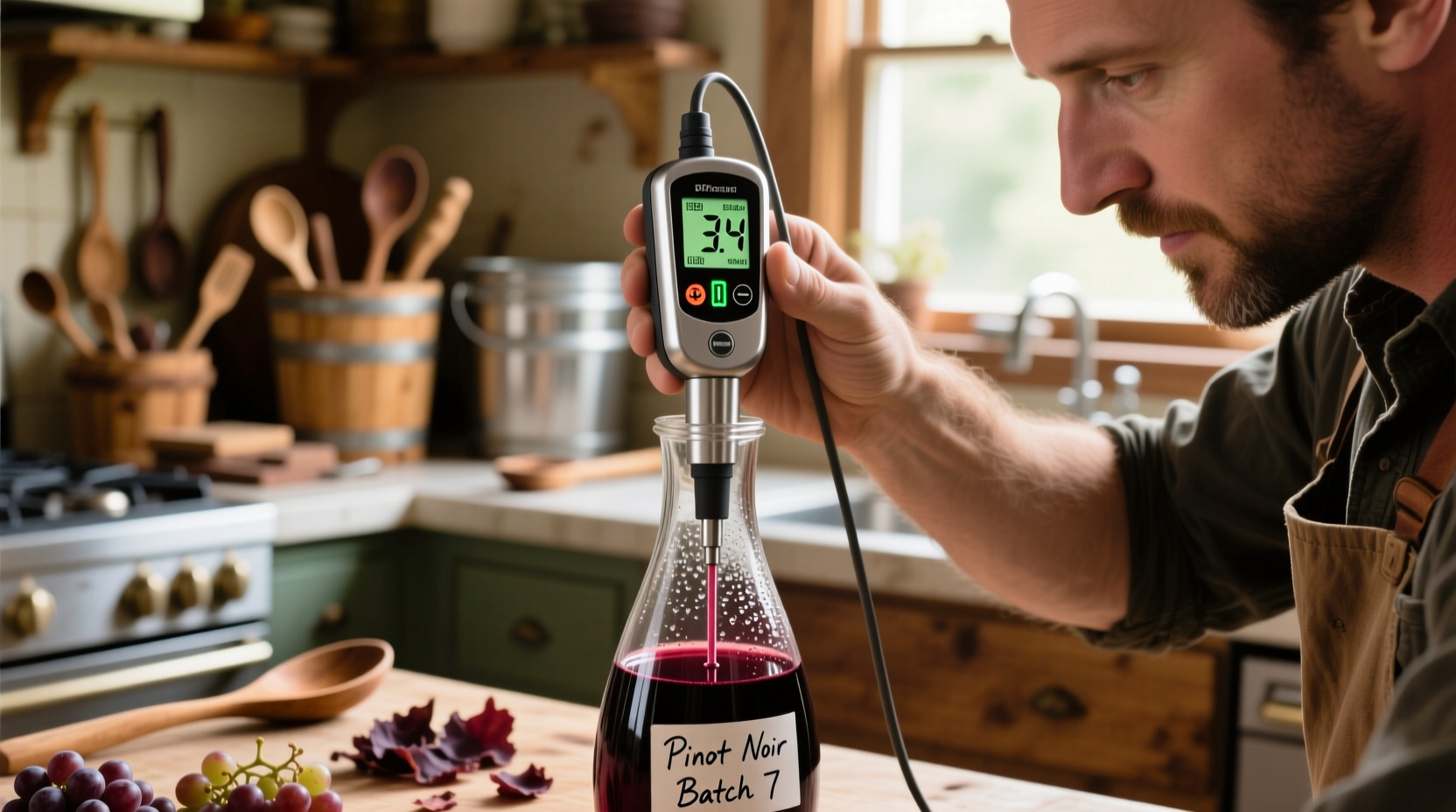
Unlike total acidity—which measures the concentration of acid molecules—pH measures the *activity* of hydrogen ions: essentially, how “available” those acids are to influence chemical and biological processes. Two wines with identical TA can have vastly different pH values due to differences in acid composition (e.g., malic vs. tartaric), potassium levels, and buffering capacity. That difference has direct consequences:
- SO₂ effectiveness: At pH 3.4, only ~25% of free SO₂ exists in the active molecular form that inhibits microbes. At pH 3.8, that drops to just ~10%. Relying on standard SO₂ addition charts without knowing pH risks under- or over-dosing—leading to spoilage or harsh, sulfurous notes.
- Microbial stability: Acetobacter and Lactobacillus thrive above pH 3.6. Without accurate pH tracking, a seemingly stable wine may quietly ferment post-bottling.
- Color and aging potential: Red wines below pH 3.5 retain brighter, more stable anthocyanin color. Above pH 3.7, color fades faster and browning accelerates.
- Malolactic fermentation (MLF): MLF is sluggish or stalls entirely above pH 3.9—and becomes risky below pH 3.2 due to bacterial stress and off-flavor formation.
These aren’t theoretical concerns. They’re daily variables affecting clarity, shelf life, and drinkability. But here’s the critical distinction: understanding pH’s importance doesn’t automatically mean you need to measure it yourself every batch.
When a pH Meter Is Truly Useful (and When It’s Not)
A wine pH meter shines not as a novelty, but as a diagnostic and decision-making tool—particularly when you’re managing variables beyond simple juice-to-wine conversion. Consider these scenarios:
Tip: Skip the pH meter if you consistently use single-source, lab-analyzed juice kits with fixed acidification instructions—and never adjust acidity, blend lots, or conduct MLF. In that case, TA testing plus careful SO₂ management per kit guidelines is sufficient.Conversely, a pH meter becomes highly valuable when you:
- Source fresh fruit (especially variable varieties like Concord, Norton, or backyard grapes) where natural acidity fluctuates seasonally;
- Perform acid adjustments pre-fermentation and want to verify target pH—not just hit a TA number;
- Conduct malolactic fermentation and need to confirm pH is within the safe 3.2–3.6 window before inoculation;
- Blend red and white lots and need to predict stability and color interaction;
- Bottle without filtration and rely heavily on SO₂ for microbial protection;
- Age wines longer than 12 months and want early warning signs of instability.
It’s less about “advanced winemaking” and more about intentionality. If your goal is consistency across vintages—or replicating a specific profile—you’re measuring outcomes, not just following steps. And pH is one of the most responsive levers you can pull.
Real-World Example: The Backyard Zinfandel Dilemma
Mark, a home winemaker in Sonoma County, pressed 120 lbs of estate Zinfandel for three consecutive years. His first vintage was vibrant but developed volatile acidity by month six. The second was overly tart, with aggressive green notes. The third—his best—was balanced and aged cleanly for 18 months. What changed?
He began using a calibrated wine pH meter alongside his TA test kit. In Year 1, he’d added potassium carbonate to reduce acidity based solely on TA (6.8 g/L), bringing it down to 6.2 g/L—but didn’t check pH. The result? pH rose from 3.42 to 3.78, creating ideal conditions for Acetobacter. In Year 2, he over-corrected, dropping TA to 5.4 g/L and pH to 3.19—stalling yeast and preserving harsh malic character. In Year 3, he targeted pH 3.45 ± 0.05, adjusting with tartaric acid in small increments and verifying each step. TA settled at 6.3 g/L—not the lowest, but chemically optimal. He also tested post-MLF and confirmed pH held at 3.51 before bottling.
“I didn’t become a chemist,” Mark says. “I became a better observer. The meter didn’t make the wine—it made me ask better questions.”
Practical Comparison: pH Meter vs. Alternatives
Not all pH measurement methods are equal. Here’s how common options stack up for home winemakers:
| Method | Accuracy | Cost (USD) | Calibration Needs | Best For |
|---|---|---|---|---|
| Lab-analyzed report (commercial lab) | ±0.02 pH units | $25–$45 per sample | None | Verification, benchmarking, annual baseline |
| Dedicated wine pH meter (e.g., Hanna HI98107, Oakton pH 700) | ±0.01–0.02 pH units | $120–$350 | 2-point calibration before each use | Active winemakers doing acid adjustment, MLF, or long-term aging |
| General-purpose pH pen (non-wine calibrated) | ±0.1–0.2 pH units | $30–$80 | Frequent calibration; prone to drift in wine matrix | Not recommended—wine’s low ionic strength and alcohol content cause significant error |
| Indicator strips (e.g., wide-range pH paper) | ±0.5 pH units | $10–$20 per 100 strips | None | Rough estimation only—useful for checking if pH is clearly <3.4 or >3.8, nothing finer |
Note: Wine-specific meters include features like temperature compensation, specialized electrodes resistant to alcohol and tannins, and calibration buffers formulated for wine’s ionic environment. Generic pens often read high by 0.2–0.4 units in red wine—enough to misjudge SO₂ needs by 50%.
How to Use a Wine pH Meter Effectively (Without Going Down a Rabbit Hole)
Ownership isn’t enough—consistent, correct use separates utility from frustration. Follow this streamlined workflow:
- Prepare your sample: Filter or centrifuge wine to remove sediment. Let it reach room temperature (68–72°F). Avoid testing immediately after racking or cold stabilization—the wine must be equilibrated.
- Calibrate rigorously: Use fresh, wine-relevant buffer solutions (pH 3.50 and 7.00 are standard). Rinse electrode with distilled water between buffers. Never use tap water—it contaminates calibration.
- Measure with patience: Submerge electrode fully. Gently swirl. Wait for reading to stabilize (usually 30–60 seconds). Record the value—not the first number that appears.
- Rinse and store properly: After use, rinse with distilled water, then soak electrode in storage solution (never let it dry out). Replace storage solution monthly.
- Verify annually: Send one sample to a commercial lab each year to cross-check your meter’s accuracy. If deviation exceeds ±0.03, service or replace the electrode.
“The biggest mistake isn’t buying the meter—it’s treating it like a kitchen thermometer. Wine pH measurement demands respect for electrochemistry. Calibrate, rinse, store, verify. Do those four things, and your $200 investment pays for itself in avoided spoilage alone.” — Dr. Laura Chen, Enology Extension Specialist, UC Davis Department of Viticulture & Enology
What You Actually Need: A Realistic Checklist
Before purchasing, honestly assess your readiness. Tick all that apply:
- ✅ You already test TA regularly and understand how acid additions affect both TA and pH.
- ✅ You’ve experienced at least one instance of microbial instability (VA, mousiness, refermentation) or inconsistent SO₂ performance.
- ✅ You’re comfortable calibrating equipment, handling lab-grade solutions, and maintaining logs.
- ✅ You produce at least 30 gallons (≈120 bottles) annually—or plan to scale up.
- ✅ You ferment native or wild yeasts, conduct MLF, or source unprocessed fruit.
- ✅ You keep detailed records (fermentation temps, additions, tasting notes) and treat winemaking as iterative learning.
If fewer than four boxes are checked, delay the purchase. Invest instead in a high-quality TA kit, a reliable hydrometer, and one professional lab analysis per year. Build confidence with fundamentals first.
FAQ: Addressing Common Concerns
Do I need both a pH meter and a TA kit?
Yes—TA and pH answer different questions. TA tells you *how much* acid is present; pH tells you *how effective* it is. You cannot calculate one reliably from the other in wine due to buffering. Both are complementary, not redundant.
Can’t I just adjust acid until the wine tastes right?
Taste is vital—but subjective and delayed. By the time harshness or flatness emerges, chemical shifts may be irreversible. pH gives you predictive control *before* fermentation or aging decisions lock in outcomes. It’s like using a thermometer while baking: you don’t wait for smoke to know it’s too hot.
My wine pH is 3.9. Is it ruined?
Not necessarily—but it requires proactive management. At pH 3.9, SO₂ demand doubles, MLF is unpredictable, and aging potential shortens. Options include: (1) blending with lower-pH wine; (2) careful tartaric acid addition (retest pH after each 0.5 g/L increment); or (3) accepting shorter shelf life and stricter SO₂ protocols. The meter reveals the problem; it doesn’t solve it—but it prevents denial.
Conclusion: Precision With Purpose
A wine pH meter isn’t over-engineering—it’s contextual engineering. For the hobbyist making two cases of kit wine per year, it’s likely unnecessary overhead. For the grower pressing their own fruit, the experimenter blending varietals, or the enthusiast committed to clean, age-worthy bottles, it transforms guesswork into grounded decision-making. The tool doesn’t define the winemaker; it amplifies intention. What matters isn’t owning the meter, but understanding what its number means—and having the knowledge to act on it wisely.
Start where you are. Test TA religiously. Taste critically. Log everything. Then, when you notice patterns—when a certain pH range consistently yields brighter color or cleaner ferments—that’s when the meter stops being equipment and starts being insight. Don’t chase precision for its own sake. Chase it for the sake of better wine.
💬 Have you used a pH meter in your home winemaking? Share your breakthrough moment—or your cautionary tale—in the comments. Your experience helps others decide what tools truly serve their craft.








