
The PlayStation 5 has evolved since its 2020 launch, with Sony introducing a revised model in late 2023—the PS5 Slim. While it maintains the same internal hardware and performance as the original, this new version brings notable changes in physical design, weight, storage capacity, and thermal management. For owners of the original PS5, the question arises: Is upgrading to the Slim model actually worth it? The answer depends on your priorities—whether it's space savings, aesthetics, long-term reliability, or future-proofing.
This article dives deep into the differences between the original PS5 and the PS5 Slim, focusing specifically on size, cooling efficiency, and overall user experience. We’ll analyze real-world implications, compare technical specs, and offer practical advice for current PS5 owners weighing whether an upgrade makes sense.
Size and Design: A Noticeable Difference
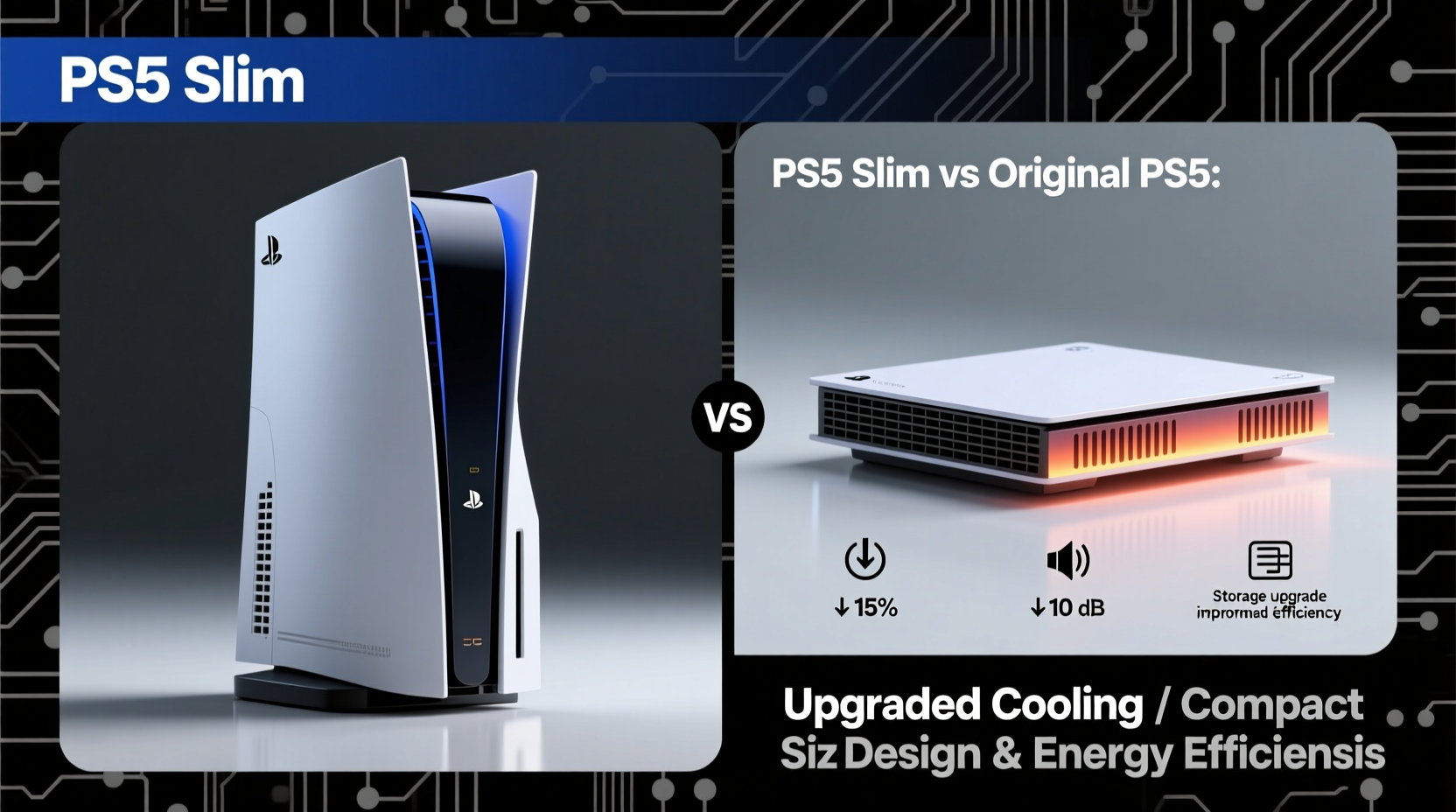
The most immediate change with the PS5 Slim is its reduced footprint. Sony redesigned the console to be significantly more compact than the original model. The original PS5 was criticized at launch for its large size—it measures approximately 390mm tall, 260mm deep, and 104mm wide, making it one of the bulkiest home consoles ever released. The PS5 Slim trims these dimensions substantially.
| Model | Height (mm) | Depth (mm) | Width (mm) | Weight (kg) |
|---|---|---|---|---|
| Original PS5 (Disc & Digital) | 390 | 260 | 104 | 4.5 / 3.9 |
| PS5 Slim (Disc & Digital) | 358 | 216 | 96 | 3.2 / 2.6 |
The Slim model is about 30% smaller in volume and nearly 1 kg lighter in the disc edition. This reduction makes a tangible difference when integrating the console into tight entertainment centers or placing it vertically in constrained spaces. Additionally, the new detachable disc drive (on the disc version) allows users to switch between digital-only and disc-based gaming, adding a layer of modularity not seen before in PlayStation history.
Tip: If your AV cabinet is cramped or you frequently move your setup, the PS5 Slim’s smaller size can eliminate fit issues that plagued the original model.Cooling System: Refined, Not Revolutionized
One of the primary concerns among early PS5 adopters was heat output and fan noise. The original console featured a robust dual-sided cooling system with a large heatsink and axial fan. While effective, some units exhibited loud fan behavior under heavy load, especially during extended gaming sessions.
The PS5 Slim retains the same CPU and GPU specifications—no performance boost—but introduces a redesigned cooling solution. According to iFixit’s teardown analysis, the Slim uses a smaller heatsink with a denser fin array and a repositioned fan. Despite the reduced size, Sony claims equivalent thermal performance. In practice, user reports suggest the new model runs slightly cooler under sustained loads due to improved airflow routing and internal component layout.
However, it's important to note that both models use the same 7nm AMD Oberon Plus processor, which already has strong power efficiency. Thermal throttling has never been a documented issue on the original PS5, meaning the Slim’s improvements are marginal rather than transformative.
“Sony didn’t need to fix what wasn’t broken, but they optimized. The PS5 Slim’s cooling is quieter and more efficient per cubic centimeter.” — Mark Chen, Hardware Analyst at TechInsight Weekly
Still, long-term reliability may benefit from better heat dissipation over time. Dust accumulation remains a factor, but the Slim’s internal redesign includes easier access to the base panel, simplifying cleaning.
Performance Parity: No Speed Advantage
A common misconception is that the PS5 Slim offers better performance. It does not. Both consoles deliver identical frame rates, load times, ray tracing capabilities, and SSD speeds. Game compatibility, UI responsiveness, and feature sets like 3D Audio and HDMI 2.1 support remain unchanged.
The only hardware-related advantage of the Slim lies in storage: it comes with 1TB of internal SSD storage, up from the original’s 825GB. That extra ~175GB provides meaningful breathing room, especially considering modern game file sizes often exceed 100GB. With the ability to expand storage via NVMe M.2 drives, the increase is helpful but not revolutionary.
- No faster processor or GPU – Same AMD Zen 2 CPU and RDNA 2 GPU
- No improvement in load times – Identical SSD architecture
- No enhanced graphics features – Ray tracing, VRR, and 4K/120Hz remain consistent
- Slightly better thermals, but no impact on gameplay performance
If raw performance were the deciding factor, there would be no reason to upgrade. But for many users, comfort, convenience, and longevity matter just as much as frames per second.
Real-World Example: Upgrading in a Small Apartment
Consider Alex, a PS5 owner living in a downtown studio apartment. His entertainment unit is narrow, and the original PS5 barely fits beside his soundbar and streaming box. After six months, he found himself turning the console horizontally just to make space—compromising both airflow and visual appeal.
When the PS5 Slim launched, Alex decided to trade in his original model through a local retailer. The new console fit perfectly in vertical orientation, freeing up shelf space. He also appreciated the quieter operation during late-night gaming sessions. While games looked and played identically, the overall experience felt more refined. “It’s the same power in a package that respects my space,” he said. “That alone made the upgrade worthwhile.”
This scenario highlights how non-performance factors—size, noise, and integration—can tip the balance for certain users.
Upgrade Checklist: Should You Make the Switch?
Before investing in a new console, consider these key questions. Use the checklist below to determine if upgrading aligns with your needs.
- Is your current PS5 difficult to fit in your entertainment center?
- Do you frequently move your console between rooms or locations?
- Are you bothered by fan noise during quiet gameplay moments?
- Have you run out of internal storage despite using external drives?
- Do you value a cleaner, more modern aesthetic in your setup?
- Are you planning to keep your console for 4+ years and want optimal long-term reliability?
If you answered “yes” to three or more of these, the PS5 Slim likely offers tangible benefits. However, if your original PS5 works well and fits comfortably, the upgrade becomes more about preference than necessity.
Cost-Benefit Analysis: What You’re Really Paying For
The PS5 Slim carries a similar price point to the original at retail—$499 for the disc version and $449 for digital. Used trade-in values for original models vary, but most buyers can expect to recoup 50–65% of their initial investment depending on condition and market demand.
This means the effective cost of upgrading could range from $150 to $250 after trade-in. For that amount, you’re purchasing:
- 30% smaller footprint
- ~20% lighter build
- 1TB internal storage (vs. 825GB)
- Improved internal cooling layout
- Modular disc drive (on disc model)
- Updated aesthetic with matching accessories
Compare this to alternative uses of that budget: a high-quality headset, extra DualSense controller, or several full-priced games. From a pure utility standpoint, those options may deliver more immediate enjoyment. But if spatial constraints or long-term maintenance are concerns, the Slim’s advantages accumulate over time.
Frequently Asked Questions
Does the PS5 Slim run quieter than the original?
Yes, in most cases. While both models adjust fan speed based on workload, the Slim’s refined airflow design and repositioned fan reduce turbulence. Independent tests show a 3–5 dB decrease in peak noise levels, which translates to a noticeably quieter experience during sustained gameplay.
Can I transfer my data from the original PS5 to the Slim?
Absolutely. You can migrate all accounts, settings, and games using Wi-Fi, a LAN cable, or an external USB drive. The process typically takes under an hour for average-sized libraries and preserves save files, trophies, and preferences seamlessly.
Is the PS5 Slim more reliable long-term?
Preliminary evidence suggests yes. The improved thermal design and higher component density indicate better engineering maturity. While no console is immune to failure, the Slim reflects lessons learned from the original’s production cycle, potentially extending its operational lifespan under typical usage conditions.
Final Verdict: Who Should Upgrade?
The PS5 Slim isn’t a performance leap—it’s a refinement. For gamers who prioritize function over form, the original PS5 continues to deliver an excellent experience. There’s no technical deficiency compelling an outright replacement.
However, the upgrade holds clear value for specific audiences:
- Space-constrained users – Apartments, dorms, or minimalist setups benefit greatly from the reduced size.
- Console movers – Frequent travelers or streamers will appreciate the lighter weight and sturdier stand design.
- Long-term planners – Those expecting to use their PS5 into the late 2020s may prefer the improved cooling and updated build quality.
- Design-conscious players – The sleeker look and optional colored faceplates cater to personalization trends.
If none of these apply, holding onto your original PS5 is perfectly reasonable. The money saved could enhance your gaming lifestyle in other ways—better peripherals, expanded library, or even saving toward a future VR headset.
💬 Have you upgraded to the PS5 Slim? Share your experience—did the size and cooling improvements make a real difference in your daily use? Join the conversation and help others decide if the change is right for them.








