Vintage-inspired cocktail events—Gatsby soirées, mid-century modern galas, or Art Deco charity balls—demand more than just period-accurate dresses and suspenders. The hat is the silent conductor of the ensemble: it anchors the silhouette, signals the decade, and communicates intentionality. Yet many guests misstep by choosing a hat that clashes tonally, overwhelms proportionally, or contradicts historical context. Matching hats with cocktail attire isn’t about nostalgia alone—it’s about sartorial literacy across eras. This guide distills decades of archival research, millinery conservation notes, and stylist consultations into actionable principles that work whether you’re wearing a bias-cut silk gown from 1938 or a sleek mod sheath from 1965.
Understanding Cocktail Attire Through a Vintage Lens
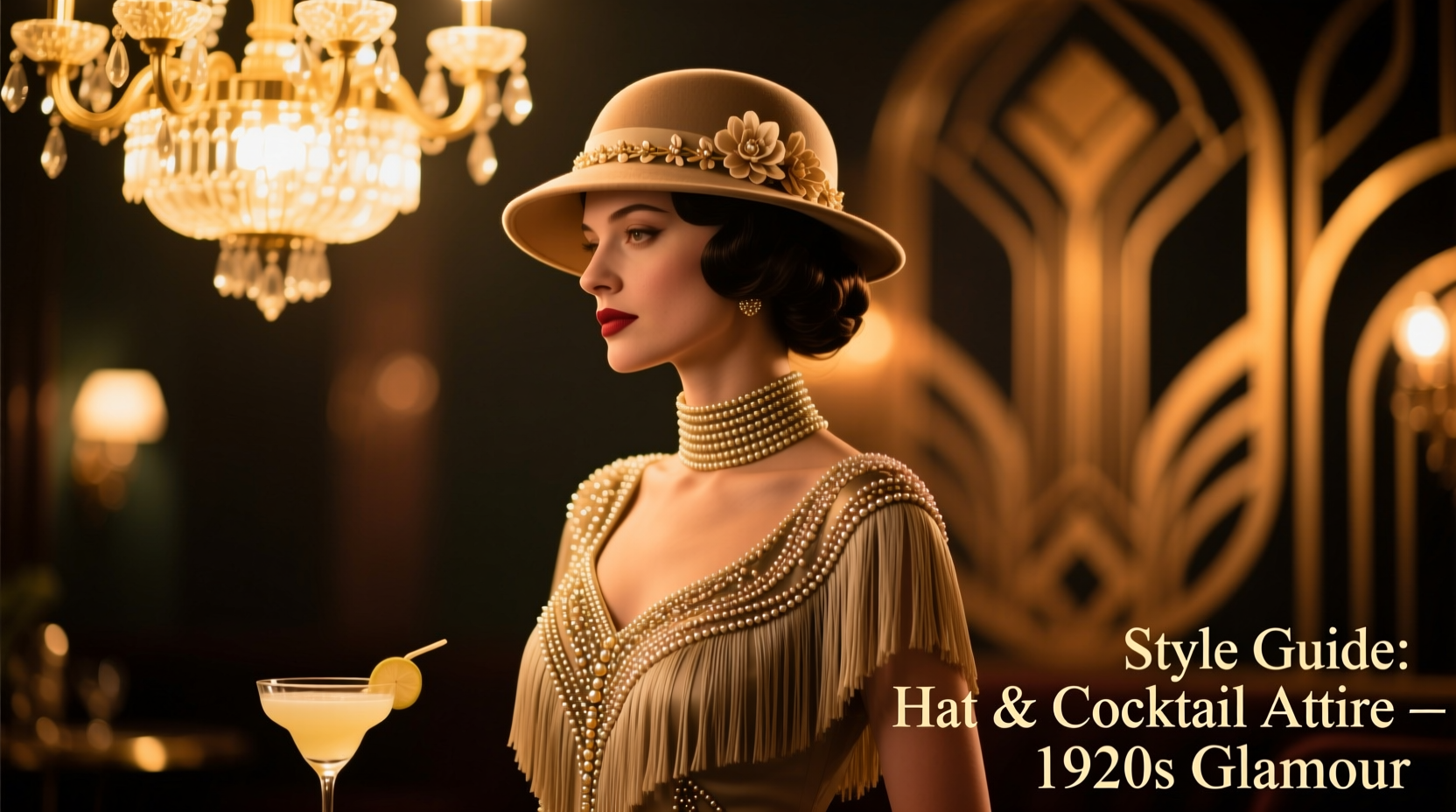
“Cocktail attire” as a category didn’t exist before the 1920s. It emerged alongside Prohibition-era speakeasies and post-war social mobility—spaces where formality relaxed but elegance remained non-negotiable. Crucially, vintage cocktail dress codes were *era-specific*, not generic. A 1927 flapper’s beaded shift demanded different headwear than a 1953 Dior “New Look” cocktail dress with its cinched waist and full skirt.
Three defining traits unify vintage cocktail wear:
- Intentional restraint: Less fabric than evening gowns, but more structure than daywear—often featuring lace insets, silk faille, or wool crepe.
- Architectural detail: Defined shoulders (1940s), nipped waists (1950s), or dropped backs (1930s) create focal points that hats must complement—not compete with.
- Contextual appropriateness: A 1920s cloche worn with a 1960s mini-dress reads as costume, not curation. Era alignment is the first filter.
Before selecting a hat, identify your garment’s precise decade of inspiration—not just “vintage,” but “1948,” “1955,” or “1932.” That date determines silhouette, proportion, and acceptable millinery vocabulary.
Era-by-Era Hat Guidelines for Cocktail Wear
Each decade developed distinct hat conventions rooted in social norms, textile availability, and silhouette evolution. Ignoring these leads to visual dissonance—even with historically accurate pieces.
| Era | Signature Hat Styles | Key Styling Rules | Common Missteps |
|---|---|---|---|
| 1920s | Cloche (tight-fitting, bell-shaped); small velvet or felt pillbox; bandeaux with feathers | Must sit low on the forehead, covering eyebrows; pairs exclusively with short bobs or finger waves; avoid veils unless sheer and narrow | Wearing a cloche with long hair down; pairing with wide-leg trousers or modern jumpsuits without tailoring adjustments |
| 1930s | Soft-brimmed berets; tilted turbans; draped silk caps; small asymmetric fascinators | Emphasizes the side profile; often worn at a slight angle over one eye; complements bias-cut gowns’ fluid drape | Using stiff, structured hats that contradict the era’s soft, sculptural lines; adding excessive rhinestones (rare pre-1940) |
| 1940s | Victory rolls with small snoods; wide-brimmed “Mad Men” hats; structured pillboxes; tilted cloches with netting | Brims rarely exceed 3 inches; hats anchor the shoulder line; always worn with gloves and coordinated handbags | Overly dramatic brims (common in 1950s); fascinators with oversized flowers (a 1950s signature); ignoring wartime fabric restrictions (no excess tulle or wire) |
| 1950s | Pillboxes (Jackie O style); saucers; halo bands; floral fascinators; miniature picture hats | Proportion is paramount: hats scale to bustline, not head size; worn centered or slightly back; coordinates with pearls and gloves | Wearing a pillbox too far forward (obscures face); mixing 1950s hats with 1920s silhouettes (e.g., flapper dress + pillbox = temporal confusion) |
| 1960s | Mod geometric caps; plastic visors; asymmetrical “space age” shapes; tiny knotted headbands | Minimalist materials (vinyl, acrylic, molded plastic); clean lines; often worn with high buns or pixie cuts; no veiling | Adding lace, feathers, or pearls (antithetical to mod ethos); pairing with full-skirted dresses unless deliberately referencing early ’60s transition |
The Material & Color Matching Framework
Matching isn’t just about era—it’s about material intelligence. Vintage millinery used textiles that responded to climate, cost, and construction techniques. Modern reproductions often miss these subtleties.
Consider three layers of harmony:
- Fabric weight alignment: A heavy wool cloche overwhelms a delicate chiffon 1930s gown. Match hat weight to dress weight—silk velvet for silk charmeuse, lightweight straw for linen blends.
- Color resonance, not duplication: A black satin dress doesn’t require a black hat. In 1920s Paris, a burgundy cloche was standard with black beaded dresses. Use the dress’s accent color (e.g., gold thread, lining hue, or embroidery tone) as your hat’s primary palette.
- Texture conversation: A smooth, molded pillbox balances ruffled sleeves; a nubby bouclé hat echoes tweed cocktail jackets. Avoid two highly textured elements competing (e.g., feathered fascinator + beaded bodice).
Historical sourcing confirms this. According to the Museum of London’s millinery collection notes, “1950s couture hats were routinely lined in matching silk, but the outer shell often featured contrasting textures—glossy patent paired with matte wool—to create deliberate tactile dialogue.”
“The most elegant vintage ensembles never ‘match’—they converse. A hat should echo a dress’s rhythm, not mirror its surface.” — Dr. Eleanor Finch, Curator of 20th-Century Fashion, Victoria & Albert Museum
Step-by-Step: Building Your Era-Accurate Hat Ensemble
Follow this sequence to avoid common pitfalls and ensure cohesion from foundation to finish:
- Identify the exact year of your dress’s inspiration using seam details, sleeve shape, and hemline height—not just “1950s.”
- Select hat style from the era-appropriate list above. Cross-reference with at least two archival photos from that year.
- Choose base material that mirrors your dress’s dominant textile (e.g., faille for faille, wool for wool). Avoid synthetics unless replicating 1960s mod looks.
- Define color strategy: Pull from your dress’s secondary color (lining, piping, or embroidery), not its dominant shade. For monochrome dresses, use metallic thread or hardware tones.
- Add minimal embellishment only if period-accurate: 1920s cloches used single ostrich plumes; 1950s pillboxes featured single silk roses; 1960s caps used geometric cutouts—not clusters or cascades.
- Final fit check: Hat must sit securely without pins or combs interfering with hairstyle. If it requires more than two discreet bobby pins, reevaluate size or style.
Real-World Case Study: The 1948 Gatsby Revival Gala
When stylist Maya Chen prepared client Lena R. for a 1948-themed cocktail gala, she faced a classic dilemma: Lena owned a stunning replica of a 1948 Schiaparelli silk faille dress with exaggerated padded shoulders and a nipped waist—but had selected a large, floppy 1930s beret for her look.
Maya’s correction followed the framework precisely:
- Era recalibration: 1948 falls firmly in the postwar “structured glamour” period—not the soft 1930s. Berets were rare after 1945.
- Silhouette analysis: The dress’s strong shoulders needed a hat that anchored the top third of the body, not softened it.
- Material match: Silk faille required a hat with similar drape and sheen—not stiff felt.
- Solution: A 2.5-inch brimmed “swing hat” in ivory silk faille, tilted slightly to the right, with a single black grosgrain bow echoing the dress’s waistband. It sat precisely at the crown, balancing shoulder volume without obscuring the face.
The result? Lena received consistent compliments on “how perfectly the hat completed the line”—not for being noticeable, but for being *inevitable*.
FAQ: Practical Questions from Vintage Event Planners
Can I wear a fascinator with vintage cocktail attire?
Yes—but only from 1955 onward, and only if it’s historically grounded. Pre-1950s “fascinators” were called “aigrettes” or “hair ornaments” and were smaller, more delicate, and pinned directly into the hair—not mounted on combs or clips. A 1960s mod fascinator might be plastic and geometric; a 1958 version would feature a single orchid or curled quill. Avoid modern multi-flower clusters—they read as contemporary, not curated.
What if my vintage dress has bold prints? Do I need a plain hat?
Not necessarily. In the 1940s and 1950s, printed dresses were frequently paired with solid-color hats in a complementary tone from the print’s palette—e.g., a navy-and-white polka dot dress with a deep coral pillbox. The key is to pull one *subdued* color from the print, not the boldest. Avoid matching the hat to the background color if it’s white or black—that’s visually flattening.
How do I secure a vintage-style hat without visible pins?
Authentic 1920s–1950s hats relied on hidden mechanisms: velvet-lined interiors for grip, adjustable inner bands, or comb mounts concealed beneath updos. For modern hair, use matte-black bobby pins inserted parallel to the scalp, then covered with a small section of hair. Never use silver or gold pins—they break the illusion. For cloches, a thin elastic band under the hairline (hidden by bangs or a headband) provides security without visibility.
Conclusion: Wear History, Not Costume
A well-matched hat transforms vintage cocktail attire from nostalgic homage into living history. It signals respect for the craftsmanship of past decades—and confidence in your own sartorial voice. You don’t need a closet full of era-specific pieces. Start with one historically precise hat, chosen using the era alignment, material resonance, and proportion principles outlined here. Wear it with intention, not imitation. Let the cloche frame your gaze like a 1927 Parisian, let the pillbox crown your poise like a 1955 Manhattan hostess, let the mod cap sharpen your silhouette like a 1963 Milan designer. These aren’t accessories. They’re punctuation marks in the sentence of your style.
💬 Your turn: Share your vintage hat triumph—or challenge—in the comments. What era are you mastering next? Let’s build a community of intentional, era-literate stylists.








