Wine tasting isn’t about pretension—it’s about perception. The human nose can distinguish over 10,000 odors, yet most of us default to vague descriptors like “fruity” or “earthy” when describing wine. That ambiguity vanishes once you learn to navigate the wine scent wheel: a structured, hierarchical tool developed by Dr. Ann C. Noble at UC Davis in the 1980s. Unlike subjective tasting notes, the wheel anchors sensory experience in shared language—transforming guesswork into repeatable analysis. It doesn’t require innate talent, just methodical practice and the willingness to slow down. This article walks you through how to use the scent wheel not as a decorative chart, but as a functional decoder ring—one that reveals varietal signatures, winemaking choices, and even subtle flaws.
The anatomy of the scent wheel: three concentric layers of meaning
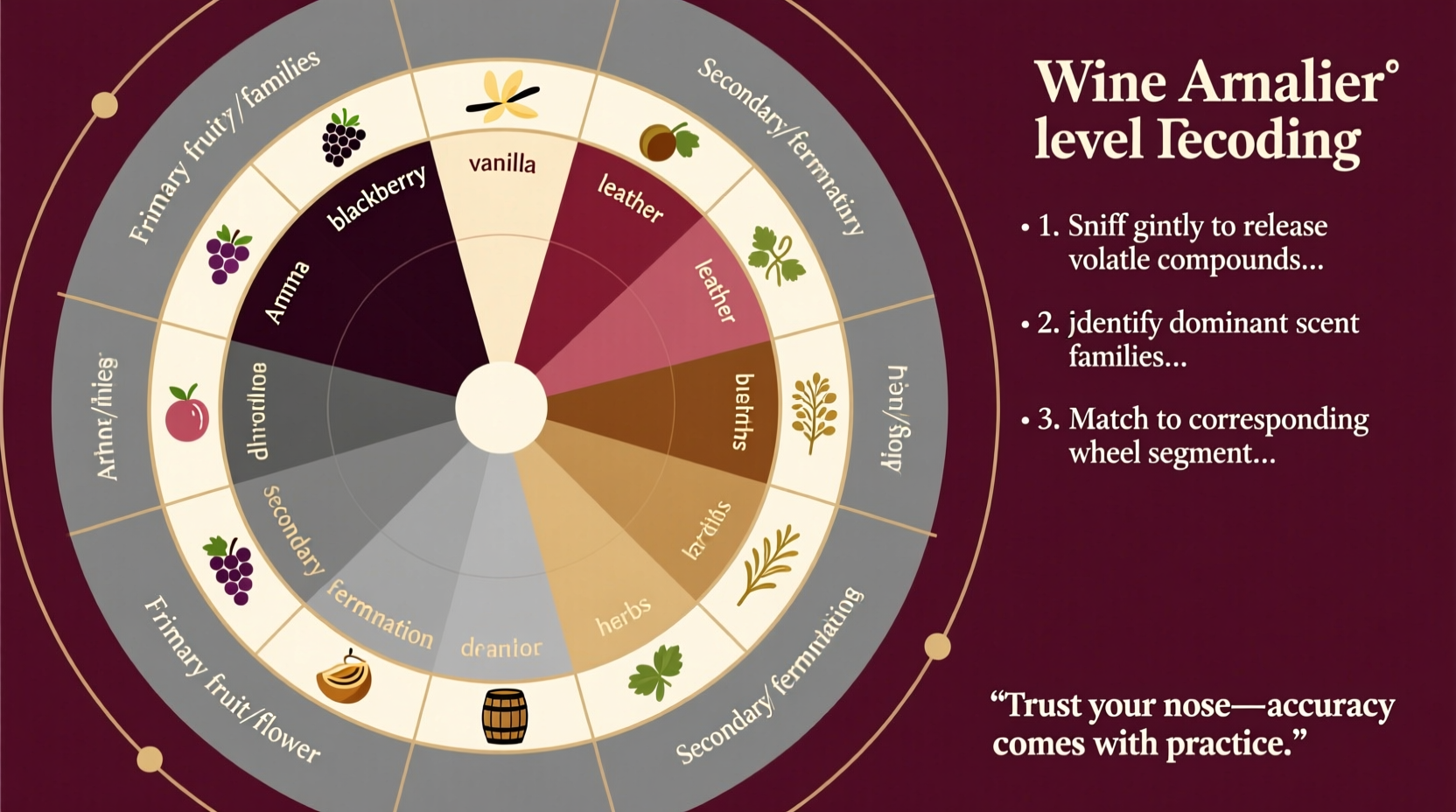
Dr. Noble’s original wheel is circular and divided into three color-coded rings. The innermost ring contains 12 broad, universally recognizable categories: *Fruity*, *Floral*, *Vegetative*, *Microbial*, *Spicy*, *Woody*, *Earthy*, *Chemical*, *Pungent*, *Oxidized*, *Floral*, and *Empyreumatic*. These are your first-level filters—broad strokes that help you eliminate noise and narrow focus. For example, if a wine immediately strikes you as “smoky,” you’d move directly to the *Empyreumatic* sector (which includes toast, smoke, coffee, and burnt sugar). If it smells like crushed violets or rosewater, you pivot to *Floral*.
The middle ring refines each primary category into subgroups. Under *Fruity*, you’ll find *Citrus*, *Tree Fruit*, *Tropical*, *Berry*, and *Dried Fruit*. Each subgroup then fans out into specific descriptors in the outermost ring—the most granular level. *Berry*, for instance, branches into *Blackberry*, *Raspberry*, *Strawberry*, *Blueberry*, *Cranberry*, and *Red Currant*. This tiered structure prevents cognitive overload: instead of scanning 100+ terms at once, you progress logically from general to precise.
Crucially, the wheel is not prescriptive—it’s diagnostic. A wine may evoke multiple sectors simultaneously (e.g., *Blackberry* from *Berry*, *Violet* from *Floral*, and *Smoked Paprika* from *Spicy*), and that layered impression is where terroir and technique converge. The wheel doesn’t tell you what *should* be there; it helps you verify what *is* there—and whether it aligns with expectations for the grape, region, or age.
A step-by-step decoding protocol (no wine school required)
Decoding aromas isn’t passive sniffing—it’s active investigation. Follow this six-step sequence before your first sip. Practice it with every bottle, even grocery-store wines. Consistency builds neural pathways faster than any app or flashcard.
- Observe the glass at rest. Hold the wine still for 5 seconds. Note the first impression—what jumps out before you swirl? This “primary aroma” often reflects fruit or floral intensity and hints at ripeness or climate.
- Swirl deliberately for 10 seconds. Rotate the glass clockwise on a flat surface, keeping the base stable. Swirling volatilizes heavier esters and aldehydes, releasing mid- and high-volatility compounds (like pyrazines in Sauvignon Blanc or ethyl acetate in oxidized whites).
- Insert your nose fully into the bowl. Don’t hover. Breathe in gently through your nose for 3–4 seconds. Exhale normally. Repeat twice. On the third inhale, hold the breath for two seconds—this allows retronasal olfaction to activate, linking smell to memory.
- Map to the inner ring. Ask: Does this belong to *Fruity*, *Earthy*, *Spicy*, or another primary category? If uncertain, compare two descriptors: “Is this more *Citrus* or *Tree Fruit*?” Elimination sharpens accuracy.
- Drill down to the outer ring. Once you’ve selected a sector (e.g., *Vegetative*), scan its subgroups (*Grassy*, *Green Bell Pepper*, *Asparagus*, *Olive*). Which term resonates most strongly? Don’t force a match—pause, reset your nose with neutral air (sniff your wrist), and try again.
- Validate with context. Cross-reference your findings: Does *Green Bell Pepper* in a Cabernet Sauvignon suggest cool-climate origin or underripeness? Does *Petrol* in a Riesling signal age or a specific clone? Context turns observation into insight.
Real-world decoding: a Pinot Noir case study
In March 2023, Master Sommelier Evan Goldstein led a blind tasting of three Pinot Noirs: one from Oregon’s Willamette Valley, one from Burgundy’s Volnay, and one from Central Otago, New Zealand. Attendees struggled to distinguish them until Goldstein introduced the scent wheel as a scaffold. Here’s how it clarified the differences:
The Willamette Valley wine opened with pronounced *Red Fruit* (outer ring: *Strawberry*, *Red Cherry*) and a distinct *Earthy* note (middle ring: *Forest Floor*, inner ring: *Mushroom*). But crucially, it also carried *Spicy* elements—specifically *White Pepper* and *Clove*—pointing to cooler temperatures during ripening and whole-cluster fermentation.
The Volnay showed restrained *Red Fruit*, dominated by *Red Currant* and *Sour Cherry*, with strong *Floral* presence (*Rose Petal*, *Violet*) and a subtle *Woody* layer (*Cedar*, *Cigar Box*) from older French oak. Its *Earthy* component was drier—*Wet Stone*, *Iron*, *Blood*—suggesting limestone-rich soils and minimal intervention.
The Central Otago wine burst with *Jammy Red Fruit* (*Raspberry Jam*, *Stewed Strawberry*) and *Empyreumatic* notes (*Toasted Almond*, *Brown Sugar*), plus a surprising *Chemical* hint (*Band-Aid*, *Medicinal*). That last descriptor—often misread as a flaw—was actually *guaiacol*, a compound enhanced by wild yeast fermentation common in NZ’s warmer, drier vintages.
Without the wheel, tasters defaulted to “fruity” or “earthy” across all three. With it, they identified structural differences rooted in geology, climate, and cellar decisions—not just personal preference.
Common pitfalls—and how to avoid them
Even seasoned enthusiasts misapply the scent wheel. These five errors undermine accuracy and stall progress:
| Pitfall | Why It Happens | How to Correct It |
|---|---|---|
| Over-relying on the outer ring | Jumping straight to “blackberry jam” without confirming the *Fruity* → *Berry* → *Blackberry* hierarchy | Force yourself to name the inner-ring category first. If unsure, ask: “Could this be *Floral*? *Spicy*? *Earthy*?” |
| Ignoring retronasal fatigue | Sniffing too many wines in succession dulls olfactory receptors, especially to delicate florals and herbs | Reset with unscented coffee beans (not roasted—raw green beans work better) or a clean cotton cloth. Wait 60 seconds between wines. |
| Mistaking faults for features | Describing *Cork Taint* (TCA) as “damp basement” or *Volatile Acidity* as “balsamic vinegar” without recognizing their warning-sign intensity | Learn the wheel’s *Fault* section (under *Chemical* and *Microbial*). TCA smells like wet cardboard—not earth. VA smells like nail polish remover—not balsamic. |
| Letting palate override nose | Tasting sweetness or acidity and retroactively assigning aromas (“This tastes sweet, so it must smell like peach”) | Close your eyes. Sniff first. Write down impressions *before* sipping. Taste confirms or challenges aroma—not the reverse. |
| Using non-wheel terms | Defaulting to metaphors (“tastes like my grandmother’s attic”) instead of wheel-aligned vocabulary | Keep a printed wheel nearby. Circle three descriptors per wine—no synonyms allowed. “Barnyard” becomes *Microbial* → *Horse Stable* → *Manure*. |
Expert insight: why precision matters beyond the tasting room
The scent wheel’s power extends far beyond scoring points in certification exams. It cultivates what sensory scientists call “olfactory literacy”—the ability to isolate, label, and recall scents with fidelity. This skill transfers directly to food pairing, winemaking evaluation, and even quality control in vineyards.
“The wheel isn’t about memorizing terms—it’s about building a reference library in your nose. When you can reliably identify *Isoamyl Acetate* as ‘banana’ in young Beaujolais, you’re not just naming a smell. You’re detecting fermentation temperature, yeast strain, and carbonic maceration. That’s actionable intelligence.” — Dr. Laura D. Catena, MD, viticulturist and founder of Catena Zapata
Dr. Catena’s team uses modified scent wheels in Mendoza vineyards to train harvest crews. Workers don’t taste grapes—they sniff clusters and log descriptors against wheel categories. A sudden uptick in *Vegetative* notes (*Green Bell Pepper*, *Grass*) triggers earlier picking for Malbec; dominance of *Dried Fruit* (*Prune*, *Fig*) signals overripeness in high-altitude parcels. In her words: “The nose is the first quality-control lab we have. Teach it rigor, and it never lies.”
FAQ: practical questions answered
Do I need the original UC Davis scent wheel—or will any version work?
The original 1990 UC Davis wheel remains the gold standard because it’s empirically derived from gas chromatography data and sensory panels—not marketing or tradition. Free PDFs exist online, but avoid simplified versions that omit the *Microbial* or *Chemical* sectors. Those are critical for spotting faults. Print the full-color wheel (available via the UC Davis Viticulture & Enology website) and keep it laminated near your tasting area.
Can I use the wheel for spirits or coffee?
Yes—but with caveats. The wheel maps wine-specific compounds (e.g., *Methoxypyrazines* in Sauvignon Blanc, *Rotundone* in Syrah). Spirits share some esters (e.g., *Ethyl Butyrate* = pineapple in rum), but lack the microbial complexity of aged wine. Coffee wheels (like the SCA’s Flavor Wheel) follow identical logic but emphasize roast-driven *Empyreumatic* notes (*Charred*, *Burnt Toast*). Cross-training sharpens your nose, but don’t force wine terms onto espresso.
What if I smell something not on the wheel—like “wet dog” or “licorice”?
“Wet dog” is almost always *Mercaptans*—a sulfur fault under *Chemical* → *Reduced*. “Licorice” belongs to *Spicy* → *Anise* → *Liquorice*, common in Syrah and old-vine Grenache. The wheel evolves: UC Davis added *Petrol* and *Kerosene* to *Chemical* after research linked them to TDN (1,1,6-trimethyl-1,2-dihydronaphthalene) in aged Riesling. If you encounter a genuine outlier, document it, research its chemical origin, and propose an addition. Dr. Noble welcomed such contributions—her wheel was designed to grow.
Conclusion: your nose is already calibrated—start trusting it
You don’t need a sommelier’s diploma to decode wine aromas. You need a framework, repetition, and permission to trust what your senses report—even when it contradicts the label or the critic’s note. The scent wheel removes subjectivity not by dictating truth, but by giving you shared coordinates to locate it. Every time you pause, swirl, and map *Blackberry* to *Berry* to *Fruity*, you’re reinforcing neural connections that make future identification faster and more intuitive. That bottle of $12 Gamay you dismissed as “simple” last month? Next time, you might detect the *Floral* lift of *Violet*, the *Spicy* whisper of *White Pepper*, and the *Earthy* depth of *Wet Stone*—and recognize it as a thoughtful expression of Beaujolais Cru terroir. That shift—from passive drinker to active interpreter—is where wine transforms from beverage to language. Pick up your glass tonight. Open the wheel. And begin translating.
💬 Try the wheel with your next bottle—and share your most surprising aroma discovery in the comments. What did you expect? What did you actually find? Let’s build our collective scent vocabulary, one descriptor at a time.








