When shopping for a midsize SUV, Honda offers two compelling options: the Passport and the Pilot. Both are built on similar platforms, share engines, and deliver the reliability the brand is known for. But if you don’t need three rows of seating, the decision shifts from pure utility to driving dynamics, maneuverability, and lifestyle fit. The question becomes: does downsizing to the five-passenger Passport make sense over the larger, more family-oriented Pilot?
The answer isn’t just about seats—it’s about how you drive, where you go, and what kind of ownership experience you want. Let’s break down the key differences and similarities to help determine whether the Passport truly stands out when you don’t need that third row.
Size, Design, and Driving Dynamics
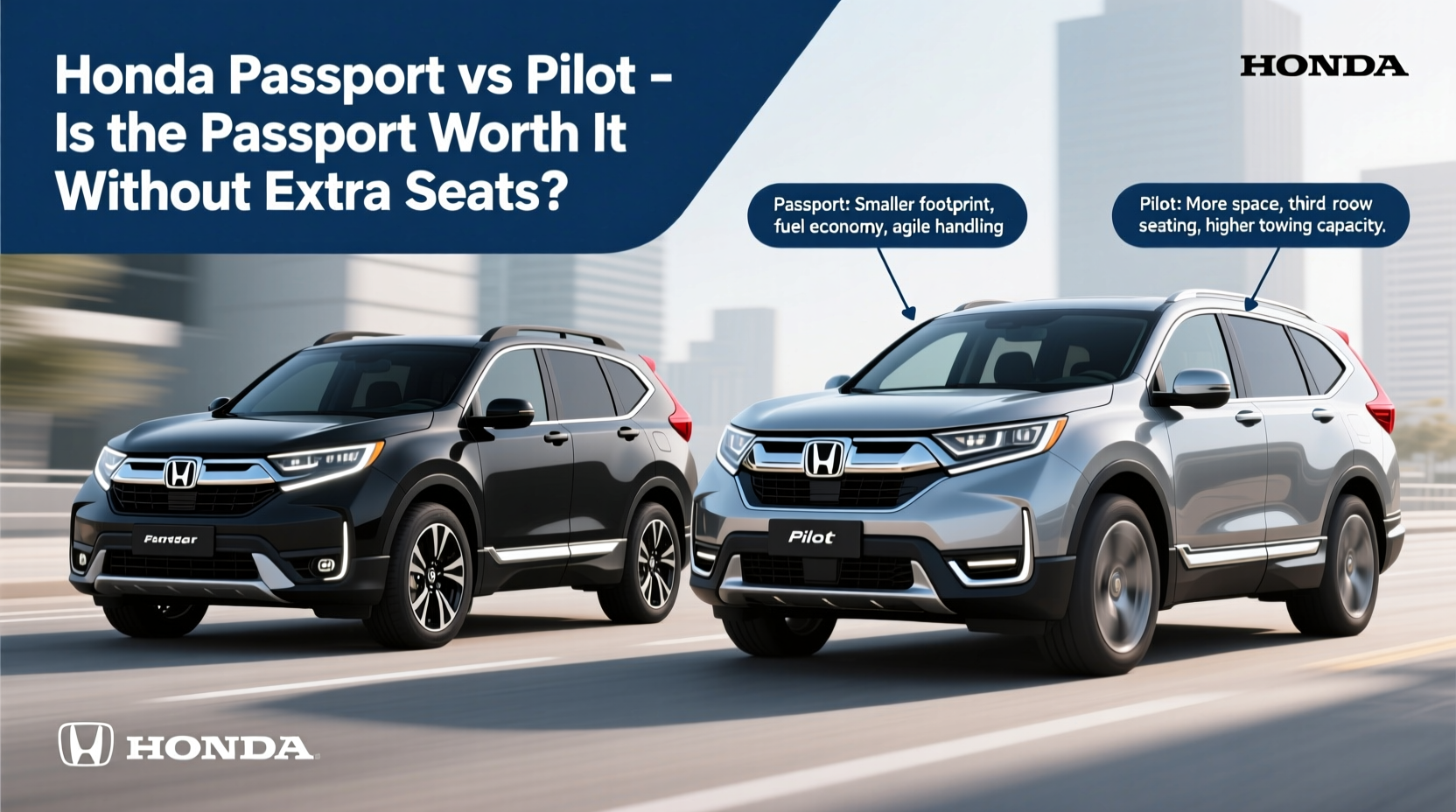
The most noticeable difference between the Honda Passport and Pilot is size. The Passport is shorter, narrower, and sits slightly lower than the Pilot. At 190 inches long and 78 inches wide, the Passport feels more agile in urban environments and easier to park. The Pilot, at 196 inches long and 79.8 inches wide, commands more space and presence but sacrifices some nimbleness.
This difference in footprint translates directly to driving feel. The Passport was engineered with a more rugged, adventure-ready image in mind—its styling cues borrow from the TrailSport trim, and it has a tighter turning radius (36.4 feet vs. 38.4 feet). On winding roads or off-pavement trails, the Passport handles with more precision and confidence.
The Pilot, while comfortable and composed, leans into its role as a family hauler. It prioritizes cabin quietness, ride smoothness, and third-row accessibility. Without needing those rear seats, you’re essentially paying for space you won’t use—and possibly sacrificing a more engaging daily drive.
Tip: If you frequently drive in cities or mountainous terrain, the Passport’s compact size and improved handling can significantly enhance your daily driving experience.Performance and Off-Road Capability
Both vehicles come standard with a 3.5-liter V6 engine producing 280 horsepower and 262 lb-ft of torque, paired with a 9-speed automatic transmission. However, where they differ is in tuning and available drivetrain features.
The Passport offers optional AWD with Intelligent Traction Management and Hill Descent Control—features tuned for light off-roading. Its higher ground clearance (7.5 inches vs. 7.1 inches) and aggressive all-terrain tires (on TrailSport trims) give it a real edge on gravel roads, muddy trails, or snowy passes.
In contrast, the Pilot’s AWD system focuses more on traction in adverse weather than trail capability. While perfectly capable in rain or snow, it lacks the Passport’s off-road oriented settings like Mud, Sand, and Snow modes. For weekend adventurers who venture beyond paved roads, the Passport delivers more confidence without requiring an upgrade to a body-on-frame SUV.
“Honda designed the Passport to bridge the gap between on-road comfort and outdoor readiness. It’s not a Jeep, but it goes places most three-row SUVs simply won’t.” — Mark Thompson, Automotive Journalist at Overland Review
Interior Space and Practicality Comparison
Even though the Passport seats five, it doesn’t drastically sacrifice cargo room. Behind the second row, it offers 41.2 cubic feet of cargo space—only about 5 cubic feet less than the Pilot with its third row folded. When you fold the rear seats, the Passport provides 77.9 cubic feet, compared to the Pilot’s 83.9 cubic feet. That 6-cubic-foot difference is negligible for most real-world uses like hauling luggage, gear, or groceries.
Inside, both models feature high-quality materials, intuitive infotainment systems, and excellent visibility. The Pilot does offer more rear legroom (40.3 inches vs. 39.3 inches), but unless you regularly carry tall passengers, this small deficit is unlikely to impact comfort.
Where the Passport shines is in its cockpit-like layout. With no third row to manage, the interior feels more driver-focused. Controls are within easy reach, and the absence of a bulky third seat allows for better airflow and a less claustrophobic atmosphere.
Seating and Cargo Capacity at a Glance
| Feature | Honda Passport | Honda Pilot |
|---|---|---|
| Passenger Capacity | 5 | 8 (or 7 w/ captain’s chairs) |
| Rear Legroom (inches) | 39.3 | 40.3 |
| Cargo Behind Rear Seats | 41.2 cu ft | 46.8 cu ft |
| Cargo with Seats Folded | 77.9 cu ft | 83.9 cu ft |
| Third Row? | No | Yes |
Technology, Fuel Economy, and Ownership Costs
Both SUVs come well-equipped with standard Honda Sensing safety suite (adaptive cruise, lane keep assist, collision mitigation), Apple CarPlay, Android Auto, and available premium audio. Higher trims add wireless charging, navigation, and ventilated seats. There’s little tech advantage between them—the main differentiator comes down to efficiency and long-term value.
Fuel economy is nearly identical: the Passport averages 20 mpg city / 25 highway, while the Pilot gets 19/26. In real-world driving, the difference is marginal—less than $100 per year in fuel costs. However, the Passport tends to have a slightly lower base MSRP, starting around $39,000, compared to the Pilot’s $40,500. Over time, that initial savings, combined with potentially lower insurance rates due to smaller size, adds up.
Maintenance costs are nearly identical thanks to shared powertrains and components. Both vehicles require routine service every 7,500 miles under Honda’s maintenance schedule, and neither has major reliability red flags. J.D. Power gives both models strong predicted reliability scores (81/100 for Passport, 80/100 for Pilot).
Real-World Example: Choosing Based on Lifestyle
Consider Sarah, a 38-year-old photographer based in Colorado. She drives her SUV for weekend photography trips into the Rockies, often on unpaved forest roads. She travels solo or with one friend and rarely needs to carry more than two people. Initially drawn to the Pilot for its reputation, she test-drove both models.
She noticed the Passport felt more planted on curvy mountain passes, had better off-road response in loose gravel, and was easier to park at trailheads. The lack of a third row didn’t matter—she used the space for camera gear and hiking equipment. Ultimately, she chose the Passport TrailSport trim and has since taken it on multiple backcountry excursions without issue.
“I realized I wasn’t buying an SUV for carpool duty,” she said. “I wanted something that could keep up with my adventures. The Passport does that better than the bigger, heavier Pilot ever could.”
Checklist: Is the Honda Passport Right for You?
- ✅ Do you primarily drive with 1–4 passengers?
- ✅ Do you enjoy weekend outdoor activities or light off-roading?
- ✅ Is ease of parking and maneuverability important in daily driving?
- ✅ Do you prefer a sportier, more responsive driving feel?
- ✅ Are you looking to save on initial purchase price and potential insurance?
- ❌ Do you foresee needing to transport large groups regularly?
If you answered “yes” to the first five and “no” to the last, the Passport is likely the smarter choice—even if the Pilot seems like the default option.
Frequently Asked Questions
Can the Honda Passport tow as much as the Pilot?
Yes. Both models can tow up to 5,000 pounds when properly equipped with the towing package. This makes either suitable for small campers, jet skis, or utility trailers.
Is the Passport less comfortable on long highway drives?
No. Despite its more rugged positioning, the Passport offers a refined ride with excellent noise insulation. Wind and road noise are well-managed, and available adaptive dampers (on Elite trim) enhance ride quality on extended trips.
Does losing the third row reduce resale value?
Not necessarily. While three-row SUVs appeal to families, the Passport’s niche as a lifestyle-oriented midsize SUV holds strong residual value, especially in outdoor-centric markets. Kelley Blue Book ranks both models similarly in projected 5-year resale value.
Final Verdict: Is the Passport Worth It Without Needing Extra Seats?
Yes—if you value driving engagement, off-road readiness, and a more compact footprint, the Honda Passport is not only worth it, it’s the superior choice. The Pilot excels as a family workhorse, but when you remove the need for third-row flexibility, much of its advantage disappears. What remains is a slightly roomier cabin at the cost of agility, visual bulk, and a less adventurous character.
The Passport strikes a rare balance: daily drivability meets weekend exploration. It’s proof that sometimes, stepping down in size actually means stepping up in capability. For drivers who prioritize experience over capacity, the Passport isn’t just a viable alternative—it’s the better SUV.
🚀 Ready to make the switch? Test drive both models back-to-back—you’ll feel the difference in handling and intent. Share your experience or ask questions in the comments below.








