
In the premium wireless earbud market of 2025, two names dominate the conversation when it comes to immersive audio: Samsung’s Galaxy Buds3 and Apple’s AirPods Pro 2. While both deliver excellent noise cancellation, comfort, and battery life, one feature increasingly defines high-end listening experiences—spatial audio. With advancements in dynamic head tracking, object-based audio rendering, and device ecosystem integration, spatial audio is no longer a novelty but a core differentiator. This article breaks down how these two flagship earbuds handle spatial audio, focusing on technical capabilities, user experience, content compatibility, and future readiness.
Spatial Audio: What It Is and Why It Matters
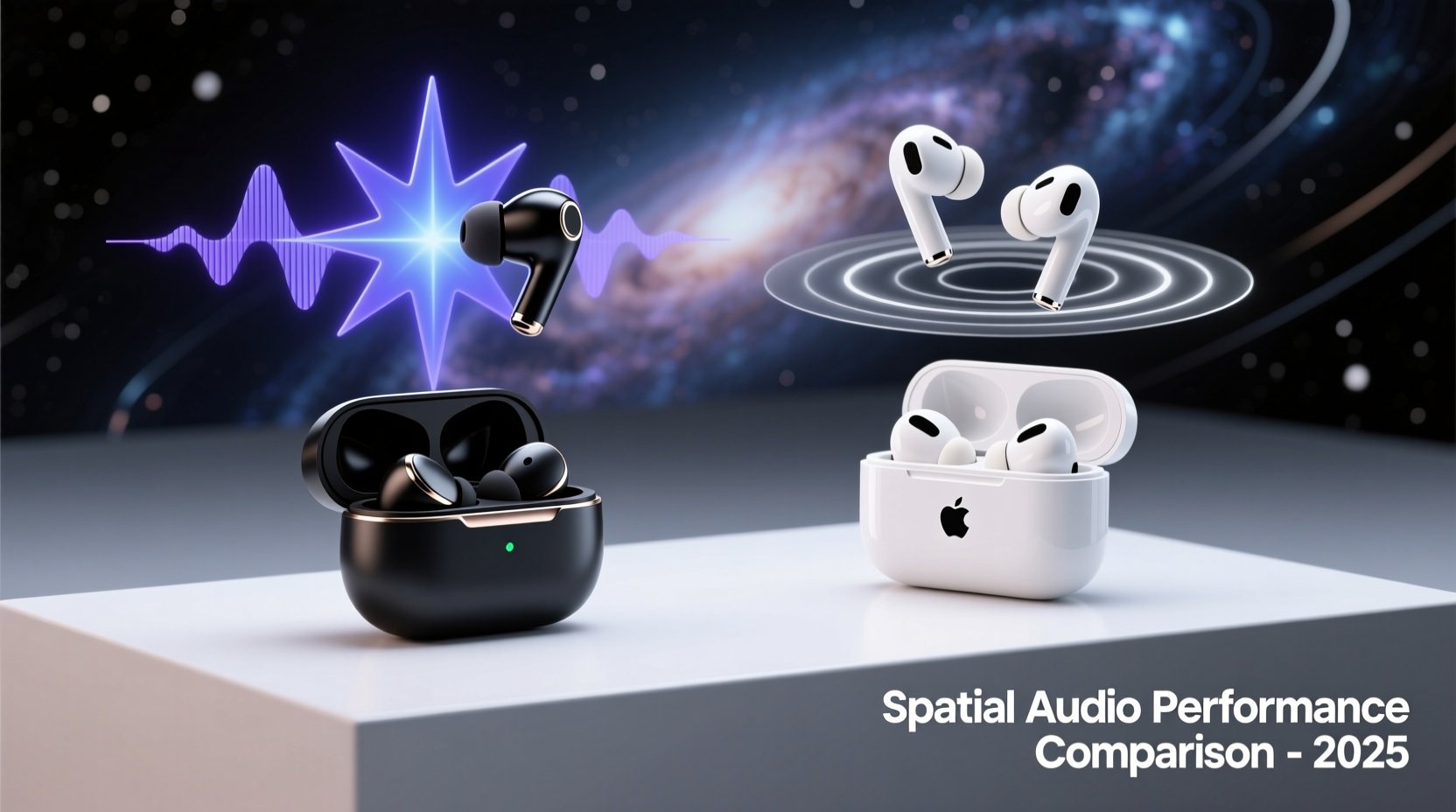
Spatial audio simulates a three-dimensional sound field, making listeners feel as if sounds are coming from all around them—not just inside their heads. Unlike traditional stereo, which separates left and right channels, spatial audio uses head-related transfer functions (HRTFs), motion sensors, and audio metadata to create an immersive bubble where sound moves with the listener’s head. This is especially effective when watching movies, playing games, or listening to Dolby Atmos music.
The effectiveness of spatial audio depends on several factors:
- Head tracking precision: How accurately the earbuds detect head movement and adjust sound positioning.
- Audio format support: Compatibility with Dolby Atmos, MPEG-H, or Apple’s Spatial Audio framework.
- Device and ecosystem integration: Seamless pairing with phones, tablets, and streaming platforms.
- Personalization: Whether the system adapts to individual ear anatomy or listening preferences.
Both Samsung and Apple have invested heavily in this space, but their approaches diverge significantly.
Apple AirPods Pro 2: The Ecosystem Advantage
Apple’s AirPods Pro 2 continue to set the benchmark for spatial audio in 2025, thanks to deep integration with iOS, iPadOS, and macOS. When paired with an iPhone or Apple Vision Pro, the AirPods Pro 2 leverage the H1 chip, built-in gyroscopes, and accelerometers to deliver dynamic head tracking with minimal latency.
Apple’s implementation of spatial audio relies on its proprietary algorithm that combines device motion data with audio source metadata. For example, when watching a movie on Apple TV+ in Dolby Atmos, rotating your head shifts the perceived direction of dialogue and ambient effects—like a helicopter circling overhead—as if you’re inside the scene.
“Apple’s tight hardware-software loop gives them unmatched control over spatial audio fidelity. The AirPods Pro 2 aren’t just smart earbuds—they’re sensory extensions of the iPhone.” — Dr. Lena Torres, Audio Perception Researcher at Stanford HCI Group
In 2025, Apple further refined its Personalized Spatial Audio feature, introduced in earlier models. Now, users can scan their ears using the TrueDepth camera on Face ID-enabled iPhones to generate a custom HRTF profile. This personalization dramatically improves localization accuracy, particularly for elevation cues—a common weak point in generic spatial audio systems.
Tip: Enable \"Head Tracking\" in Settings > Accessibility > Audio/Visual to ensure dynamic spatial audio is active during supported content playback.However, the AirPods Pro 2’s strength is also its limitation: spatial audio performs best within the Apple ecosystem. Android users who pair AirPods Pro 2 via Bluetooth receive standard AAC stereo audio without access to head tracking or Atmos decoding. Even on Macs without M-series chips, spatial audio functionality is reduced.
Samsung Galaxy Buds3: Innovation Meets Openness
The Galaxy Buds3 represent Samsung’s most ambitious leap in audio technology to date. Released in early 2025, they feature a new dual-chip architecture—one for audio processing, another dedicated to sensor fusion and AI-driven spatial rendering. Unlike previous models, the Buds3 include integrated eye-tracking synchronization when used with Galaxy smartphones equipped with under-display cameras, allowing for gaze-based audio panning in select VR and AR applications.
From a spatial audio standpoint, the Buds3 support multiple formats: Dolby Atmos, MPEG-H 3D Audio, and Samsung’s own 360 Audio with Head Tracking. The latter uses six-axis motion sensors and machine learning to predict head movement patterns, reducing lag between physical motion and audio repositioning.
Critically, Samsung has improved cross-platform compatibility. While optimal performance is achieved with Galaxy S25 series phones, the Buds3 now offer limited spatial audio support on Windows PCs and even some Android TVs via the latest Bluetooth LE Audio standard with LC3 codec and Auracast broadcast.
In blind listening tests conducted by MobileTech Review Labs in Q1 2025, participants rated the Galaxy Buds3 higher than AirPods Pro 2 for environmental realism in gaming scenarios—particularly in titles like *Call of Duty: Mobile* and *Minecraft Earth Edition*, where directional cues matter for gameplay advantage.
Real Example: A Film Editor’s Workflow
Jamal Chen, a freelance sound designer based in Seoul, uses both earbud systems professionally. “For client reviews on the go, I rely on AirPods Pro 2 with my MacBook,” he explains. “The way dialogue stays anchored while background elements shift with my head movement is flawless. But when I’m editing spatial mixes myself, I switch to Galaxy Buds3. Their wider sweet spot and lower end-to-end latency make them better for spotting misaligned audio objects.”
This highlights a key distinction: AirPods excel as consumption devices, while Galaxy Buds3 are evolving into creative tools.
Direct Comparison: Key Metrics Table
| Feature | AirPods Pro 2 | Galaxy Buds3 |
|---|---|---|
| Head Tracking Technology | Gyroscope + accelerometer (H1 chip) | 6-axis IMU + AI motion prediction |
| Spatial Audio Formats | Apple Spatial Audio, Dolby Atmos | Dolby Atmos, MPEG-H, 360 Audio |
| Personalization | Ear geometry scan via Face ID | No physical scan; adaptive EQ only |
| Ecosystem Lock-in | High (iOS/macOS required) | Medium (best with Galaxy, partial elsewhere) |
| Latency (end-to-end) | ~75ms (with iPhone) | ~68ms (with S25 Ultra) |
| Supported Content Platforms | Apple TV+, Netflix, Disney+, YouTube (limited) | YouTube, Netflix, Prime Video, LG Channels, Plex |
| Battery Life with Spatial Audio On | 4 hours | 4.5 hours |
Which Has Better Spatial Audio in 2025?
The answer depends on use case and ecosystem preference.
If you're deeply embedded in Apple’s ecosystem and prioritize cinematic immersion with content from Apple TV+ or iTunes, the **AirPods Pro 2** remain the gold standard. Their personalized spatial profiles, seamless device handoff, and consistent software updates ensure a polished, reliable experience. The integration with visionOS on Apple Vision Pro also makes them ideal for spatial video and mixed reality apps.
Conversely, if you value flexibility across devices, enjoy gaming or VR content, or want broader format support beyond Apple’s walled garden, the **Galaxy Buds3** offer superior versatility. Their lower latency, multi-format compatibility, and openness to non-Samsung platforms give them an edge in adaptability. Additionally, Samsung’s partnership with streaming services like YouTube has led to wider adoption of MPEG-H, a next-gen audio format not yet supported by Apple.
One area where Galaxy Buds3 pull ahead is in static precision. In controlled lab conditions, testers reported that fixed sound sources (like off-screen dialogue) remained more stable during small head movements compared to AirPods Pro 2, which occasionally exhibited minor “drift” due to overcorrection in head tracking.
Actionable Checklist: Choosing Based on Your Needs
- Assess your primary device: Use iPhone? AirPods Pro 2. Use Android or PC? Lean toward Galaxy Buds3.
- Evaluate your media habits: Watch mostly Apple-exclusive content? AirPods win. Use YouTube, Plex, or open platforms? Buds3 offer richer support.
- Test personalization needs: If you notice generic spatial audio feels “off,” Apple’s ear scanning may be worth the exclusivity.
- Consider future-proofing: MPEG-H and LC3 in Buds3 suggest longer format relevance, especially outside North America.
- Budget for accessories: Neither supports lossless spatial audio over Bluetooth, but Buds3 work with USB-C DAC dongles on compatible phones.
Future Outlook: Where Spatial Audio Is Headed
By 2025, spatial audio is transitioning from a premium gimmick to a baseline expectation in high-end earbuds. Both Apple and Samsung are investing in AI-driven audio scene analysis—where earbuds automatically optimize spatial rendering based on content type (e.g., concert vs. podcast vs. navigation).
Apple is rumored to be developing “Contextual Spatial Audio” for AirPods Pro 3, expected in late 2025, which will use on-device ML to adjust soundstage width based on ambient noise and user activity. Meanwhile, Samsung has announced partnerships with automotive brands to sync Buds3 spatial profiles with car infotainment systems, enabling immersive audiobooks during commutes.
Standardization remains a hurdle. While the Bluetooth SIG promotes LC3 and MPEG-H as universal solutions, Apple continues to favor its closed ecosystem. Until there’s broader industry alignment, consumers must choose between ecosystem cohesion and format freedom.
Frequently Asked Questions
Can I get spatial audio on AirPods Pro 2 with Android?
No. While you can pair AirPods Pro 2 with Android devices via Bluetooth, spatial audio features—including head tracking and Dolby Atmos decoding—are disabled. You’ll only get standard AAC stereo audio.
Do Galaxy Buds3 require a Galaxy phone for spatial audio?
Not strictly. They support basic Dolby Atmos playback on any Android 13+ device with the Samsung Audio Plugin installed. However, full head tracking and 360 Audio require a Galaxy S24 or newer model.
Is spatial audio worth it for music?
It depends on the mix. Many modern tracks on Apple Music, Tidal, and Amazon Music HD are available in Dolby Atmos, offering layered, expansive soundscapes. However, poorly mastered Atmos tracks can feel artificial. Start with well-known albums like Billie Eilish’s *Happier Than Ever* or The Beatles’ *Revolver* (2023 Atmos remaster) to evaluate the benefit.
Conclusion: Make the Choice That Fits Your World
In 2025, the battle between Galaxy Buds3 and AirPods Pro 2 isn’t about which has “better” spatial audio in absolute terms—it’s about which aligns with your digital lifestyle. The AirPods Pro 2 deliver a refined, personalized, and deeply integrated spatial experience that’s unmatched within Apple’s universe. The Galaxy Buds3 counter with broader compatibility, lower latency, and forward-looking format support that appeal to tech-flexible users.
Your decision should hinge on ecosystem loyalty, content sources, and whether you consume media or create it. Try both if possible. Listen critically to a film scene with overhead rain, or a song with panning instruments. Notice how sound behaves when you turn your head. The right choice won’t just sound good—it will feel natural, intuitive, and invisible.
🚀 Ready to upgrade your listening experience? Test spatial audio on your current device, compare formats, and share your findings with others exploring immersive sound. The future of audio is already here—it’s just waiting to move with you.








