
As 2025 approaches, the decision between an electric vehicle (EV) and a hybrid is no longer just about environmental impact—it’s increasingly a financial calculation. With rising fuel prices, evolving tax incentives, and rapid improvements in battery technology, both options offer compelling long-term savings. But which truly wins when you crunch the numbers over five to ten years of ownership?
The answer depends on driving habits, local energy costs, available rebates, and maintenance patterns. While EVs promise zero fuel costs and lower servicing needs, hybrids provide flexibility without range anxiety and often come at a lower upfront price. Understanding the full cost of ownership—purchase price, charging or refueling, insurance, depreciation, and repairs—is essential for making a smart investment.
Upfront Cost Comparison: Breaking Down the Initial Investment
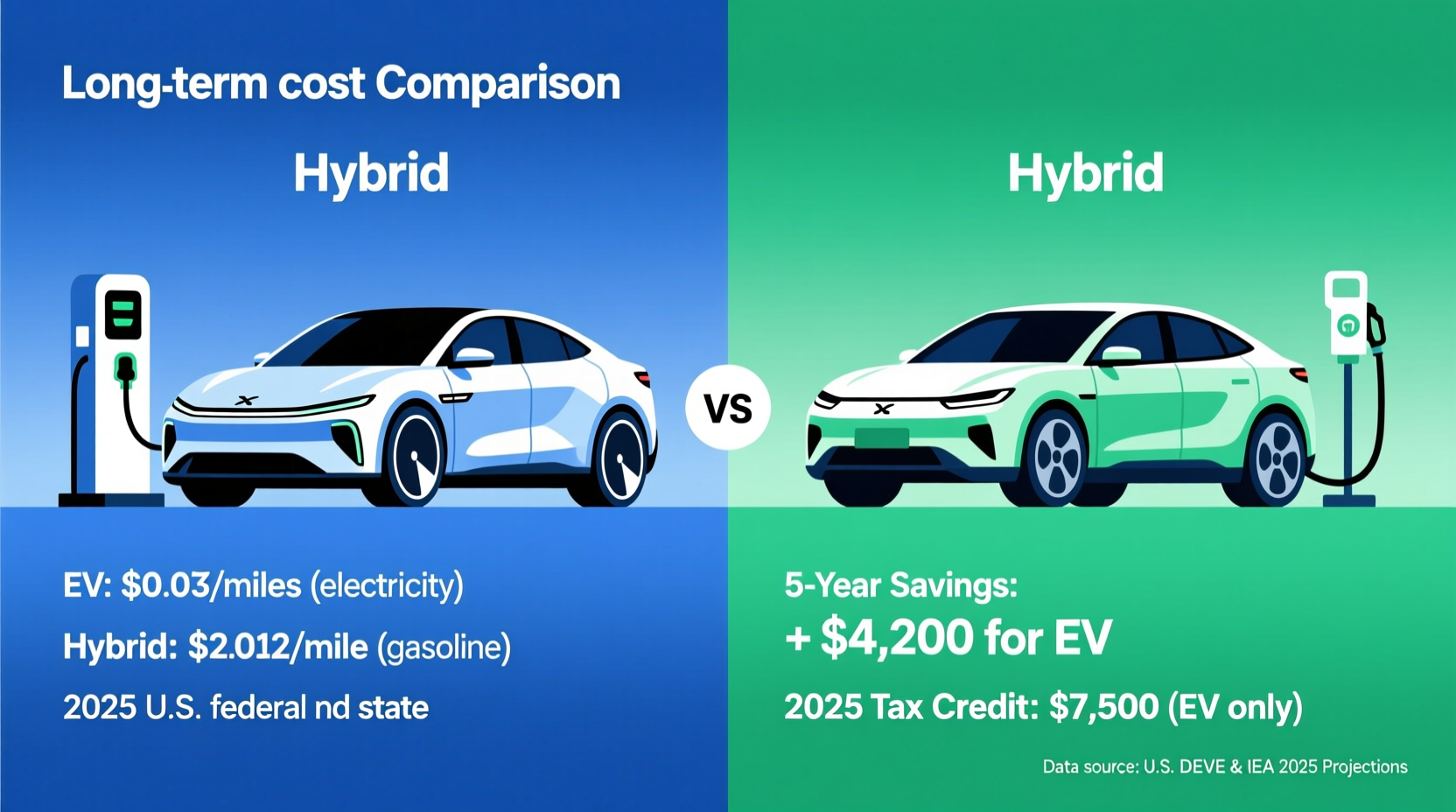
One of the most immediate factors in the EV vs hybrid debate is sticker price. In 2025, many all-electric models still carry a premium compared to their hybrid counterparts. For example, a base model Toyota Prius Hybrid starts around $28,000, while a comparably equipped Chevrolet Bolt EV begins at approximately $26,500 after federal incentives. However, higher-end EVs like the Tesla Model 3 or Hyundai Ioniq 5 can exceed $40,000 before incentives.
Hybrids generally have a smaller price gap with conventional gasoline vehicles, making them accessible to a broader market. Plug-in hybrids (PHEVs), such as the Toyota RAV4 Prime or Ford Escape PHEV, sit between standard hybrids and full EVs in pricing—often starting in the mid-$30,000 range but eligible for up to $7,500 in federal tax credits.
Tip: Always check eligibility for federal and state incentives before purchasing—an EV or PHEV that seems expensive upfront may qualify for thousands in rebates.Despite higher initial costs, EVs are closing the gap. Battery prices have dropped nearly 90% since 2010, according to BloombergNEF, and automakers are scaling production to reduce consumer prices. By 2025, industry analysts expect several mass-market EVs to reach price parity with internal combustion engine vehicles.
Total Cost of Ownership: Fuel, Electricity, and Long-Term Savings
The true value of EVs and hybrids reveals itself over time through operating costs. The largest difference lies in fuel versus electricity expenses.
Assuming an average annual driving distance of 12,000 miles:
- Gasoline cost (hybrid): A hybrid averaging 50 MPG at $3.50 per gallon spends about $840 per year.
- Electricity cost (EV): An EV using 30 kWh/100 miles at $0.15/kWh spends roughly $540 annually.
- Plug-in hybrid (mixed mode): If driven primarily on electric (say, 40 miles/day), a PHEV might use minimal gas, reducing fuel costs to $300–$500/year.
Over a decade, that’s a potential saving of $3,000–$5,000 for EV owners compared to hybrids—and even more if electricity rates remain stable while gas prices rise.
“By 2025, EV drivers who charge at home during off-peak hours could see energy costs less than half of what hybrid owners pay in fuel.” — Dr. Linda Chen, Energy Economist at the Institute for Sustainable Transport
Maintenance is another major factor. EVs have fewer moving parts—no oil changes, spark plugs, exhaust systems, or transmission fluids. A study by Consumer Reports found that EV owners spend about 50% less on maintenance and repairs over the vehicle’s lifetime compared to gasoline-powered cars.
Detailed Comparison Table: EV vs Hybrid (2025 Models)
| Category | Electric Vehicle (e.g., Nissan Leaf) | Hybrid (e.g., Toyota Camry Hybrid) | Plug-in Hybrid (e.g., RAV4 Prime) |
|---|---|---|---|
| Average MSRP (before incentives) | $32,000 | $31,000 | $44,000 |
| Federal Tax Credit | Up to $7,500 | $0 | Up to $7,500 |
| Annual Fuel/Electricity Cost | $540 | $840 | $400 (with daily charging) |
| Maintenance (10-year estimate) | $3,800 | $7,200 | $5,500 |
| Depreciation (5 years, avg.) | ~45% | ~38% | ~42% |
| Break-Even Point (vs. gas car) | ~4 years | ~6 years | ~5 years |
Note: Depreciation varies widely by brand and model. EVs historically depreciated faster, but newer models like the Tesla Model Y and Hyundai Kona Electric now hold value better due to strong demand and proven reliability.
Real-World Example: Sarah’s Commute Decision
Sarah lives in Denver and commutes 35 miles round-trip to work. In early 2024, she faced a choice: buy a used Honda Accord Hybrid for $24,000 or a new Nissan Leaf SV Plus for $31,000 with a $7,500 federal credit—effectively $23,500 out-of-pocket.
She drives 12,000 miles per year. Her home has a Level 2 charger installed using a $500 rebate from her utility company. Charging overnight at $0.12/kWh, her monthly electricity cost is about $45. The hybrid would cost her $70/month in gas.
After five years, Sarah’s total costs break down as follows:
- Nissan Leaf: $23,500 (net purchase) + $2,700 (electricity) + $1,800 (maintenance) = $28,000
- Honda Hybrid: $24,000 + $4,200 (fuel) + $3,600 (maintenance) = $31,800
Even with insurance slightly higher on the EV ($150 more per year), Sarah saves nearly $4,000 over five years—and enjoys quieter rides and instant torque. She also qualifies for a Colorado state incentive of $2,000 for EV buyers, further improving her savings.
This case illustrates how favorable conditions—access to home charging, federal/state incentives, and consistent daily driving—can tilt the balance decisively toward EVs.
Step-by-Step Guide: How to Determine Which Option Saves You More
Follow this timeline to make a personalized, data-driven decision by 2025:
- Step 1: Calculate Your Annual Mileage
Track your current driving or estimate based on commute and lifestyle. Most Americans drive 12,000–15,000 miles per year. - Step 2: Research Local Energy and Fuel Prices
Check your utility’s residential kWh rate and nearby gas prices. Use the U.S. DOE’s eGallon tool to compare fuel costs across technologies. - Step 3: List Available Models and Incentives
Identify three EVs and hybrids within your budget. Visit fueleconomy.gov and afdc.energy.gov to verify tax credits and state rebates. - Step 4: Estimate Charging Behavior
If considering an EV, determine whether you can charge at home nightly. Public charging adds cost and complexity. - Step 5: Project 5- to 10-Year Ownership Costs
Include purchase price (after rebates), estimated maintenance (use Consumer Reports data), insurance (get quotes), depreciation (check Kelley Blue Book), and energy/fuel. - Step 6: Factor in Lifestyle Needs
Do you take frequent long trips? Hybrids offer quicker refueling and no range anxiety. Do you live in a cold climate? EV range drops in winter, affecting efficiency. - Step 7: Reassess Annually
Tax policies, electricity rates, and used EV prices change. Re-run your calculations each year to stay informed.
Common Misconceptions About EV and Hybrid Economics
Several myths persist that can distort financial expectations:
- Myth: EV batteries are too expensive to replace.
Reality: Most EV batteries are warrantied for 8 years/100,000 miles. Replacement costs have fallen to $5,000–$8,000 (down from $12,000+ in 2016), and many last beyond 150,000 miles. - Myth: Hybrids save as much on fuel as EVs.
Reality: Even the most efficient hybrids still burn gas. In high-mileage scenarios, EVs consistently deliver lower per-mile costs. - Myth: Insurance is the same for all vehicles.
Reality: EVs often have higher premiums due to costly repairs and specialized parts. Shop around and ask about green vehicle discounts.
FAQ: Electric Vehicle vs Hybrid Money Questions
Is it cheaper to charge an EV than to fill a hybrid’s tank?
Yes, in nearly all cases. Charging an EV at home costs the equivalent of $1–$2 per gallon of gasoline in terms of energy efficiency. Even with rising electricity rates, EVs typically cost half as much per mile to operate compared to hybrids.
Will my EV save money if I don’t drive much?
Possibly not immediately. Low-mileage drivers may not recoup the higher purchase price through fuel savings alone. However, if you qualify for incentives and enjoy lower maintenance, an EV can still be economical—especially if you plan to keep it for 8+ years.
Are hybrids going away?
No, but their role is shifting. Automakers like Toyota continue investing in hybrids as a bridge technology. However, by 2030, many brands plan to phase out hybrids in favor of full electrification. This could affect resale value and service availability down the line.
Final Verdict: Which Saves More by 2025?
In most scenarios, **electric vehicles offer greater long-term savings than hybrids by 2025**, provided you can charge at home and drive at least 10,000 miles per year. The combination of lower energy costs, reduced maintenance, and robust incentives makes EVs financially competitive—even when they carry a higher initial price tag.
However, hybrids remain a smart choice for drivers without reliable charging access, those who frequently travel in rural areas with limited EV infrastructure, or buyers seeking a lower-risk entry into fuel-efficient driving. Plug-in hybrids strike a strong middle ground, offering electric-only range for daily commutes and gas backup for longer trips.
The key is personalization. Run your own numbers. Consider your driving pattern, local costs, and future plans. As battery prices fall and charging networks expand, the economic advantage of EVs will only grow stronger in the coming years.
“The tipping point for EV affordability isn’t just about sticker price—it’s about total ownership experience. By 2025, millions of drivers will find that going fully electric pays for itself.” — Michael Tang, Senior Analyst at CleanTech Insights
Take Action Today
Your next vehicle doesn’t have to be a compromise between practicality and savings. Whether you lean toward an EV or a hybrid, start by gathering real data: get insurance quotes, calculate your current fuel spending, and explore local incentives. Test drive both types to understand how they fit your life. The most cost-effective choice is the one that aligns with your routine, budget, and long-term goals.
💬 Ready to make the switch? Share your EV or hybrid experience below—help others discover the true cost of clean driving in 2025.








