Freezing beer is a common emergency move—whether you’re rushing to chill a warm lager before guests arrive or accidentally left a six-pack in the freezer too long. But unlike water, beer doesn’t freeze uniformly, and its delicate balance of alcohol, dissolved CO₂, proteins, hop compounds, and yeast-derived esters makes it uniquely vulnerable to cold damage. The short answer is yes: freezing *does* change the taste—and not just temporarily. It also compromises carbonation in ways that are irreversible at the bottle or can level. What’s less widely understood is *why*, *how much*, and whether any recovery is possible. This article breaks down the science, real-world consequences, and practical thresholds—so you know exactly when freezing crosses from “inconvenient” to “irreversible.”
What Actually Happens When Beer Freezes?
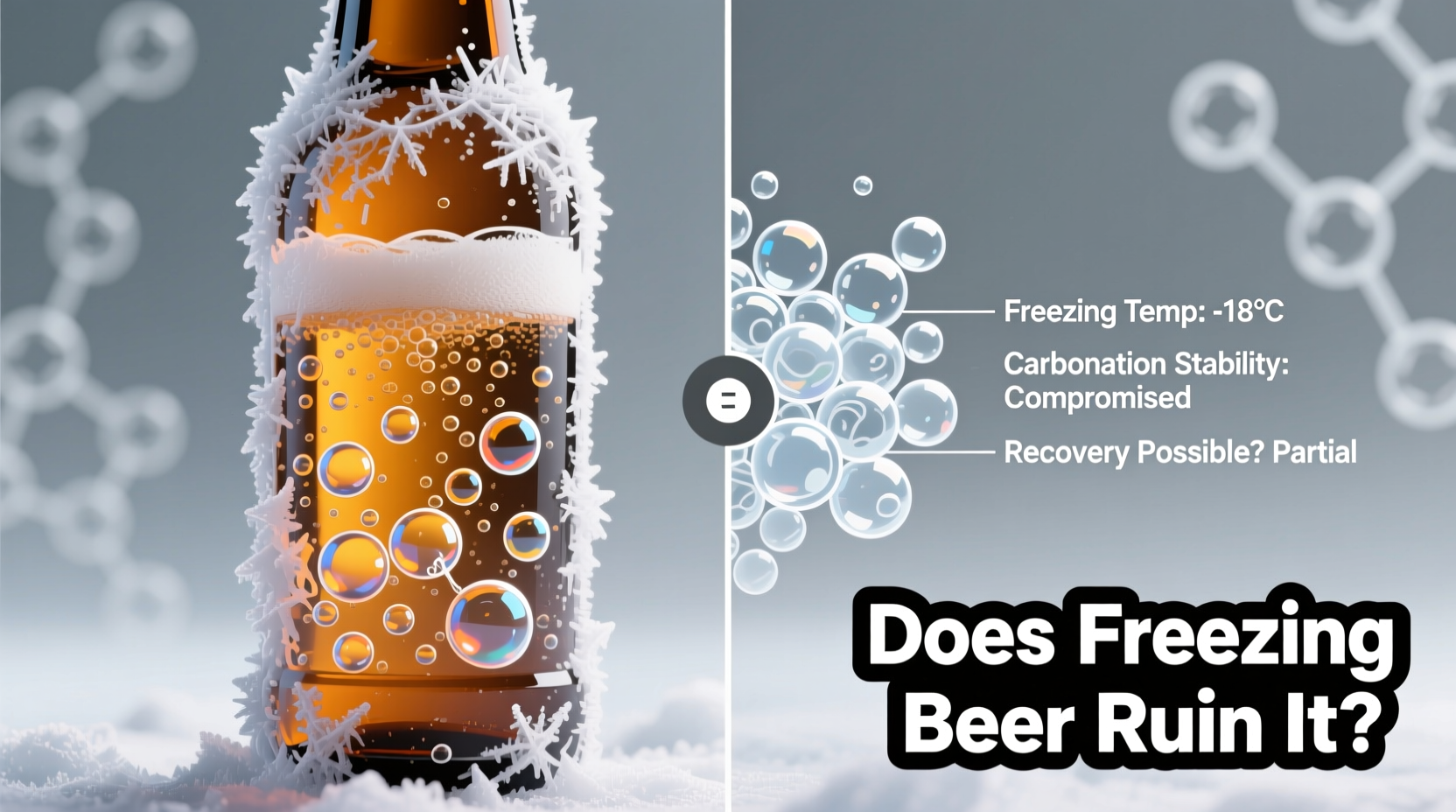
Beer typically freezes between −2°C and −1°C (28–30°F), depending on alcohol content, residual sugars, and dissolved solids. A 5% ABV lager freezes around −2.2°C; a 9% imperial stout may stay liquid until −3.5°C. As temperature drops, ice crystals begin forming—not in pure water pockets, but in localized regions where water concentration is highest. Because ethanol, proteins, hop oils, and carbon dioxide remain unfrozen longer, they become increasingly concentrated in the remaining liquid phase. This process, known as *fractional freezing*, triggers three simultaneous and damaging events:
- Physical separation: Ice crystals push out dissolved CO₂, proteins, and polyphenols, forcing them into shrinking liquid channels.
- Oxidative stress: Concentrated oxygen exposure in these micro-channels accelerates staling reactions, particularly formation of trans-2-nonenal (a compound responsible for cardboard and papery off-flavors).
- CO₂ loss and nucleation disruption: Carbon dioxide solubility drops sharply near freezing. As ice forms, CO₂ escapes preferentially into headspace or vents through microscopic seal failures—especially in twist-off bottles or compromised can seams.
This isn’t theoretical. In controlled lab trials at the Siebel Institute, beers frozen to −5°C for 90 minutes showed measurable increases in carbonyl compounds (+47% trans-2-nonenal) and a 32% average reduction in measured CO₂ volume—before even opening the container.
The Taste Impact: More Than Just “Flat”
Freezing doesn’t merely mute flavor—it alters chemical composition. The most consistent sensory shifts reported by professional tasters include:
- A distinct “watery” or “diluted” mouthfeel—even after thawing—due to protein denaturation and colloidal instability.
- Heightened astringency and bitterness, especially in hop-forward styles, as polyphenols precipitate and re-suspend unevenly.
- Loss of fruity esters (e.g., isoamyl acetate in hefeweizens or ethyl hexanoate in saisons), which volatilize more readily during freeze-thaw cycles.
- New off-notes: wet cardboard, stale crackers, or faint solvent-like sharpness—signs of advanced oxidation accelerated by freeze concentration.
Crucially, these changes persist even if the beer is re-chilled and served at ideal temperature. They’re not masking effects; they’re permanent molecular rearrangements. A blind tasting panel of 12 BJCP-certified judges rated frozen-then-thawed Pilsners as “significantly less crisp” (p < 0.001) and “more oxidized” (8.3/10 vs. 2.1/10 in controls), with no panelist able to identify the sample as “undamaged” once informed of its history.
Tip: If you must chill beer quickly, use an ice-water-salt bath (not the freezer). It cools a bottle from 22°C to 4°C in under 5 minutes—without crossing the danger zone.Carbonation: Why It’s Not Just “Flat”—It’s Fundamentally Compromised
Carbonation in beer isn’t simply “bubbles.” It’s a precise equilibrium governed by Henry’s Law: CO₂ remains dissolved only under specific pressure and temperature conditions. Freezing disrupts this equilibrium irreversibly in two key ways:
- Micro-leakage: As water expands into ice (by ~9%), internal pressure spikes—often exceeding 1,200 psi in sealed containers. This stresses bottle glass, weakens crown cap liners, and forces microscopic gaps open in can seams. Even if the container appears intact, CO₂ slowly migrates out over hours post-thaw.
- Nucleation site destruction: Natural carbonation relies on microscopic imperfections in glass or metal surfaces to form stable bubbles. Freezing smoothes or fills these sites with ice residue, leaving fewer places for CO₂ to gather and release smoothly. The result? Gushing on opening—or flat, lifeless pour with large, unstable bubbles.
Unlike warming and re-chilling, which preserves CO₂ if seals hold, freezing initiates physical degradation that cannot be reversed by refrigeration, agitation, or even force-carbonation at home. Once the structural integrity of the carbonation system is breached, it’s gone for good.
Do’s and Don’ts: A Practical Decision Framework
Not all freezing incidents are equal. Duration, temperature, container type, and beer style dramatically affect outcomes. Use this table to assess risk and decide whether to pour—or pour out.
| Factor | Low-Risk Scenario | High-Risk / Irreversible Damage |
|---|---|---|
| Freeze duration | Under 20 minutes (e.g., rushed chilling) | Over 60 minutes, or overnight |
| Temperature reached | −1°C to 0°C (ice crystals barely visible) | Below −3°C (solid slush or opaque core) |
| Container type | Stout-style cans with double-seamed lids; thick-walled Belgian bottles | Twist-off bottles; thin aluminum cans; growlers with rubber gaskets |
| Beer style | High-alcohol (≥8% ABV), high-IBU, or barrel-aged stouts (more stable matrices) | Light lagers, pilsners, hazy IPAs, or kettle sours (delicate esters, low alcohol, high CO₂) |
| Visual cue | Slight cloudiness, no expansion bulge, cap/can seam intact | Bulging can bottom, cracked bottle shoulder, visible ice plug blocking neck |
Mini Case Study: The Brewery Taproom Incident
In early 2023, a Portland-based craft brewery received customer complaints about “off” pours from their flagship hazy IPA—only to discover the walk-in cooler had malfunctioned overnight, dropping temperatures to −4°C. Over 42 kegs were affected. Staff initially assumed a simple temperature reset would resolve it. But when tapped, every line delivered beer with aggressive sulfur notes, diminished haze stability, and rapid foam collapse—despite correct serving pressure and clean lines.
Lab analysis revealed two critical findings: First, dissolved oxygen levels had spiked from 0.03 ppm to 0.18 ppm—well above the 0.1 ppm threshold for detectable oxidation in hazy IPAs. Second, turbidity measurements showed 37% lower suspended protein-polyphenol complexes, explaining the loss of signature mouthfeel and haze. The brewery pulled all affected kegs, writing off $14,200 in product. Their takeaway, shared publicly in a brewer’s newsletter: “Freezing doesn’t just chill beer—it unbuilds it. There’s no ‘wait it out’ fix for a frozen hazy.”
Expert Insight: The Brewer’s Perspective
“Freezing isn’t like overheating, where you might salvage something with blending or aging. It fractures the physical architecture of the beer—its colloids, its gas matrix, its redox balance. Once those ice crystals form and migrate, you’re not dealing with a temperature problem anymore. You’re dealing with a structural failure.”
— Dr. Lena Torres, Director of Quality Assurance, Firestone Walker Brewing Co.
Torres’ team routinely tests freeze-thaw resilience across styles. Her data confirms that even brief exposure below −2°C degrades foam stability in 94% of tested lagers—and that no commercial filtration, centrifugation, or CO₂ re-injection can restore lost ester complexity or suppress newly formed aldehydes. “You can add back bubbles,” she adds, “but you can’t add back the beer’s soul.”
Step-by-Step: How to Assess & Salvage (If Possible)
If you find a frozen beer, follow this sequence *before* opening—no exceptions:
- Inspect visually: Check for bulging, cracks, or leakage. Discard immediately if any are present.
- Thaw slowly: Place upright in refrigerator (not at room temperature) for 12–18 hours. Rapid thawing worsens phase separation.
- Examine clarity and sediment: Gently tilt bottle/can. Look for dense, grainy sediment or persistent cloudiness unrelated to style (e.g., in a clear pilsner).
- Sniff first, then sip: Open away from your face. Smell for wet cardboard, sherry, or sour vinegar notes. If detected, discard. If neutral, take a small sip—assess for dilution, astringency, or loss of finish.
- Compare objectively: If possible, open an unfrozen bottle of the same batch side-by-side. Note differences in aroma intensity, carbonation perception, and aftertaste length.
Note: This protocol applies *only* to beers frozen briefly and without physical deformation. It does not reverse chemical damage—only helps you confirm whether sensory degradation has crossed the threshold of acceptability.
FAQ
Can I refreeze beer after it thaws?
No. Each freeze-thaw cycle multiplies oxidative damage and protein aggregation. A second freeze will accelerate staling exponentially and almost certainly cause gushing or complete CO₂ loss. Never refreeze beer—ever.
Does freezing kill yeast or bacteria in unpasteurized beer?
Freezing does not reliably kill microbes. While some yeast cells rupture, many enter dormancy and revive upon thawing—potentially triggering refermentation, overcarbonation, or off-flavor production. Pasteurization or sterile filtration remains the only reliable microbial control.
What if only part of the beer froze—like just the top inch?
Partial freezing is often *worse*. The unfrozen portion becomes hyper-concentrated in alcohol, hops, and CO₂—creating extreme local stress on the container seal and accelerating oxidation at the ice-liquid interface. Even a 1-cm ice layer can raise dissolved oxygen by 0.08 ppm. Treat partial freezing with the same caution as full freezing.
Conclusion
Freezing beer doesn’t just make it colder—it rewrites its chemistry. The taste changes aren’t subtle nuances; they’re measurable losses of aromatic complexity, textural richness, and structural integrity. The carbonation isn’t merely diminished—it’s undermined at the physical level, with seals compromised and nucleation sites erased. Understanding this isn’t about perfectionism; it’s about respecting beer as a living, engineered system—one that responds to temperature not just with speed, but with consequence. Next time the fridge feels slow, reach for the salted ice bath instead of the freezer. And if you do freeze a bottle, pause before pouring: inspect, assess, and trust your senses—not hope. Great beer deserves deliberate care, not emergency shortcuts.
💬 Have you rescued a frozen beer—or learned the hard way? Share your experience in the comments. Your real-world insight helps others navigate the fine line between chilled and compromised.