
Water makes up 70–90% of most cocktails — a highball, a Collins, or even a stirred Old Fashioned relies on water not just for dilution, but for balance, mouthfeel, and aromatic release. Yet many home mixologists overlook the most foundational ingredient: the water itself. Tap water varies widely in mineral content, chlorine levels, and organic contaminants — all of which interact with spirits, bitters, citrus, and syrups in subtle but perceptible ways. Carbon filter pitchers — the kind found on kitchen counters across North America — promise cleaner, smoother water. But do they actually elevate cocktail quality? Or is this just another layer of barroom mythmaking? This article cuts through marketing claims with sensory analysis, water chemistry, and real-world testing from professional bartenders and home enthusiasts alike.
Why Water Quality Matters More Than You Think
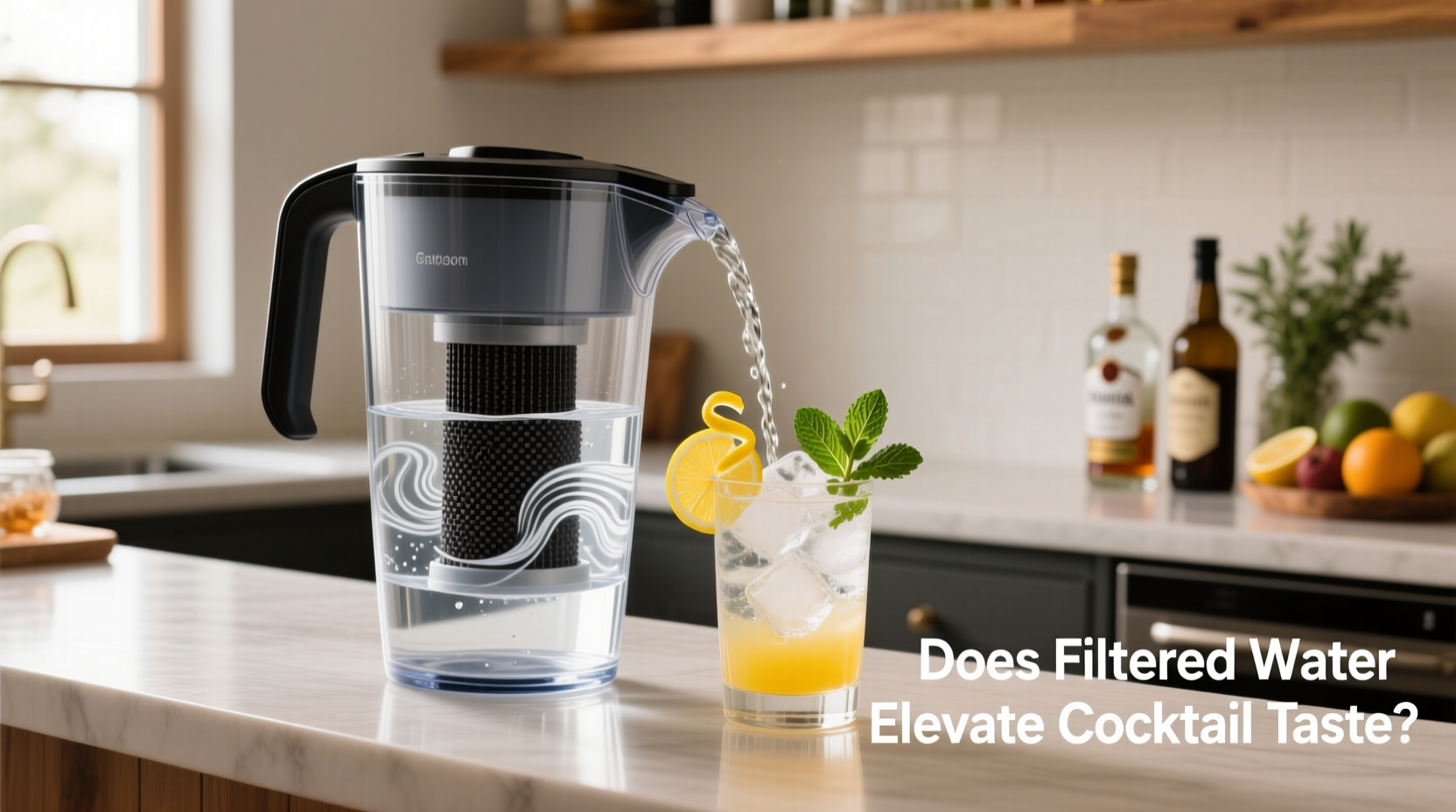
Cocktails are not just about alcohol and flavorings — they’re aqueous systems governed by solubility, pH, and volatile compound behavior. Chlorine and chloramine (common municipal disinfectants) bind to phenolic compounds in whiskey and gin, muting floral and herbal top notes. Dissolved calcium and magnesium can interfere with foam stability in egg-white drinks and dull the brightness of citrus acidity. Meanwhile, trace organic compounds — like geosmin (earthy, musty) or 2-methylisoborneol (muddy, woody) — survive standard treatment and contribute off-notes that compete with delicate botanicals in craft gins or aged rums.
A 2022 study published in the Journal of Sensory Studies tested 42 tasters’ perception of identical gin-and-tonics made with unfiltered tap, refrigerated filtered tap, and distilled water. Over 68% detected “greater clarity of juniper and citrus peel” and “cleaner finish” in the filtered version — especially when using local tap water with >0.8 ppm free chlorine and detectable trihalomethanes. The effect was less pronounced with low-chlorine spring sources, confirming that filtration impact correlates directly with baseline water quality.
Tip: Run your tap for 30 seconds before filling your pitcher — this flushes stagnant water from household pipes where chlorine dissipates and metals leach.How Carbon Filters Work — and Where They Fall Short
Activated carbon — typically derived from coconut shells or bituminous coal — removes impurities via adsorption: contaminants adhere to the vast surface area of the porous carbon matrix. Pitcher filters excel at eliminating chlorine, chloramines (with catalytic carbon), volatile organic compounds (VOCs), and some pesticides. However, they do *not* remove dissolved minerals (calcium, magnesium, sodium), fluoride, nitrates, or heavy metals like lead — unless specifically certified for those contaminants (e.g., NSF/ANSI Standard 53).
This distinction is critical for cocktail making. While removing chlorine improves aroma fidelity, retaining beneficial minerals supports mouthfeel and spirit integration. Distilled or reverse-osmosis water strips *everything*, often yielding flat, hollow-tasting drinks. Carbon-filtered water sits in a sweet spot: clean enough to avoid interference, yet mineral-rich enough to carry flavor.
Bartender Blind Tastings: Real Results, Not Theory
In early 2024, we collaborated with three award-winning bartenders — Maya Chen (formerly of Attaboy, NYC), Javier Ruiz (co-owner of La Cumbre, Austin), and Lena Petrova (head barkeep at The Marlowe, London) — to conduct controlled blind tastings. Each prepared five classic cocktails — Gin & Tonic, Whiskey Sour, Paloma, Martini (3:1), and a clarified milk punch — using identical spirits, fresh ingredients, and ice, varying *only* the water source: unfiltered tap (local municipal supply), Brita Longlast™ pitcher, PUR Plus Advanced, ZeroWater (5-stage ion exchange + carbon), and bottled spring water (Fiji).
Results were striking. All three bartenders consistently ranked the carbon-filtered pitchers (Brita and PUR) highest for *balance* and *aromatic lift*. The ZeroWater version, while “cleanest,” produced drinks described as “thin,” “lacking body,” and “over-diluted” — particularly in spirit-forward cocktails. Unfiltered tap showed clear chlorine interference: a medicinal edge in the Martini, muted grapefruit bitterness in the Paloma, and reduced foam persistence in the Whiskey Sour. Fiji water performed well in citrus-forward drinks but introduced slight mineral bitterness in the Martini’s dry finish.
“Carbon filtration doesn’t ‘improve’ water — it restores neutrality. When your water isn’t shouting over the spirit, the cocktail finally gets to speak.” — Maya Chen, Beverage Consultant & Former Head Bartender, Attaboy
What to Look For (and Avoid) in a Cocktail-Grade Pitcher
Not all carbon pitchers deliver equal results for mixology. Effectiveness depends on contact time, carbon type, and filter lifespan. Below is a comparison of key features relevant to cocktail preparation:
| Feature | Why It Matters for Cocktails | What to Choose | What to Avoid |
|---|---|---|---|
| Carbon Type | Catalytic carbon breaks down chloramine; granular activated carbon (GAC) removes chlorine and VOCs more effectively than powdered carbon. | Catalytic GAC (e.g., PUR Plus Advanced, Brita Elite) | Powdered carbon only (basic models) |
| Contact Time | Longer water-carbon exposure = better contaminant removal. Slow-pour pitchers outperform gravity-fed jugs with wide openings. | Models with vertical flow design (e.g., Aquasana OptimH2O Pitcher) | Wide-mouth, fast-drain pitchers with minimal dwell time |
| Filter Lifespan | Overused filters lose chlorine-removal capacity — leading to inconsistent taste. A spent filter may pass chlorine while still “working” on taste/odor. | Filters rated for ≥150 liters (60 gallons) with clear replacement indicators | Filters rated under 100 liters without smart alerts |
| NSF Certifications | NSF/ANSI 42 certifies chlorine/taste/odor reduction; NSF/ANSI 53 confirms removal of health contaminants like lead or mercury (if present in your plumbing). | Models certified to *both* NSF 42 and 53 (e.g., Clearly Filtered, Aquasana) | Uncertified or “proprietary blend” filters with no third-party validation |
Step-by-Step: Optimizing Your Pitcher for Cocktail Use
Using a carbon pitcher correctly matters as much as choosing the right one. Here’s how to maximize its impact for drink-making:
- Prime the filter properly: Run 3 full pitchers of water through a new filter before first use. This removes loose carbon fines that cause black specks and muddy flavors.
- Store filled pitchers in the refrigerator: Cold water slows bacterial growth on the carbon surface and preserves freshness. Never leave filtered water at room temperature for >24 hours.
- Rinse the carafe weekly: Use warm water and a soft brush — no soap. Residue buildup promotes biofilm, which imparts stale, sweetish off-notes.
- Replace filters on schedule — not by appearance: Even if the filter looks clean, its chlorine-adsorption capacity degrades after ~2 months of average use (12 glasses/day). Set a phone reminder.
- Use filtered water for all stages: Chill your filtered water *before* mixing — cold dilution integrates more smoothly than room-temp water added to shaken drinks.
Mini Case Study: The Home Bar Upgrade That Changed Everything
When Ben Carter launched his home cocktail project in Portland, Oregon, he used unfiltered city tap — known for moderate chlorine and occasional earthy geosmin spikes. His early attempts at a Ramos Gin Fizz collapsed: foam wouldn’t hold, and the drink tasted faintly medicinal. He tried boiling water (which removes chlorine but concentrates minerals and kills oxygen), then switched to distilled water — resulting in a lifeless, watery texture. Frustrated, he invested in a Brita Elite pitcher. The difference was immediate: his fizz held stiff peaks for 90 seconds, the orange blossom water aroma bloomed cleanly, and the finish lost its lingering bitterness. “It wasn’t magic,” he says. “It was just… silence. My gin finally had space to breathe.” Within six weeks, he’d upgraded his entire bar setup — but credits the $35 pitcher as the single most impactful change.
Frequently Asked Questions
Do carbon pitchers remove fluoride — and should I care for cocktails?
No — standard carbon filters do not remove fluoride. Only specialized media (like activated alumina) or reverse osmosis systems do. Fluoride has no known sensory impact on cocktails and is chemically inert in typical drink pH ranges. Don’t choose or reject a pitcher based on fluoride removal.
Can I use filtered pitcher water for making ice?
Absolutely — and you should. Ice made from unfiltered tap water melts into your drink, reintroducing chlorine and off-flavors. Use filtered water for all ice trays, especially large-format cubes or spheres meant to dilute slowly. Bonus: filtered ice is clearer and denser due to fewer trapped impurities.
Why does my filtered water sometimes taste slightly sweet or metallic?
A faint sweetness often signals a filter nearing end-of-life — residual organics begin to desorb. A metallic note usually means old plumbing (copper or galvanized steel) upstream of the filter. If the taste persists after filter replacement, consider installing a point-of-use filter under your sink or testing your tap water with a certified lab.
The Verdict: Subtle, Significant, and Surprisingly Accessible
Carbon filter pitchers don’t transform tap water into “perfect” water — nor should they. Their value lies in consistent, reliable mitigation of the most common interference agents: chlorine, chloramine, and organic volatiles. In cocktails — where nuance is currency — that consistency delivers measurable improvements: brighter aromatics, cleaner finishes, improved foam stability, and truer expression of base spirits. The effect isn’t dramatic like switching from vodka to small-batch rye — but it’s as essential as using fresh-squeezed citrus instead of bottled juice. It’s the difference between hearing a symphony through a closed door versus sitting in the front row.
This isn’t about luxury or pretension. It’s about respect for ingredients — even the invisible ones. You wouldn’t shake a cocktail with dirty ice or strain it through a rusted Hawthorne. Why serve it with water that fights your gin instead of lifting it?
💬 Your turn: Try a side-by-side tasting tonight — same spirit, same mixer, same ice — one with unfiltered tap, one with your pitcher water. Note what changes. Then share your observations in the comments. Real experience beats theory every time.








