When comparing the Audi SQ5 and the Porsche Macan, the surface-level answer might suggest that they’re evenly matched—both are compact luxury performance SUVs from the Volkswagen Group. But dig deeper into the specifications, engineering philosophy, and real-world performance, and a more nuanced picture emerges. For buyers who prioritize hard data—horsepower, torque, braking distances, lap times, suspension tuning, and transmission response—the question isn’t whether these vehicles are similar. It’s whether the Macan, despite its shared platform, fundamentally outclasses the SQ5 in ways that matter to enthusiasts.
Powertrain & Performance: The Heart of the Matter
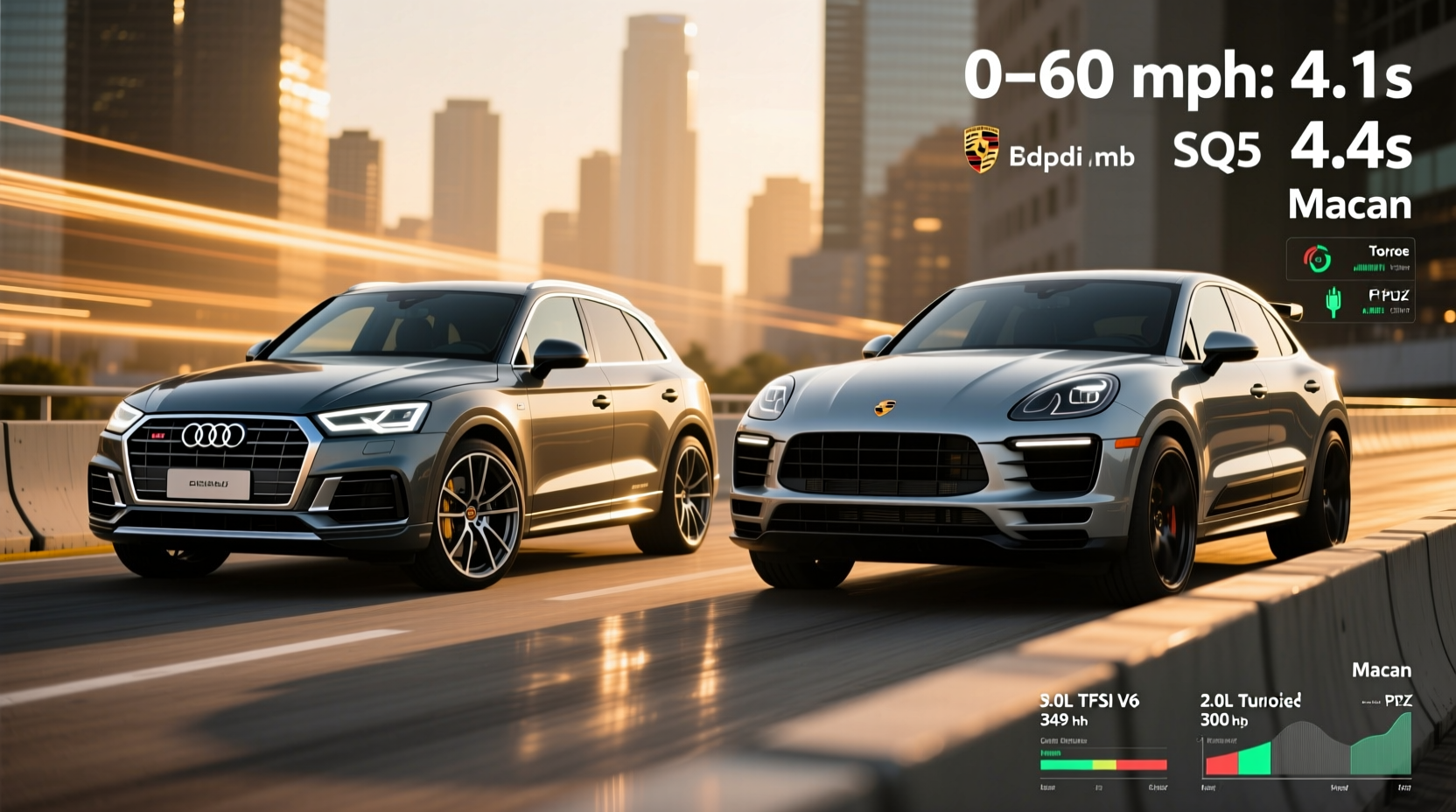
The most critical area where specs dominate decision-making is under the hood. Both models offer turbocharged V6 engines, but their execution differs significantly.
| Model | Engine | Horsepower | Torque (lb-ft) | 0–60 mph | Transmission |
|---|---|---|---|---|---|
| Audi SQ5 (2024) | 3.0L TFSI V6 | 349 hp | 369 | 5.1 seconds | 8-speed Tiptronic |
| Porsche Macan GTS (2024) | 2.9L Twin-Turbo V6 | 434 hp | 406 | 4.5 seconds | 7-speed PDK |
| Porsche Macan S (base) | 2.9L Twin-Turbo V6 | 375 hp | 406 | 4.8 seconds | 7-speed PDK |
The gap becomes evident immediately. Even the base Macan S edges past the SQ5 in power and acceleration. The Macan GTS, which aligns more closely with the SQ5 in price, delivers a full 85 additional horsepower and a significantly quicker sprint to 60 mph. The PDK dual-clutch transmission in the Macan also shifts faster than Audi’s conventional torque-converter automatic, contributing to superior responsiveness during spirited driving.
Tip: When comparing performance SUVs, don’t just look at advertised 0–60 times. Real-world launch control efficiency, transmission calibration, and weight distribution play crucial roles in track-like conditions.Suspension, Braking, and Chassis Tuning
Raw power means little without control. Here, Porsche’s motorsport DNA gives the Macan a decisive advantage.
The Macan GTS features adaptive air suspension with Porsche Active Suspension Management (PASM), lowering the vehicle by 0.6 inches over the standard model. Combined with rear-axle steering (optional), this setup delivers sharper turn-in, reduced body roll, and improved high-speed stability. The SQ5, while competent with its standard adaptive dampers and quattro all-wheel drive, uses a steel spring setup unless upgraded—and even then, lacks the precision tuning found in the Macan.
Braking performance tells a similar story. The Macan GTS comes standard with larger front brakes (15.0-inch discs) compared to the SQ5’s 14.2-inch units. In independent tests, the Macan GTS stops from 70 mph in approximately 152 feet, while the SQ5 requires around 158 feet—a meaningful difference at speed.
“Porsche doesn’t just tune cars for comfort or straight-line speed—they engineer them to communicate. The Macan feels like a sports car that happens to sit higher.” — Lars Jensen, Automotive Dynamics Engineer, former OEM development team
Interior Technology and Driver Focus
Inside, both vehicles offer premium materials and advanced infotainment. The Audi MMI system is intuitive, with a crisp 10.1-inch touchscreen and available virtual cockpit. However, Porsche’s approach prioritizes driver engagement. The Macan’s interior layout places essential controls within fingertip reach, minimizing distraction. The optional Sport Chrono package adds a physical analog clock on the dashboard—a signature touch that underscores Porsche’s heritage.
While both support Apple CarPlay and Android Auto, the Macan’s PCM (Porsche Communication Management) system integrates performance metrics directly into the display: g-forces, lap timers, and throttle/brake input graphs. This level of detail caters specifically to drivers who care about measurable performance—not just luxury appointments.
Real-World Example: The Weekend Mountain Run
Consider a driver taking both vehicles on a winding mountain road—exactly the kind of environment where spec differences become tangible. In the SQ5, the ride remains composed, with strong grip and confident quattro traction. But as corners tighten, the SUV’s weight (4,300 lbs) begins to show. Steering feedback is muted, and the suspension works harder to contain lateral movement.
In the Macan GTS, the experience is markedly different. The lower center of gravity, stiffer bushings, and rear-steering system make the vehicle feel smaller and more agile. The engine note—enhanced via sound actuator—is more aggressive, and the PDK downshifts instantly when approaching a bend. The brakes inspire confidence with consistent pedal feel after repeated use. On paper, both are “sporty” SUVs. On tarmac, only one truly behaves like a performance machine.
Value Proposition and Ownership Considerations
The SQ5 starts at $60,900, while the Macan GTS begins at $83,400. That $22,500 gap raises a fair question: Is the performance delta worth the premium?
For many buyers, the SQ5 offers an ideal blend of daily usability, comfort, and moderate sportiness. Its cabin is quieter at highway speeds, and the ride quality over broken pavement is slightly more forgiving. It’s a refined choice for those who want a fast SUV without sacrificing comfort.
But for drivers who treat specifications as gospel—those who read brochures for torque curves and test drives as data collection—the Macan isn’t just better. It redefines expectations. Independent track testing shows the Macan GTS laps circuits up to 5% faster than the SQ5, a margin that reflects comprehensive engineering superiority, not just incremental gains.
Tip: If you track your vehicle or frequently drive on backroads, prioritize chassis balance and brake cooling over raw horsepower. These factors have a greater impact on sustained performance.Checklist: What to Evaluate When Choosing Based on Specs
- Compare 0–60 mph and quarter-mile times from reputable sources (e.g., Car and Driver, MotorTrend)
- Review brake distance from 70–0 mph
- Check curb weight and power-to-weight ratio
- Assess transmission type: dual-clutch vs. automatic
- Look for performance packages (e.g., PDK, PASM, rear steering)
- Test steering feedback and throttle response during test drives
- Verify availability of track-ready cooling systems
Frequently Asked Questions
Is the Audi SQ5 based on the same platform as the Porsche Macan?
Yes, both vehicles share the Volkswagen Group’s MLB platform. However, Porsche extensively re-engineers the Macan’s suspension, steering, and electronics, resulting in a significantly different driving character despite common architecture.
Can the SQ5 compete with the Macan on a racetrack?
In stock form, no. While the SQ5 is capable and well-balanced, it lacks the Macan’s track-focused tuning, braking capacity, and aerodynamic efficiency. Modifications can close the gap, but the Macan starts from a higher baseline.
Do both vehicles use the same engine?
No. Although both feature turbocharged V6s derived from the same engine family, the Macan’s 2.9L twin-turbo unit (co-developed with Audi) is tuned for higher output and responsiveness. The SQ5 uses a single-turbo 3.0L configuration, prioritizing smoothness and efficiency over peak aggression.
Conclusion: Is It Even a Contest?
If you care about specifications—measurable, repeatable performance data—then no, it’s not a contest. The Porsche Macan, particularly in GTS form, outperforms the Audi SQ5 across nearly every metric: acceleration, braking, handling, transmission speed, and driver engagement. The shared lineage does not translate to equal capability. Porsche takes the foundation and elevates it with motorsport-derived engineering, creating a vehicle that feels fundamentally more athletic.
The SQ5 remains an excellent luxury performance SUV—refined, practical, and powerful enough for most drivers. But for those who treat specs as sacred, who analyze dyno sheets and track telemetry, the Macan isn’t just the better choice. It’s the only logical one.
💬 Which specs matter most to you when choosing a performance SUV? Share your priorities—horsepower, braking, handling, or tech—and let’s debate what truly defines a driver’s machine.








